Most South Asian countries, particularly Bangladesh, India and Pakistan, are already burdened with smokeless tobacco related diseases. Alongside some other South Asian countries, the prevalence of current smokeless tobacco use is more than half of all tobacco use in Bangladesh.
Researchers and experts on public health and tobacco control said these at a workshop held in Dhaka on Monday.
Presenting the keynote paper at this event, Prof Kamran Siddiqi of Global Public Health at the Department of Health Sciences of the University of York in the UK stated that like other countries in the world, the prevalence of smokeless tobacco use in Bangladesh, India, and Pakistan is significantly higher.

“Although the number of cigarette and bidi users has decreased slightly in Bangladesh in the last few years, the rate of smokeless tobacco users has remained almost unchanged. Against this backdrop, it is high time to give special focus on this sector in order to control the smokeless tobacco in the country,” he said.
Speakers at the workshop said that standard packaging is essential to control the smokeless tobacco products in Bangladesh. They called for bringing the smokeless tobacco products under legal framework.
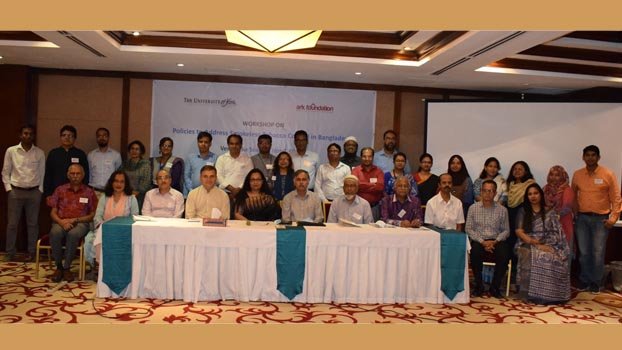
The ARK Foundation, the University of York, and the Health Economics Research Network (HERN) jointly arranged the workshop titled ‘Policies to Address Smokeless Tobacco Control in Bangladesh’ at Six Seasons Hotel in the capital.
Prof AHM Enayet Hossain, former director general of the Directorate General of Medical Education (DGME) presided over the event, while Dr Shakil Ahmed, director at the National TB Control Programme, spoke on the occasion as the chief guest.
Dr Rumana Huque, professor at Department of Economics of the University of Dhaka and executive director of ARK Foundation moderated the workshop, while Dr Syed Mahfuzul Huq, national professional officer at the World Health Organization (WHO), Dr Khaleda Islam, former director at Primary Health Care of Directorate General of Health Services (DGHS), Dr Nasir Uddin Ahmed, former chairman of the National Board of Revenue (NBR), and Advocate Syed Mahbubul Alam Tahin, technical adviser at The Union, took part in the panel discussion session of the workshop.
Prof Dr Golam Mohiuddin Faruque, project director at Bangladesh Cancer Society delivered the address of welcome, while Bazlur Rahman, an associate professor of Dhaka International University (DIU), Fahmida Islam, STOP Bangladesh Focal Point, Abu Naser Anik of AID Foundation; and Mukhlesur Rahman of Dhaka took part in the open discussion, among others.
Officials of various non-governmental organizations, development workers and journalists were also present at the workshop.

The speakers said that about 22 million people in Bangladesh currently use smokeless tobacco which is about 58% of total tobacco users in the country. However, the matter of controlling the use of smokeless tobacco is not being given as much importance as are given in controlling the use of cigarette and bidi.
In his keynote presentation, Prof Kamran Siddiqi placed several recommendations to control the use of smokeless tobacco products. These include-- removing flavours, restricting TSNAs, setting standards and monitoring their contents; introducing licensing for retail sales and viable alternatives, enforcing a strict ban on online/social media advertising, and empowering communities to enforce bans on the sale to anyone under the legal age, and tax increasing frequently and greater than cigarettes with a minimum floor price that equals to a 20-stick cigarette pack.
Panel discussants of the workshop said that 84 per cent of the packets of smokeless tobacco products in Bangladesh don’t have proper graphic health warnings. Even if they contain graphic health warnings, they are not compliant with the law and regulations. However, 30 per cent of packets don’t have any health warnings. The rate in neighbouring India is only 7 per cent.
They also said that 16 per cent of TB patients in Bangladesh use tobacco products. Against this backdrop, if tobacco consumption is controlled, it will play a vital role in controlling tuberculosis.