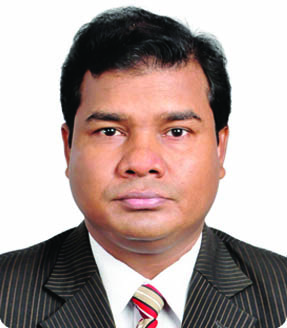
Ahammad Parvej Khan
Public-Private Partnership (PPP) is one of the most powerful mechanisms for building a globally competitive tourism & hospitality industry, said Karthi VK, General Manager of Crowne Plaza Dhaka Gulshan, in an exclusive interview with Bangladesh Post.
Mr Karthi opined that the government's role is to create an enabling environment through policy stability, infrastructure development, improved connectivity and destination planning.
Karthi VK , a hospitality leader with nearly two decades of international experience across India, Nepal and Bangladesh, mentioned that Bangladesh is set to become one of South Asia's most attractive hospitality investment markets in the next 5 years.
Having led award-winning hotel openings, business transformations and luxury operations with IHG Hotels & Resorts, The Oberoi Group and Trident Hotels, he is recognised for building high-performing teams, driving commercial excellence and delivering guest-centric innovation.
Replying to set of queries made by Bangladesh Post, he described almost all the prospects, problems and future of the hospitality industry of the sub-continent.
The excerpts of his interview is as bellows:
Bangladesh Post: How do you see the growth of the hotel business in Bangladesh in the last 30 years?
Karthi VK: Thirty years ago, Bangladesh's hospitality industry was largely transactional. Today, it is becoming experiential. International brands have not only raised service standards but also transformed governance, sustainability, talent development and guest expectations. The industry has evolved from providing accommodation to creating destinations, experiences and communities. That evolution is far more significant than simply adding more hotel rooms.
Looking ahead, I believe the industry's next phase of growth will be driven by the government's continued investment in infrastructure, including the Third Terminal of Hazrat Shahjalal International Airport, improved national connectivity, and increased private-sector investment in tourism. At the same time, there is tremendous potential to expand International and domestic MICE travel.
Bangladesh Post: The present government has planned to develop the hospitality sector. Do you think
Karthi VK: Bangladesh can become a tourism hub in South Asia? What suggestions would you give to improve the tourism sector?
Bangladesh has never had a tourism asset problem; it has a tourism positioning problem. We possess one of the world's longest natural sea beaches, the largest mangrove forest, rich heritage and an incredibly warm culture. Yet globally, Bangladesh is still perceived primarily as a business destination rather than a leisure destination.
The next phase of growth should focus on destination branding, seamless connectivity, simplified visas and public-private collaboration. Tourism today is an export industry without shipping products overseas. Every international visitor brings foreign exchange, creates employment and supports thousands of SMEs. If we position Bangladesh correctly, tourism can become one of the country's strongest economic engines
Bangladesh Post: The Middle East situation has affected petroleum prices and created uncertainty. How is this creating a knock-on effect on the hotel business?
Karthi VK: Hospitality is highly sensitive to global events because it is fundamentally driven by travelers’ confidence. Geopolitical uncertainty doesn't just influence fuel prices, it affects airline capacity, corporate travel decisions and overall business sentiment.
For a market like Dhaka, where international business travel is a key demand driver, prolonged uncertainty can lead to more cautious travel planning, shorter booking windows and softer demand from certain international markets. This naturally makes forecasting more challenging and requires hotels to remain agile in their commercial strategies.
Higher fuel costs also place pressure on airlines, travel budgets and supply chains, increasing operating costs across the hospitality ecosystem.
Bangladesh Post: The hospitality sector needs skilled and experienced manpower. How can Bangladesh groom skilled talent?
Karthi VK: People are the greatest asset in hotels! I believe Bangladesh's hotels don’t have a talent shortage - it has an exposure shortage. Young professionals need greater access to structured internships, global standards, mentoring and international career pathways. Hotels, educational institutions and international hotel brands must work together to build a talent pipeline where graduates are operationally ready from day one.
Investing in people delivers the highest long-term return in hospitality. The future of our industry will not be defined by the hotels we build, but by the people who bring those hotels to life.
Bangladesh Post: Hotel rents are high in Bangladesh compared to countries like Kathmandu, Bangkok, Kuala Lumpur, Kolkata, Bangalore, and Chennai. Why?
Karthi VK: Guests compare room rates; investors compare market fundamentals. Hotel pricing is ultimately driven by demand, operating economics and market dynamics rather than geography alone.
Cities such as Bengaluru, Chennai and Kuala Lumpur often command premium room rates because they benefit from strong domestic demand, diversified business sectors, mature MICE markets and consistent year-round travel. Their occupancy levels provide greater pricing stability.
Dhaka, on the other hand, remains predominantly an international corporate market. Pricing is influenced by business travel demand, market supply, operating costs and the investment required to maintain international brand standards. As Bangladesh's tourism ecosystem matures and domestic and leisure travel continue to grow, the market will become even more competitive and resilient.
The objective should never be to have the highest room rates; it should be to create sustainable value for guests while delivering healthy returns for investors. A stronger tourism ecosystem and continued investment will naturally support long-term pricing power.
Bangladesh Post: What policy support can the government provide to boost the hospitality sector?
Karthi VK: If I could recommend three policy priorities, they would be:
First, make Bangladesh easier to visit through faster visa processing and stronger air connectivity.
Second, make investment easier by rationalizing duties on hospitality infrastructure and offering long-term policy certainty.
Third, market Bangladesh globally with the same ambition that we invest domestically. Great destinations are not discovered, they are promoted consistently.
Bangladesh Post: Bangladesh has witnessed many five-star hotels in the last 20 years. Will more five-star hotels create healthy competition?
Karthi VK: I have always believed that "more is merrier." The entry of more international hotels will raise service standards, attract global talent and further strengthen Bangladesh's reputation as a credible business and hospitality destination. The objective should never be to simply divide existing demand, it should be to expand the market, create new demand and elevate the destination
Of course, greater competition also means greater responsibility for General Managers like me. It challenges us to think differently, innovate continuously and avoid complacency. We have to create new experiences, unlock new revenue streams, strengthen commercial partnerships and constantly evolve our business strategy to stay ahead.
Bangladesh Post: How can public-private sectors work together to boost hospitality?
Karthi VK: Public-Private Partnership (PPP) is one of the most powerful mechanisms for building a globally competitive tourism & hospitality industry. The government's role is to create an enabling environment through policy stability, infrastructure development, improved connectivity and destination planning. The private sector, in turn, brings investment, innovation, international expertise and world-class operational standards.
Together, they can accelerate the development of tourism destinations, convention centres, heritage sites, eco-tourism projects and hospitality infrastructure while strengthening destination marketing and hospitality education.
Bangladesh Post: How can Bangladesh share success stories from neighbouring countries like India, Maldives, Nepal, Bhutan, Malaysia, Indonesia, and Singapore?
Karthi VK: Bangladesh should take inspiration from successful tourism destinations without trying to imitate them. The Maldives is known for exclusivity, Nepal sells adventure, Singapore for efficiency and India for its diversity. Bangladesh must define its own unique story, one built around its authentic culture, majestic rivers, rich heritage, natural beauty, vibrant cuisine and genuine hospitality
The most successful tourism destinations don't imitate others; they tell their own story exceptionally well. Bangladesh has an authentic story to tell, and with the right positioning, it can establish itself as a distinctive destination.