Air pollution, noise pollution, waterlogging, safe water crisis and traffic jams joint together have turned the capital city of Dhaka a almost a dead megacity.
River pollution and encroachment, unplanned urbanization and poor civic services are making life increasingly difficult for city dwellers. In this circumstance, it is impossible to save Dhaka only through infrastructure development, it requires political decision through capable leadership, accountability and information-based decisions.
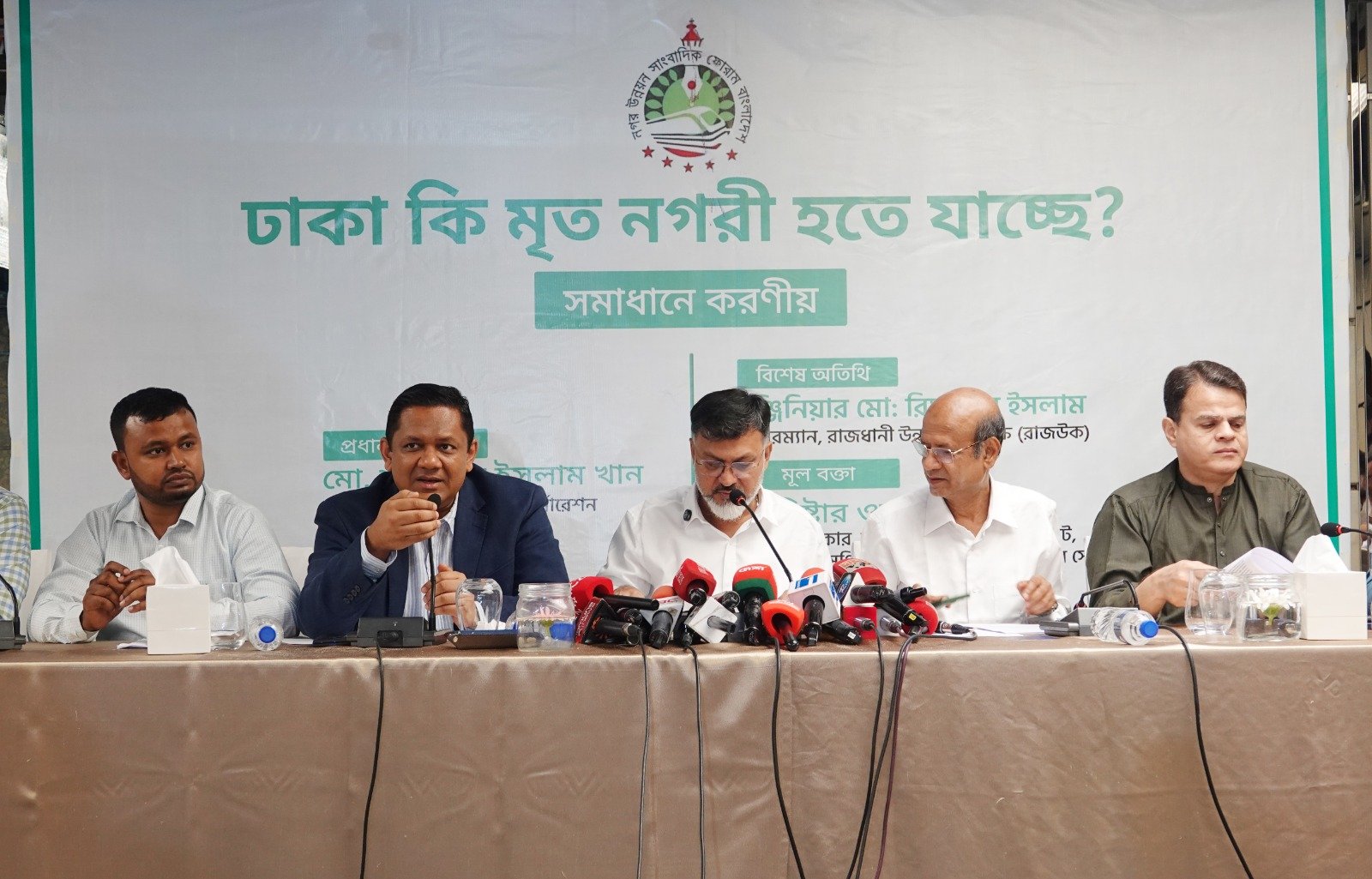
These issues were highlighted in the key-note speech at a city dialogue titled 'Is Dhaka going to become a dead city? What needs to be done to solve it'. Barrister Omar Sadat, president of Gulshan Society and also an urban rights activist, presented the key-note speech at the dialogue held at a hotel in Gulshan of the the capital city of Dhaka on Saturday.

Barrister Omar Sadat in his key-note speech mentioned that if Dhaka is to be revived, effective steps must be taken now, combining political will and professionalism. Otherwise, this megacity will become completely dead in the near future.
The article states that Dhaka is facing a terrible crisis and that the surrounding rivers, including the Buriganga, are practically dead due to encroachment and pollution. Therefore, the city dwellers have to rely on the distant Meghna River to meet their water needs, which is very risky in the long term. In addition, air pollution is 10 to 15 times higher than the tolerable level.
Stating that the time to overcome the problem is not over yet, he said that strict law enforcement, building an integrated urban governance system, restoring the environment, introducing a modern public transport system and ensuring citizen participation - if these steps are implemented quickly, the situation can change. Initiatives such as planned greening, modern waste management and freeing the sidewalks from encroachment are also essential.
Speaking as the chief guest at the dialogue, Dhaka North City Administrator Shafiqul Islam Khan said that the Paris Canal in Mirpur has been cleaned seven times in the last two months. Even after that, the canal has become dirty again. Discussions are underway to bring those who throw waste on the canal banks under the ambit of fines.

The administrator said that where there were once 200 hawkers on the sidewalks, now there have been 2,000. The suffering of 98 percent of the people has reached its peak because of 2 percent of the people. The suffering of the entire Dhaka population is not desirable for a few hawkers.
Stating that arrangements are being made for hawkers to sit temporarily and mobilely in specific places, the administrator said that for the rehabilitation of hawkers, a plan has been taken to initially set up temporary markets in six open places of the two city corporations of Dhaka. They will be given the opportunity to do business there through registration. The place will be maintained by collecting a certain amount of fee. The shops will be mobile like trolleys, so that they can be removed after a specific time.
Speaking as a special guest, Rajdhani Unnayan Kartik (RAJUK) Chairman Riazul Islam said that if urban services are brought under one umbrella, the lack of coordination will reduce and the quality of services will increase. Due to lack of information, the implementation of proper plans is being hampered in many cases. Work is underway to rescue parking spaces to resolve traffic congestion and those who have built designated parking spaces are being punished, he added.

Dhaka WASA Additional Chief Engineer Alamgir Hasin Ahmed said that although water treatment plants are under construction in various places in the city, the work is being hampered due to administrative complications. Although a project is supposed to be completed in 5 years, it is taking 12 years. No work is being done on time.
Dhaka Transport Coordination Authority Deputy Transport Planner Dhrub Alam said that a 20-year plan is being worked on for Dhaka's public transport. Efforts are being made to reduce the number of routes in Dhaka from 42 to 32 in coordination with various bus associations. Only one company's buses will run on one route. If buses operate in this way, discipline will be brought to Dhaka's public transport. Buses will be put on the routes according to this plan within this year.
The city dialogue was presided over by the organization's president Matin Abdullah. General Secretary Hasan Emon moderated. Present were urban planner Adil Muhammad Khan, executive director of the Institute of Planning and Development (IPD), assistant professor of architecture at North South University, Sujaul Islam Khan, entomologist Indrani Dhar, and environmental lawyer Syed Mahbubul Alam.