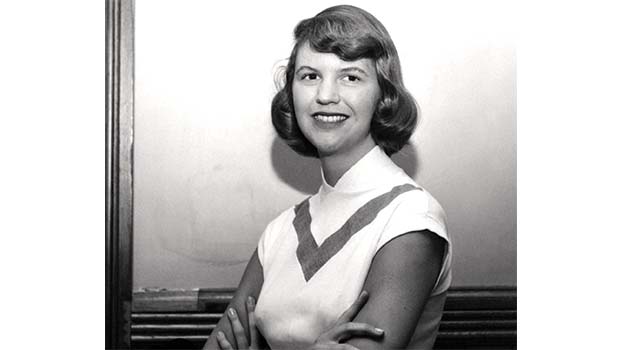
On October 27, 1932, poet Sylvia Plath is born in Boston. Her father, a German immigrant, was a professor of biology and a leading expert on bumblebees.
Plath was an outstanding student. She won a scholarship to Smith, published her first short story, “Sunday at the Mintons,” in Mademoiselle while she was still in college, and won a summer job as “guest managing editor” at the magazine. After the job ended, she suffered a nervous breakdown, tried to commit suicide, and was hospitalized. She returned to school to finish her senior year, won a Fulbright to England, and went to Cambridge after graduation, where she met poet Ted Hughes in February 1956. They married four months later.
Plath took a job teaching at Smith, which she kept for a year before quitting to write full time. She and Hughes lived in Boston, and she attended poetry workshops with Robert Lowell, whose confessional approach to poetry deeply influenced her. Hughes won a Guggenheim fellowship in 1959 and the couple returned to England, where Plath had her first child.
Her first poetry collection, Colossus, was published in 1960 to favorable reviews. The couple bought a house in Devon and had a second child in 1962, the same year that Plath discovered her husband was having an affair. He left the family to move in with his lover, and Plath desperately struggled against her own emotional turmoil and depression. She moved to London and wrote dozens of her best poems in the winter of 1962. Her only novel, The Bell Jar, a semi-autobiographical account of a college girl who works at a magazine in New York and suffers a breakdown, was published in early 1963 but received mediocre reviews.
With sick children, frozen pipes, and a severe case of depression, Plath took her own life in February 1963 at age 30. Hughes edited several volumes of her poetry, which appeared after her death, including Ariel (1965), Crossing the Water (1971), and Collected Poems (1981), which won the Pulitzer Prize in 1982. —History