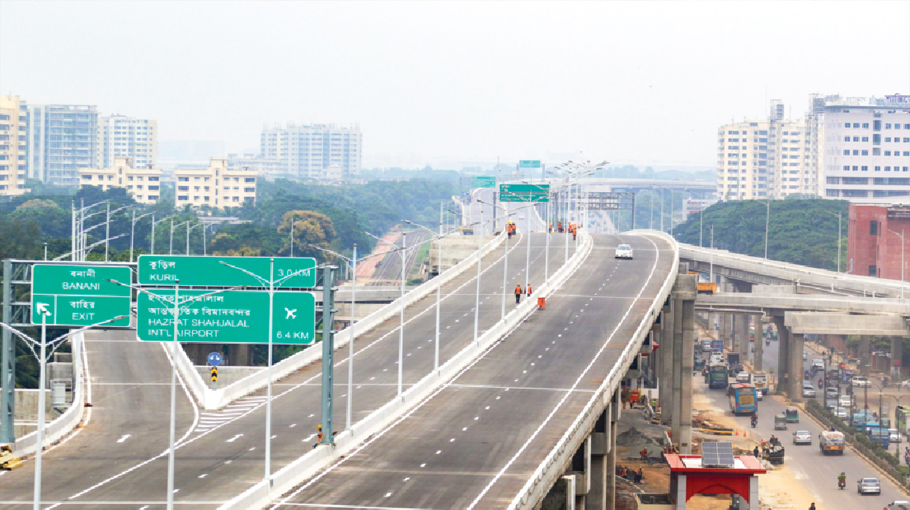
Prime Minister Sheikh Hasina is set to inaugurate a significant infrastructure development in the capital today.
The inauguration ceremony will mark the opening of a 12-kilometer elevated expressway stretching from Kawla, near the airport, to Tejgaon-Farmgate.
Following the inauguration, the expressway will be opened to the public from Sunday early morning.
This expressway promises to be a game-changer for commuters in the capital city, reducing travel time from Kawla to Farmgate-Tejgaon railway station to just 10 to 11 minutes.
The announcement was made by Road Transport and Bridge Minister Obaidul Quader during his visit to the venue of the inaugural stage at the old trade fair grounds in Dhaka on Friday.
The minister said, “The positive impact of this infrastructure project is that it will greatly benefit the residents of Dhaka by easing traffic congestion and making daily travel more efficient.”
He also informed that 65 percent of the work has been completed, with plans to open the entire Dhaka Elevated Expressway, covering Airport to Farmgate, Farmgate to Moghbazar, and Moghbazar to Kutubkhali, by 2024. This expansive project covers a total distance of 46 kilometers, including ramps.
However, as per the directive of the road transport and bridge ministry, both two and three wheelers, pedestrian will not be allowed on the expressway. At the same time, no vehicles will be allowed to stop over the expressway and take photographs. On the other hand, vehicle speed limits will not exceed 60 kilometer (km) on the expressway and 40 km on the ramps.
Vehicles plying on Dhaka Elevated Expressway have to pay a toll. This toll will be collected in four categories.
Private cars, microbuses (less than 16 seats) and mini-trucks (less than 3 tonnes) will pay Tk 80, medium-sized trucks (up to 6 wheels) and larger trucks with more than six wheels Tk 320 and Tk 400 respectively.
Meanwhile, all buses and minibuses with 16 or more seats on Kawla-Farmgate section of Dhaka Elevated Expressway will have to pay Tk 160.
Additionally, the Minister emphasized that the benefits of this expressway will be further amplified once the Metro Rail from Uttara to Agargaon is fully operational, along with the completion of the Motijheel section. The Metro Rail will significantly reduce travel times within Dhaka, offering a more efficient and modern transportation system for the city's residents.
Quader shared ambitious goals for Dhaka's transportation infrastructure, aiming to launch six metro lines by 2030 to address the ongoing challenges of traffic congestion in the city.
The expressway is set to connect the capital city with the Dhaka-Chattogram highway, specifically at Kutubkhali. In the first phase of construction, significant progress has been made with the completion of 1482 piles, 326 pile caps, 325 columns, 325 cross beams, and an impressive 3,048 eye girders.
Additionally, 328 bridges have been successfully built. This phase of the project has reached an impressive 97.28 percent completion rate. Moving on to the second phase, which has achieved a 54.22 percent completion rate, construction work includes 1,633 piles, 335 pile caps, 323 columns, 320 cross beams, and 2,305 eye girders, along with 233 bridges.
The expressway is progressing through three phases with the help of Public-Private Joint Investment (PPP). The first phase covers the area south of Hazrat Shahjalal International Airport, running from Kawla to Banani Railway Station. The second phase extends from Banani railway station to Moghbazar railway crossing.
Finally, the third phase connects Moghbazar rail crossing to Kutubkhali on the Dhaka-Chattogram highway.
Construction on this project commenced on January 19, 2011, and it is finally nearing completion. The estimated construction period spans from July 2011 to June 2024, with an estimated project cost of around Tk 8,940 crores, of which the government of Bangladesh is contributing Tk 2,413 crores.