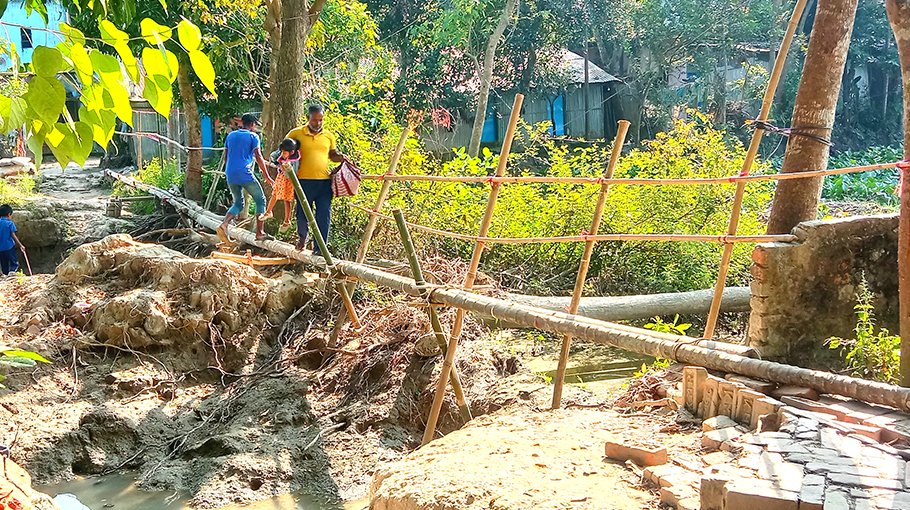
People at Noapara union in Raozan upazila of Chattogram are suffering for a long time now as a they are forced to cross several parts of Sammahaldarpara-Mokamipara-Chhamidar Koang connecting road with risky bamboo poles due to the lack of a paved road there.
There is two bamboo pole on one side of that portion of the road and 10,000 people from seven villages cross that with risk of falling down. They have urged the authorities to fix that portion and build a permanent paved road there.
Locals said that six months ago, approximately 400 meters of a road listed under Local Government Engineering Department (LGED) was washed away due to tidal currents from the Karnaphuli and Halda rivers during heavy rains and merged with nearby land. Another 200 meters of the road also suffered similar damage in several spots. As a result, vehicular movement on the road came to a halt, and even pedestrians faced severe hardships while traveling.
However, this is a common occurrence every year, as this road gets damaged during every rainy reason.
This year, for the last six months, around 10,000 residents from seven villages crossed the area using makeshift bamboo poles and tree trunks, enduring significant difficulties. Despite this, neither LGED nor the local Department of Disaster Management took any steps to repair the road and alleviate their suffering. This forced students, women, and children to use the risky bamboo poles to travel to and from the villages.
In early April, heavy rains and the impact of a cyclone caused multiple sections of the road to collapse under the river’s forceful currents. Later, floods washed away four to five more sections of the road, turning it into a hazardous ditch. Consequently, the villagers built temporary bridges at their own expense, relying on walking for transportation.
When this correspondent visited the site, it was seen that the 400-meter stretch that collapsed was in the Mokamipara area. Additionally, sections of the road in Sammahaldarpara and Samidur Koang had completely merged with nearby farmland, leaving no trace of the original road.
Local resident Shamsur Nahar Begum explained that during every monsoon, the road erodes and merges with the land due to tidal waters from the river. She urged authorities to rebuild the road at a height of 3 to 4 feet with reinforced concrete walls on both sides.
Villagers added that the 2-kilometer road gets damaged five to seven times every rainy season. In response, young volunteers in the area repair the road annually through self-funded efforts. For at least 10 years, this had been the only solution, as no government intervention occurred. Residents further said that during heavy rains, water levels in the Halda River—flowing beside the village—increases by 6 to 8 feet, worsening the road's condition. They emphasized the need to elevate the road by 4 to 5 feet and construct protective walls on both sides.
SM Jahangir Alam, the former president of the Mokamipara Government Primary School management committee, said that approximately 10,000 people from seven villages rely on this road. Despite years of appeals to make the road sustainable, no action was taken, leaving villagers almost isolated for six months of the year due to the damaged road.
SM Kaiser Hamid, a local youth involved in road repair efforts for six years, said that 15 to 20 volunteers collect funds and repeatedly repair the road. However, since the village is located by the river, monsoon waters frequently inundates and damages the road. He added that the problem could have been resolved with a protective embankment along the river.
Abul Kalam, Upazila Engineer of LGED, said, "We inspected the road after the floods. A proposal for RCC paving and protective walls was sent to the LGED headquarters. Once funds were allocated, the work would commence promptly."