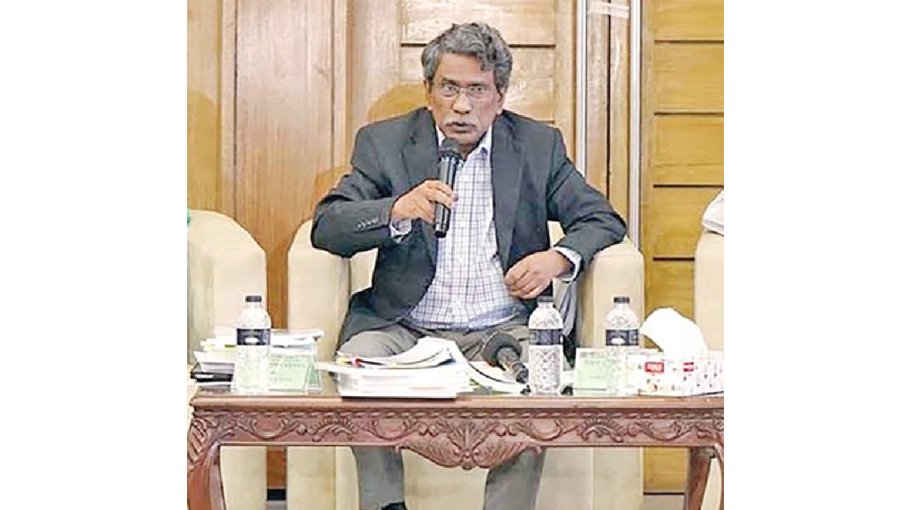
National Consensus Commission Vice-Chairman Professor Ali Riaz on Monday said the political parties agree to ensure that the declaration of a state of emergency should not be used politically under any circumstances.
“Political parties also agree to amend, add, subtract, change and revise all the provisions of Article 141 (a), (b), (c) of the existing constitution,” he told a media briefing after the end of the 10th day of the second phase of the talks of the commission with political parties at Foreign Service Academy in the capital.
Commission members Dr. Iftekharuzzaman, Dr. Badiul Alam Majumder, Safar Raj Hossain, Dr. Md. Ayub Mia and Chief Adviser’s Special Assistant Monir Haidar were present at the time.
Ali Riaz said the declaration of a state of emergency and the expansion of subordinate courts at the upazila level were discussed during the commission’s meeting with the political parties yesterday.
Article 141 of the existing constitution contains the issue of declaring a state of emergency, which did not have much scope for discussion in the past, he said.
“In the context of the previous discussions, a revised proposal has been made by the Consensus Commission on declaring a state of emergency. This proposal needs more discussion in the next meeting. Future discussions will clearly state how much agreement has been reached on this issue,” he said.
He said the political parties and alliances participating in the discussions with the Consensus Commission have agreed on the phased expansion of subordinate courts at the upazila level.
However, the parties and alliances feel that some issues need to be taken into consideration for the expansion of subordinate courts, he said, adding, for example, the courts of the Sadar Upazilas should be attached to the District Judge Court and specified.
Ali Riaz said the existing Chowki Courts, Island Courts and already established courts should be maintained and the necessary infrastructure should be built. There is no need to establish new courts in upazilas near the district headquarters, he said, adding that in this case, the necessary survey is needed.
The remaining upazilas should be established in phases, taking into account the population density, geographical location and characteristics, transportation system, distance, economic status, and number of cases.
Representatives of 30 political parties including Bangladesh Nationalist Party (BNP), Bangladesh Jamaat-e-Islami, Jatiya Nagorik Party (NCP), Gana Odhikar Parishad, Gana Sanghati Andolon, Communist Party of Bangladesh (CPB), Biplobi Workers Party, Amar Bangladesh (AB) Party participated in today's discussion with the National Consensus Commission.
UNB adds: Vice-Chairman of the National Consensus Commission Professor Ali Riaz on Monday said all are unlikely to reach a consensus on every aspect of state reforms and mentioned that the commission is making sincere efforts to avoid any misunderstandings or confusion.
“We are striving to ensure that the proposals align with your (politicians’) views and aspirations,” said Dr Riaz while addressing the second round of discussion on its 10th day between the National Consensus Commission and political parties at the Foreign Service Academy in the capital.
Dr Ali Riaz clarified that the commission’s proposals do not require unanimous agreement. “I have repeatedly said, we will not agree on everything. When engaging separately with parties, I have made this clear from the commission’s side,” he said.
Citing examples, he mentioned that the proposal on forming a National Constitutional Commission (NCC) had faced objections from the majority of parties. In response, a revised proposal—not an entirely new one—was presented. “As everyone is stressing structural reforms, we are aligning with you on those fronts,” he added.
On the matter of core principles, he said, “There was initial objection to the inclusion of pluralism, so it was not included in the second revised version. Similarly, the proposal from the Public Administration Reform Commission to form four provinces did not achieve consensus at this stage, so it was left out of discussion.”
Ali Riaz acknowledged that compromises had to be made. “We are proceeding by leaving out several issues because consensus cannot be reached on all of them. Still, we must focus on areas where agreement is possible,” he said.
He added that progress had been made on some topics, while others remained under discussion or yet to be addressed. “Matters where preliminary consensus has already been reached have not been brought up today. While political positions may differ, there is a collective effort to find common ground. We are focusing on crucial issues and attempting to reach agreement,” he stated.
Highlighting time constraints, Ali Riaz urged political parties to consider the importance of these discussions alongside their organisational commitments. “We had initially thought this would be the last meeting this week, allowing you to attend other engagements or informal consultations. But based on feedback from most parties, we will likely meet again once more this week,” he said.
“Next week marks the death anniversaries of Shaheed Abu Sayed and Mugdha. Despite those programmes, we must find time to continue our discussions,” he added.
Pointing at politicians, Dr Ali Riaz appealed for continued participation. “If you prioritise the commission’s meetings alongside your organisational activities, it will help us move forward.”
He reaffirmed the commission’s commitment, saying, “After our talks with you, the commission will sit to review how to revise proposals in line with your positions. We will keep up this effort wholeheartedly to avoid misunderstandings and ensure the proposals reflect your inputs and expectations.”