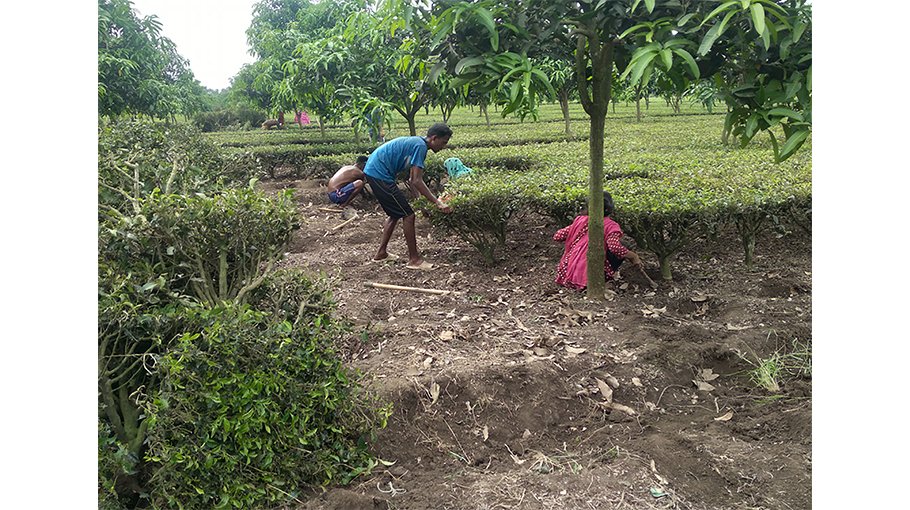
The small time tea farmers, as well as the large tea garden owners in Panchagarh are facing losses due to low price of tea leaves and uprooting the tea plants in their garden.
The tea garden owners said raw tea leaves are harvested and sold in six rounds over twelve months. Generally, after harvesting the raw tea leaves in the first round, the second round is harvested within the next 45 days. This means that farmers collect raw leaves from the gardens six times a year. However, during the sale of these leaves, garden owners often face various difficulties in each round. Sometimes, due to low prices set by factories for raw leaves, as well as the tea leaves that are discarded for lower quality, farmers end up with no money after selling and supplying leaves to the factories. This is especially true during the first and last rounds of the current season, where farmers cannot even cover the costs of maintaining the gardens with the money earned from selling the leaves.
Meanwhile, the small time tea farmers said the tea factories buy raw tea leaves at Tk 10 to Tk 15 per kg. Morever, 40 to 45 percent raw tea leaves that are not dry or of poor quality are discarded. The farmers get paid for the rest of the raw tea leaves. As a result, they are facing severe economic losses. Despite years of protests and movements regarding the pricing of raw tea leaves in Panchagarh, they still don’t get fair price and many small tea farmers are uprooting their gardens due to that. Many garden owners are neglecting the maintenance of their fields, leading to a deteriorating condition in the tea gardens.
A long time tea farmer and owner of large tea garden in Tentulia upazila, as well as former UP chairman of sadar union parishad, Kazi Anisur Rahman said my tea garden covers approximately 60 acres. In 2022, I spent around Tk 23 lakh on garden maintenance, but I only earned Tk 19 lakh from selling the tea leaves. To avoid further losses, I have decided to uproot about 6 acres of the tea garden in 2023. As a shareholder and director of Bismillah Tea Factory, I will also say that I have invested in this factory, but I am unable to sell the tea produced by it in the market. Consequently, the factory is also facing losses. If this situation continues, I might have to call a meeting with other directors to decide on permanently shutting down the factory.
Experts on tea industry said, the amount of tea produced in Panchagarh and the northern plains is outpacing the demand for tea leaves in the market. If the government can export the tea produced in the northern plains to countries such as Pakistan, Afghanistan, Saudi Arabia, and other Middle Eastern nations, it would help protect tea cultivation in Panchagarh. Additionally, if the factory owners can sell the produced tea at good prices, they would be able to purchase tea leaves from farmers at a rate of at least Tk 20 Tk 25 Taka per kg. As a result, farmers would be encouraged to focus on maintaining their gardens rather than uprooting them.
Development Officer of Bangladesh Tea Board Panchagarh office Md Amir Hossain said a third tea auction center has been established in Panchagarh district. However, due to lower market demand compared to the amount of tea produced, the price of tea leaves has decreased. To sustain this promising industry, farmers must produce high-quality leaves (two buds and one leaf) to supply to the factories. By processing the supplied raw tea leaves into high-quality tea, the factories can sell it at higher prices at auctions. Ultimately, both tea farmers and factory owners need to work together collaboratively for the improvement of the tea industry in Panchagarh and to overcome its challenges.