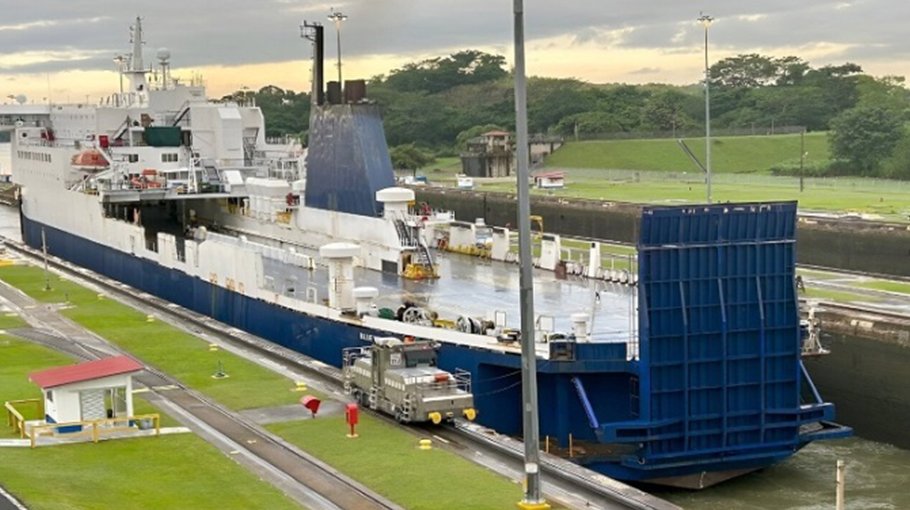
The Panama Canal Authority (ACP) said Wednesday that the famed waterway continues to face a water shortage, despite recent rains alleviating most restrictions imposed following last year's drought.
"The waterway continues to face the impact of a prolonged dry season from this past year that limited the capacity of daily passages through the canal," the ACP said in a statement. "Despite the start of the rainy season, the water problem for Panama and its Canal is not over."
Unlike other waterways such as the Suez Canal, the Panama Canal, which usually handles about six percent of global maritime trade, operates with rainwater from the artificial lakes Gatun and Alajuela.
Due to the meteorological phenomenon known as El Nino this past year, the drought-stricken canal has had to reduce the number of shipping vessels that pass through each day, as well as the size of each ship's draft.
However, the agency said Wednesday it will allow an increase in a vessel's draft to 14.6 meters (48 feet) starting July 11, and a maximum of 35 ships will be allowed to pass through per day beginning August 5.
The ACP, which oversees the canal, also called for alternative water sources to be identified and storage projects developed.
In the 2023 fiscal year, 511 million tons of cargo passed through the Panama Canal, generating $3.34 billion in revenue.
Since June 2023, the Panama Canal Authority has been restricting both the number and size of ships passing through the Panama Canal due to historically low water levels in Lake Gatun, the principal hydrological reserve for the Canal (Figure 1a), causing disruptions to global shipping that are still ongoing.
Rainfall in Panama is known to be strongly influenced by the El Niño Southern Oscillation (ENSO), with large storms and extremely heavy precipitation tending to occur in the negative phase (La Niña years) and the positive phase (El Niño years such as 2023-24) typically associated with late onset and early end of the rainy season, and lower precipitation throughout.
Scientists from Panama, the Netherlands, Sweden, and the United Kingdom collaborated to assess to what extent the 2023-4 El Niño and human-induced climate change altered the likelihood and intensity of the low rainfall during 2023, and also examined whether changes in evapotranspiration may have contributed to the low lake levels.
The study uses peer-reviewed methods to assess changes in May-December rainfall in the area immediately around the catchment of Lake Gatun in central Panama (Figure 1b). Potential evapotranspiration is evaluated over the same region during the dry season (January-April).