Daoud Kuttab
An eerie feeling overcame me this week as I walked through the streets of the Old City of Jerusalem. Shops were open and a scant few locals and even fewer tourists walked by, rarely buying anything. But the body language and the faces were dark, as if most of the merchants were experiencing a strange extraterrestrial problem. The situation in the nearby governorates of Bethlehem and Ramallah was no less reassuring.
The question on everyone’s lips was “when will the US-Israeli war erupt again?” While Palestinians appeared resigned to accept whatever happens, some had taken things a step further and begun hoarding products in fear that there would soon be shortages. In one case, an unused family water well was used to hoard gasoline as soon as the news of this week’s Iranian attacks on the UAE spread.
Palestinians with relatives and friends in the UAE rushed to their phones on Monday and Tuesday, checking on the safety of their relatives as stories of doom and possible Israeli or American use of highly sophisticated, destructive weapons made the rounds. Some even suggested the use of a small nuclear weapon as a means of bringing the Iranians to their feet, similar to what happened when the US used this lethal weapon against the Japanese in 1945, despite the enormous differences between the two cases. Neither the US, Europe nor even Israel have faced anything close to the existential scenarios that people are pitching and repeating ad nauseam.
The Iranian war notwithstanding, Palestinians are still concerned about the marked increase in settler violence in most parts of the West Bank, as well as the Old City of Jerusalem in particular. Fears in Jerusalem were exacerbated by the publication of a picture and later a video of a French nun being cowardly pushed by an extremist Jewish Israeli man, who then started walking away before returning to the felled nun and kicking her.
The combination of unchecked settler violence and anti-Christian attacks have caused many, including a former Israeli senior intelligence officer, to predict that another angry explosion may be in the making. Former Mossad chief Tamir Pardo said he felt “ashamed to be a Jew” after touring Palestinian communities in the West Bank that have come under repeated attack from Israeli settlers, warning that current Israeli policy there is “planting the seeds for the next Oct. 7.” He added: “It will happen in a different way, and it could be much more painful, because the West Bank is more complicated.”
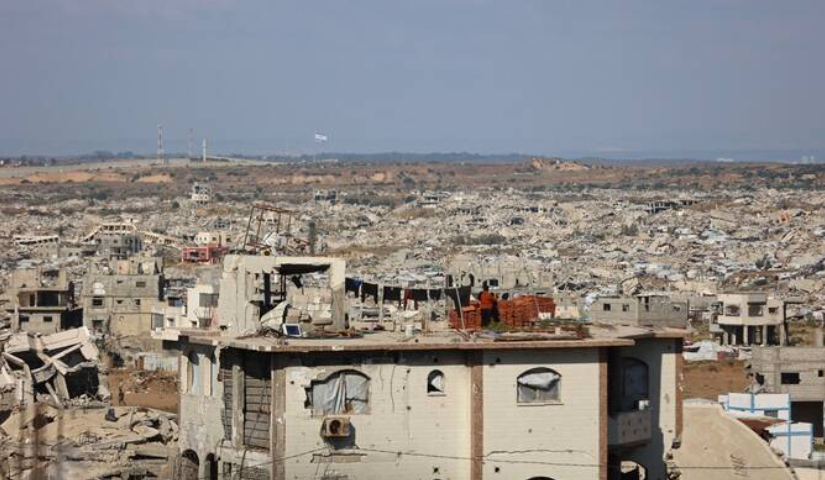
While the daily attacks against Palestinians in the West Bank continue without accountability, the Israeli army has not ended its own expansionism and attacks on Palestinians in Gaza, despite a ceasefire that appears to be only being adhered to by the Palestinian resistance. Israeli troops have killed an average of more than three Palestinians every single day since last October, when the ceasefire came into effect. The 50 percent-plus of the Strip that Israel had cut out from the east of Gaza to create an artificial (and rather ineffective) buffer zone has now been expanded, with homes and buildings under the direct control of Israel’s army being turned into rubble.
Negotiators acting on behalf of the US-led Board of Peace have been trying without success to find a formula amid the exaggerated Israeli demand that Hamas give up all its weapons in return for Israel “considering” withdrawing from some of the land in Gaza. Reports suggest that the talks carried out by the US envoy with Hamas have the latter insisting that it will only discuss a gradual decommissioning when Israel fulfills its obligations under phase one of the peace plan, which have yet to be carried out — most importantly, its withdrawal from the area up to the “yellow line.” Instead, the Israeli army, without any justification, has further expanded into Gaza with a new frontier named the “orange line” that reportedly covers more than 60 percent of the already-crowded Strip.
Overlooked amid all this violence and hopelessness is the Ramallah-based government, which last month completed a rather acceptable round of municipal elections that included the Deir Al-Balah elections in Gaza. Palestinian officials in Ramallah feel upbeat about the trajectory of their reforms, even though no one is paying attention and Israeli-inspired reports in the US State Department appear to be scraping the bottom of the barrel in a bid to find mistakes and holes in the reform effort. Security officials close to President Mahmoud Abbas appear to be engaged in political engineering for both the municipal elections and the Eighth Fatah Congress, scheduled for May 14.
Palestine and the Palestinians are going through an extremely difficult and miserable time. But their quietness should not be mistaken for acquiescence. Despite the depressing picture, there are obvious signs of steadfastness. Activists, civil society and a horde of smart and energetic young people are trying to find their way through this maze. And if no explosion occurs, they might be able to show the world the type of resilience and courage that will restore pride and lift people out of their current desperation.
Daoud Kuttab is an award-winning Palestinian journalist and former Ferris Professor of Journalism at Princeton University. He is the author of “State of Palestine Now: Practical and Logical Arguments for the Best Way to Bring Peace to the Middle East.” X: @daoudkuttab