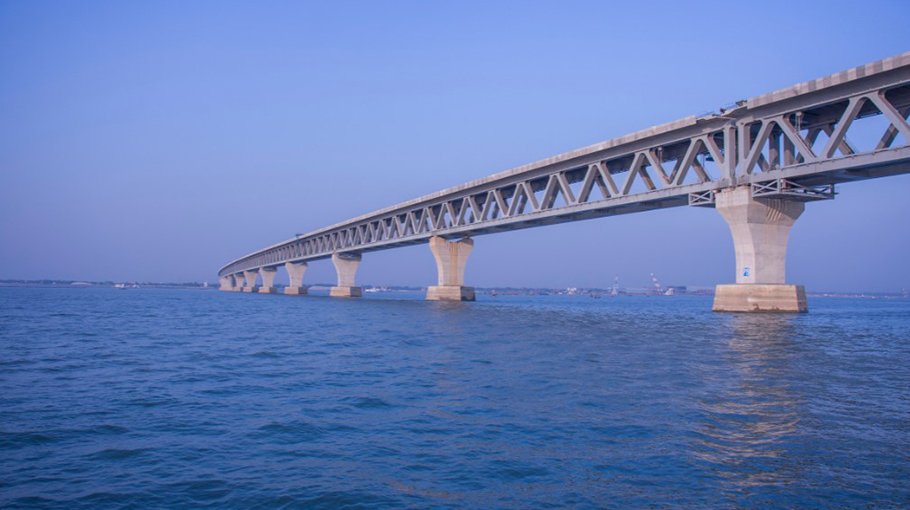
The 6.15 km double-deck rail road Padma Bridge that linked the country's less developed southwestern region to capital Dhaka as well as the eastern region has appeared as a symbol of national pride as it's the first mega project implemented with domestic fund displaying the country's strong economic footing.
According to political analysts and experts, overcoming all odds and challenges including financial, engineering and political, the country got back its dignity with the construction of its longest bridge with its own funds in a brave move after the World Bank (WB) withdrew from the project.
On June 25 in 2022, Prime Minister Sheikh Hasina inaugurated the bridge on one of world's mightiest rivers connecting southwestern Bangladesh with the capital and other parts while both the streams are considered powerful in terms of their length, water discharge and morphological trends.
The event came 25 years after she opened the Bangabandhu Bridge on the Jamuna River, another most powerful stream, linking northwest with Dhaka and other parts of the country in 1998, until when that was Bangladesh's longest multipurpose bridge.
But the Padma Bridge carries extra significance as the structure was built entirely with domestic financing, defying speculations by many financial analysts if Bangladesh could mobilize the fund depending on domestic resources.
The Padma Bridge project witnessed several engineering wonders as well as technological challenges but eventually emerged as a wonder structure for Bangladesh that saw use of state-art machineries and know how.
On political considerations, the project also was faced with multi-pronged obstacles amid subtle campaigns to force the government to virtually abandon the initiative halting overseas funding for its construction.
Several political and diplomatic analysts even some overseas partners had also speculations that the project would eventually be a failure.
But, at last, the mighty Padma River becomes conquered and people living on both the banks are no more helpless as they have now got the connectivity with both sides.
The Padma Bridge connects Louhajang Upazila of Munshiganj and Zazira Upazila of Shariatpur and a small part of Shibchar Upazila of Madaripur.
After the inauguration of the bridge to traffics, the people of southwestern region are driving straight to Dhaka by road, leaving the awful nightmare of ferry ghat, as they can now cross the river in just six minutes over the bridge.
The dream bridge which not only established the long-awaited direct road and rail communications between capital city Dhaka and south-western parts of the country, but also opened up the doors of greater connectivity and trade among the Asian countries.
Besides, the bridge also has significant economic impacts by cutting the travel time as well as other costs to bring prosperity for 21 districts in particular alongside the national in general.
The Padma Bridge became visible with the installation of the first span on 37th and 38th number pillars on September 30, 2017.
Later, all 41 spans were installed on 42 pillars one after another. The entire structure of the multi-purpose 6.15 kilometer Padma Bridge became visible with installation of its last 41st span on December 10, 2020.
The bridge is considered to be the most challenging construction project in the history of Bangladesh, the steel truss bridge carries a four-lane highway on the upper level and a single track railway on the lower level. The self-financed bridge project was implemented at the total cost of Taka around 30,193 crore.
The cost of the main bridge construction is Taka 12,133 crore (including Taka 1,000 crore for 400 KV transmission line tower and gas line) and the cost of river training works (RTW) of 13.8km is Taka 9,400 crore.
The first span of the Padma Bridge was installed at the Jajira point of Shariatpur on October 7, 2017.
The construction works began in December, 2015 as the premier inaugurated the river training work and main construction works of Padma Multipurpose Bridge project at Jajira point in Shariatpur district on December 12 in 2015.
But, the prime minister formally laid the foundation stone of the Padma Bridge at Mawa in Munshiganj on July 4 in 2001.
After the Awami League formed government in 1996, she visited Japan in 1997. She proposed building of bridges over the rivers Padma and Rupsha.
The Japanese government agreed to construct bridges over the two rivers. As river Padma is a mighty one having strong current, Japan began Padma River surveying and they started construction works on river Rupsha at her request.
In 2001, Japan submitted the survey report to Bangladesh on construction of a bridge on river Padma. In the Japanese survey, Mawa point of Munshiganj was selected as the site for Padma Bridge construction.
On the basis of the survey, the premier formally laid the foundation stone of the Padma Bridge at Mawa in Munshiganj on July 4 in 2001.
But, Awami League could not come to power in 2001 elections. After assuming power, the BNP-Jamaat alliance government stopped the bride construction programme at Mawa point and asked the Japan government to conduct survey again for Padma Bridge at Aricha point in Manikganj.
After surveying for second time, Japan submitted report specifying Mawa point as site for Padma Bridge construction.
After assuming power in 2009 again, the AL government included Padma Bridge construction in the list of highest priority.
On the 22nd day of assuming office, New Zealand based consultant firm Monsel Eicom was appointed to prepare complete design of Padma Bridge.
At the outset, railways facility was not in the bridge project. As per the order of the premier, the final design of the bridge was prepared keeping railways facility.
On October 10 in 2023, Prime Minister Sheikh Hasina inaugurated the 82-km train service on Dhaka-Bhanga route through Padma Bridge while the commercial train movement on Dhaka-Khulna route began from November 1.
The bridge is expected to boost the GDP of Bangladesh by as much as 1.23 percent.
Following the opening of the bridge, economic activity in the southwestern regions are expected to get especially boosted with several big companies already starting their productions, so 17 economic zones are planned at different places in the southwestern regions.
Since its inauguration, it generated approximately Taka 800 crore through toll collection in one year. Data analysis from the bridge department reveals that on average, more than 15,000 vehicles have crossed the bridge daily.
To ensure convenient travel to other destinations by crossing the Padma Bridge, the government has initiated numerous projects, including the Dhaka-Mawa-Bhanga Elevated Expressway, aimed at enhancing road connectivity.
It was reported by Daily Purbadesh in 1971 that a team of survey experts from Japan submitted a feasibility report for the construction of the Dhaka-Faridpur road to Bangladesh.
As part of the construction of the road, they suggested building a bridge over the Padma River. After the liberation of Bangladesh, Father of the Nation Bangabandhu Sheikh Mujibur Rahman, the first president of Bangladesh, announced the construction of a bridge over the river Padma, but due to his death, the project was not implemented.