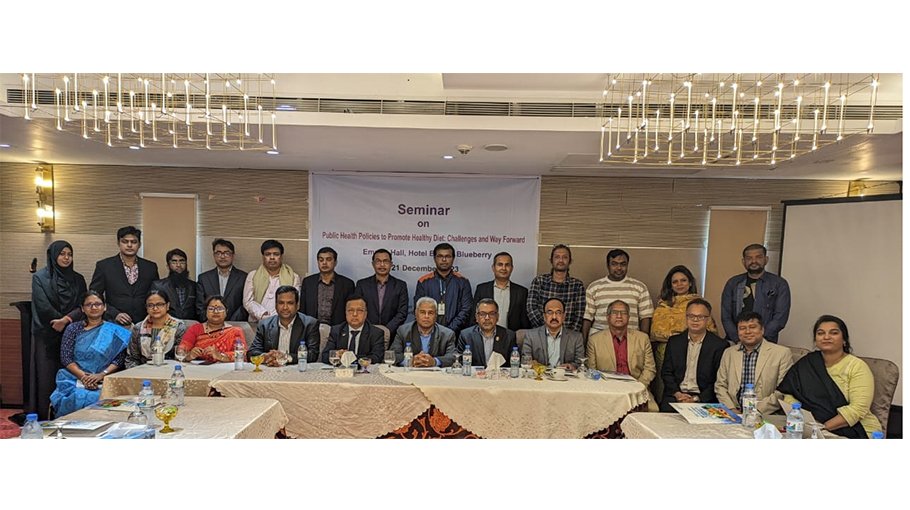
Speakers at a seminar have said that unhealthy food is one of the health problems around the world nowadays. 70 per cent of deaths in Bangladesh are caused by non-communicable diseases (NCDs), which are linked to food habit.
They also said that along with urbanization and changes in lifestyles, dietary habits of children have undergone major changes. Advertising campaign or awareness alone cannot be an effective measure. Taxation, improved labeling and packaging system, and market regulation can be effective ways to discourage unhealthy eating, they opined.
Center for Law and Policy Affairs-CLPA, ARK Foundation, Public Health Law Network and Citizen Network jointly arranged the seminar titled “Public Health Policies to Promote Healthy Diet: Challenges and Way Forward” at Hotel Bengal Blueberry in Gulshan-2 in the capital on Thursday (December 21, 2023).
It was said in the seminar that Bangladesh Food Safety Authority (BFSA) has formulated regulations to control Trans fats, and the government body is working to curb misleading advertising. However, it is important to make consumers aware of healthy food intake, which should be brought into the education system. Besides, healthy food habits should be developed at home.
Project director at Bangladesh Food Safety Authority (BFSA) and member (public health and nutrition) Manjur Morshed Ahmed, public health expert Md. Fahimul Islam Vital Strategies, and professor of economics of Dhaka University and executive director of ARK Foundation Dr. Rumana Huque spoke at the seminar.
Kamrunnisa Munna of CLPA moderated the event, while public health and environment policy expert Advocate Syed Mahbubul Alam Tahin presented the keynote paper. It was addressed, among others, by project director at Department of Agricultural Extension (DAE) Dr. AKM Shamim Alam, executive director of Gram Bangla Development Committee AKM Maksud, deputy secretary of Law Ministry Rumana Yasmin Ferdousi, Dr Mohammad Nazrul Islam Bhuiyan of BCSIR, associate professor of Bangladesh University of Health Sciences (BUHS) Palash Chandra Banik, associate professor of Dhaka International University Md Bazlur Rahman, and Ziaur Rahman of WBB Trust. Representatives from JICA, Ward Bank Group and GAIN, Article 19, Savar Municipality, URB Bangladesh and some other organisations were also present at the event and took part in open discussion.
Speakers of the seminar emphasized on awareness of production and marketing in accordance with the Food Safety Act, 2013 while issuing license. Besides, people who are involved in producing food in the restaurants need to be trained in the production of safe food.
They said, “We need to think more broadly about public health. The departments concerned of the Health Ministry are making people aware about nutritious food, while the Department of Agricultural Extension (DAE) is producing food items. The Railways Ministry and Shipping Ministry should come forward to bring the nutritious food at low cost. It is possible to develop the public health system with such integrated initiative of each department.”
The speakers said that public health has been given importance in Articles 16, 18, 37, 43 of the country’s constitution, but lack of implementation hinders the process. Public health should be prioritized in policies and regulations. All policies that conflict with health should be void. If the immune system is not strengthened, it will not be possible to reduce the pressure on the country's hospitals, they said.
The seminar recommended initiatives to increase tax on unhealthy food items and reduce tax on healthy foods, strengthen packaging and labeling, as well as control advertising of unhealthy food to children. Besides, all the packets contain extra salt and sugar, it is recommended to use color or special symbols so that the people of all walks of life can easily understand.
The Bangladesh Standards and Testing Institutions (BSTI) ensures that food commodities comply with the laws and quality standards mentioned in them. Through the collaboration of BSTI and Bangladesh Food Safety Authority (BFSA), a comprehensive set of standards for food quality has been developed under the Food Safety Act 2013.
This law also provides for establishing BFSA to oversee and regulate the activities related to food production, import, processing, storage, distribution and sale in the country. The following laws govern the labelling criteria in Bangladesh:
i) The Packaged Food Labelling Regulations 2017
ii) Bangladesh Standards of Weights and Measures (Commodity Packing) Rules 2007
iii) Bangladesh Import Order 2015-2018 iv) The Food Safety Act 2013.
Despite the fact that there are regulations governing food labelling, Bangladesh's packaged food labelling laws have been followed rarely. These laws are intended to offer a set of guidelines on product manufacturing to delivery.