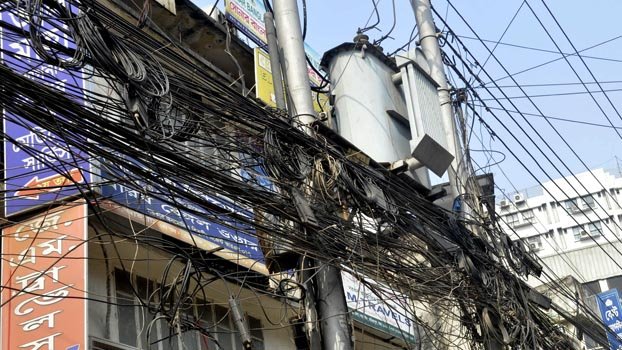
The government is going to remove all kinds of overhead cables, including electricity, internet and dish TV lines in Dhaka city soon. A committee of the Power Division has already submitted some recommendations to the ministry. To execute the recommendations, a meeting will be held this month, an official said.
Sylhet is the first city in the country to have road with no overhead cables. Bangladesh Power Development Board (BPDB) successfully initiated underground power lines in the Dargah Gate area and removed all overhead cables and electric poles last Sunday. State-owned Dhaka Power Distribution Company (DPDC) and Dhaka Electric Supply Company (DESCO), now engaged in power distribution in the city, had undertaken a project to take their overhead electric cables underground in Dhanmondi and Gulshan areas.
State Minister for Power, Energy and Mineral Resources Nasrul Hamid said, Sylhet city is being changed. There will be no overhead cables beside the roads. The installation work of overhead line is going on to ensure uninterrupted electricity supply. Some of the work has already been done. DPDC has already worked to lay underground cables in Dhaka. However, underground cable lines including in Narayangonj, Savar, Keraniganj and all other cities across the country will be laid in phases.
He also said, we plan to hold a meeting again with the stakeholders, including NTTN and ISP companies. After the meeting, we’ll give some suggestions to them. If they don’t follow, we’ll go for action against the troublemakers regarding the removing of haphazardly hung cables from electric poles.
On 31 October last year, the Power Division constituted a committee, headed by its joint secretary (good governance and APA), Abul Khayer Md. Aminur Rahman, to prepare a report on required actions for removing all the overhead cables hanging from electric poles.
When asked, Abul Khayer told Bangladesh Post, ‘We have already submitted a few recommendations to the Ministry of Power, Energy and Mineral Resources. It is essential for the Ministry’s directive to implement the recommendations. That’s why we will sit at a meeting headed by the State Minister, which may be held this month.’
The Nationwide Telecommunication Transmission Network (NTTN) providers have installed underground line. But the internet service providers (ISPs) are not using it. We suggested that the ISPs must use the line and its execution is not difficult. Initially our target is to negotiate with them. On the other hand, DPDC is working in Dhanmondi area to install underground cables, the other service providers will have to coordinate with the DPDC regarding all kinds of cables installed underground,’ he added.
Internet service providers and cable TV operators are stringing up illegal overhead cables all over the capital. The messy tangle of these cables, along with the cables of telephone and electricity lines, are not only an eyesore, but also pose a risk for accidents. It is also a great threat to uninterrupted power supply.
The government committee formed to remove these illegal cables said that despite removing the cables several times, the cable operators and internet service providers simply hang them up again. In many places, these illegal cables are seen entangled with telephone and electricity lines, as well as with the pole electricity transformers. The transformers, wrapped with all these cables, can burst anytime and cause serious accidents.
Following the model of many developed countries, the Bangladesh government has set up Nationwide Telecommunication Transmission Network (NTTN), an underground common network system that does not require any overhead cable. All the cables can be connected to an underground management system, and without interrupting the internet connection, the cables can be connected to the system within 24 hours.