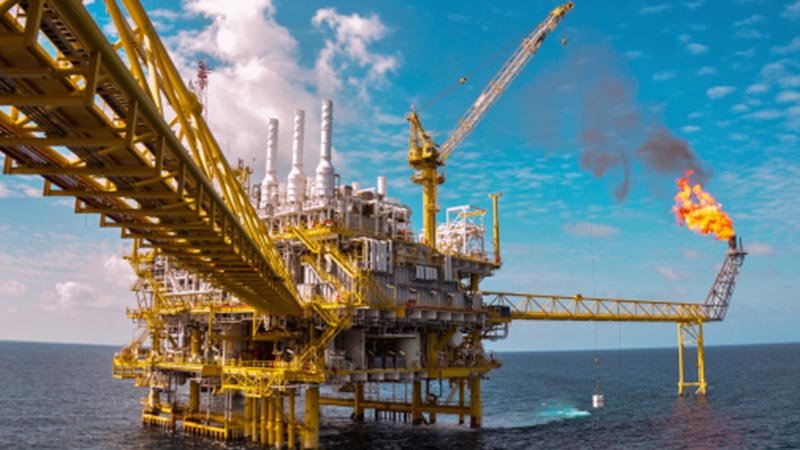
With the support of an Indian company Bangladesh would start drilling in the Bay of Bengal for oil and gas in about 14,000 square kilometers areas from this month or early November. The drilling will begin with the help of an Indian company titled ONGC Videsh Ltd. (OVL) exploring the sea bed from 20 meter depth to 200 meters.
All necessary data has already been acquired to find the rough reserve of hydrocarbon like seismic study to gain knowledge on the valuable fuels. This is the 2nd offshore drilling after Shangu drilling to explore the fuel reserves - gas and crude oil in the country. Experts said that any fresh discovery of hydrocarbon in offshore field will boost the country's future oil and gas reserves.
“To meet the domestic demand, Bangladesh is importing costly LNG from the international market. If the country finds sufficient amount of reserves in the Bay, it can save a huge amount of money. Besides, the move may also help overcome the current crisis of gas in the country,” experts said.
An official of energy division said that the Indian companies have already completed around 3,100 line-kilometer 2D or two dimensional seismic survey on both the shallow sea blocks. They have already selected a drilling contractor - a joint venture of China based company - Sinopec and US based company Halliburton.
The ONGC will also have to drill another well in shallow sea water in Block SS-09 by February 2021. Bangladesh Oil, Gas & Mineral Corporation (PetroBangla) signed the Production Sharing Contracts (PSC’s) contracts of the blocks SS-04 and SS-09 with consortium ONGC Videsh Limited (OVL) & OIL India Limited (OIL) and Bangladesh Petroleum Exploration and Production Company Limited (BAPEX) on 17 February, 2014.
According to contracts, OVL is operator of these two offshore blocks with participating interest of 45 percent. OIL will holds 45 per cent participating interest and BAPEX 10 holds the remaining 10 per cent interest. The block SS-04 covers an area of 7,269 square km with water depths ranging from 20-200 m and the block SS-09 covers an area of 7,026 sq. km with water depths ranging from 20-200 m.
The exploration term for the both blocks consists of 8 (eight) consecutive contract years comprising 5 (five) years as Initial Exploration Period and 3 (three) years as Subsequent Exploration Period.
As per PSC, ONGC Videsh Limited will conduct 2700 line kilometer 2D Seismic Data Acquisition and Processing & 1 exploratory well in Block SS-04 and 2700 line kilometer 2D Seismic Data Acquisition and Processing & 2 exploratory wells in Block SS-09. Now Exploration Phase I is in progress for both Blocks.
Bangladesh needs to go for hydrocarbon exploration massively to meet its rising energy demand, as the current gas reserves of 11.47 trillion cubic feet and it will run out by next decade at the current rate of consumption. Petrobangla said, it can be increased for lifting of gas until 2020. Then it will be stable in 2024-25. After then, it will decrease.
According to Petrobangla, the demand will rise to 4,770 million cubic feet in 2024-25, whereas the production capacity will be 2,196 million cubic feet from the current gas fields in the country.
In the next fiscal, the demand and production capacity will be 4,910 and 1,702 million cubic feet. In the same way, demand and production ratio will be 5,200 and 1,054 million cubic feet in 2028-29. Gradually, it will decrease, and if the new gas fields are not discovered during this period, gas production will be zero in 2041.
In March 2012, and July 2014, in historic victories at the UN Maritime Tribunal, Bangladesh got 11,631 square kilometres and 19,467 square kilometres from Myanmar and India respectively. With readjustment, the energy division has been divided into 26 blocks in the entire sea territory. However, work has begun in 4 blocks.
Sources said, there are indications of vast reserves of oil and gas in Block D-12 in the deep sea, and Bangladesh could have a minimum of 5 prospective structures in the Bay of Bengal following the 2-D seismic survey of 1,580 sq kms in the area.