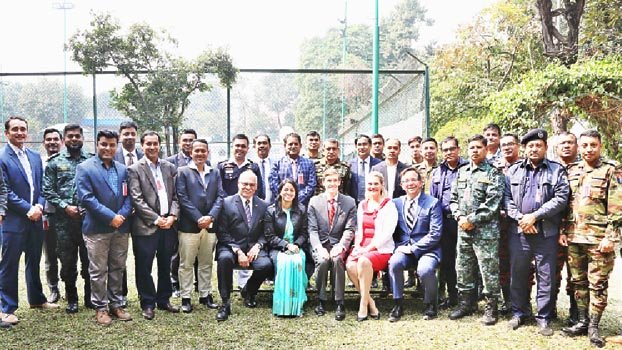
The government officials of both civil and military organisations have participated in a course administered by the US embassy in Dhaka for strengthening their ‘interagency counterterrorism collaboration’.
Representatives of eight Bangladeshi government civilian and military organisations participated in the week long course aimed at “strengthening efficient crisis response capability following terrorism incidents,” the embassy said. The course ended on Thursday. Members of the US Joint Special Operations University (JSOU) based in Tampa, Florida provided the course instruction.
The training brought together 29 officials from a number of ministries and security organisations, including the Ministry of Foreign Affairs, the Ministry of Defense Armed Forces Division (including the Army, Navy, and Air Force), the Counter-Terrorism Transnational Crime Unit, Customs Investigations and Intelligence Directorate, Fire Services Civil Defense, and Police Special Branch, who participated in the interactive training.
The Bangladesh-US Inter-ministerial Collaboration Course on Counterterrorism is one of the many initiatives of Washington “to promote greater cooperation, dialogue, and mutual understanding between Bangladesh and the United States, and a strong partnership to help ensure a free and open Indo-Pacific region”.
“I’m proud the United States and Bangladesh share a long history of collaboration responding to emergencies and crises. This course is another example of our strong and enduring security partnership,” US Ambassador Earl Miller, speaking on the occasion, said.
The US Embassy staff are working with participating ministries and security organisations to explore the possibility of offering other JSOU-provided courses in Bangladesh focused on a variety of subjects, including Countering Violent Extremism and Civil-Military Operations Seminar.
Integrating the various ministries seamlessly in a post-terrorism event is critical to developing an efficient crisis-response capability, as well as the resilience to recover following an emergency. Course participants learned about plan development, strategic communication, and policy development, and gained a better understanding of interagency capabilities and limitations, the US embassy said. The course provided an open forum for participants from diverse backgrounds, sectors, and organisations to share and discuss new ideas and perspectives.
After a series of initial lectures, participants were divided into groups and tasked with working together to develop a hypothetical intergovernmental policy on current issues. The course tested participants’ ability to think critically, while increasing integration between ministries and security organisations that need to collaborate in response to terrorism incidents.