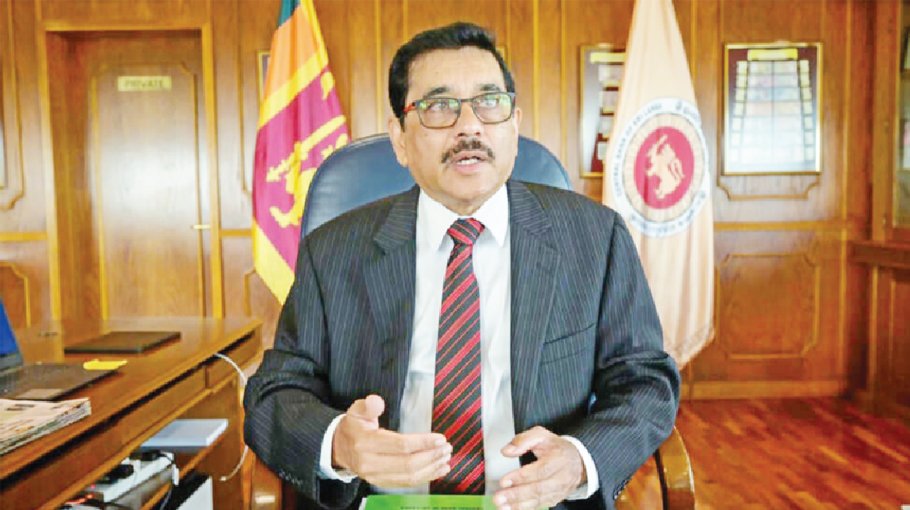
The man charged with clawing Sri Lanka out of bankruptcy says he had warned about economic calamity years before it hit -- and was pressed into retirement for his troubles.
Central bank chief Nandalal Weerasinghe was asked to return to the island nation last year to help steer it through a financial collapse that triggered months of food shortages, petrol queues and nightly blackouts.
The 63-year-old says his mandate coincides with Sri Lanka's one final opportunity to rescue itself from a cycle of economic shocks that stretches back decades.
"There's no excuse this time, no second chance, we have to get it right this time," he told AFP at his Colombo office this week. "This is where I think crisis is an opportunity."
Weerasinghe was the Central Bank of Sri Lanka's number two when Gotabaya Rajapaksa was elected president in 2019 on populist promises of generous tax cuts. Government debt soared as Rajapaksa pursued an unorthodox policy of printing exorbitant amounts of money while holding down exchange and interest rates to spur growth.
"As the senior deputy governor, I always raised concerns," Weerasinghe said. But with Rajapaksa's administration steamrolling objections from him and other senior central bankers, Weerasinghe said he felt he had no option but to take early retirement.
"Obviously I saw if those policies continued in that way... we'll end up in a situation that I said at that time was exactly what happened," he added.
Weerasinghe had decamped for a quiet life in Australia, spending time with his children and hitting the golf course five days a week, when Rajapaksa asked him to come back and helm the central bank.
He returned to a country in chaos, its currency in freefall and the government days from defaulting on its $46 billion foreign debt.
The Covid-19 pandemic had dealt a hammer blow to already precarious public finances, as the island's lucrative tourism industry shuttered and remittances from Sri Lankans working abroad dried up.
Foreign exchange reserves had almost been exhausted, leaving importers unable to buy goods necessary to keep the economy functioning.
Supermarket shelves were empty, long lines snaked from fuel stations, and thermal power stations were forced to ration electricity for 13 hours each day.
By July, Rajapaksa had fled the country after months of protests demanding his resignation for mismanaging the crisis.
- 'China on board' -
Rajapaksa's successor, Ranil Wickremesinghe, has sought to repair the
nation's finances through a $2.9 billion International Monetary Fund bailout.
The rescue package commits Sri Lanka to an austerity regime of steep tax
hikes and an end to generous consumer utility subsidies, both of which have
proven deeply unpopular.
Its passage was reportedly held up for months when China -- Sri Lanka's
largest bilateral creditor -- resisted agreeing to a haircut on its loans.
Chinese debt has been controversial politically, with Rajapaksa and his elder
brother Mahinda -- himself a former president -- accused of taking Beijing's
money to finance costly vanity projects.
Weerasinghe said the delays to the IMF package were understandable because
Beijing was a relatively "new player" to bilateral lending.
"China is fully on board, and agreed to support Sri Lanka and help Sri Lanka
to come out of this crisis," he said.
- 'End of the story' -
Last year brought Sri Lanka's worst economic downturn in its 75-year history
as an independent nation, with GDP contracting 7.8 percent and inflation
hitting 70 percent at its peak.
But the island's tea- and tourism-dependent economy is no stranger to shocks,
with foreign exchange shortages triggering recessions and government
rationing of consumer goods numerous times in prior decades.
Sri Lanka had already gone to the IMF cap in hand 16 times before last year,
but failed to stick with agreed-upon reforms, giving it a serious credibility
gap.
Weerasinghe said the country had two choices this time around: if it sticks
to its current IMF programme, its economy would return to normal within "two
to four years".
If it did not, Sri Lanka would no longer be indulged if it fell off the wagon
and returned to its spendthrift ways at the first sign of stability, he
warned.
"This time, the 17th time with the IMF, is different," he said.
"If you are trying to go back to another programme, that will be most
difficult, and I think that will be the end of the story."