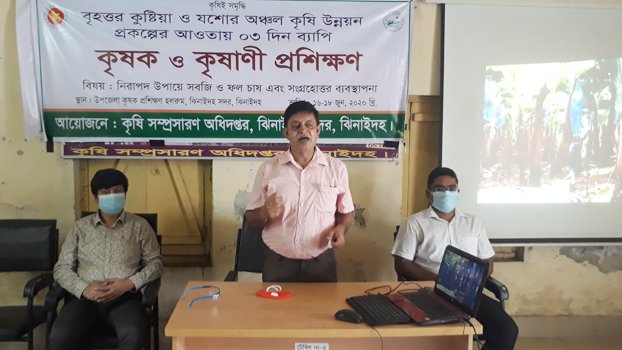
A three-day training for the male and female farmers began in Jhenaidah on Tuesday. The training was held in the conference room of the deputy director of agriculture.
Department of agriculture extension (DAE) in Jhenidah office sources said the training was organized under the assistance of greater Jashore and Kushtia region agriculture development project.
Presided over by upazila agriculture officer (UAO) Mofakkharul Islam, additional deputy director of the DAE Kripangshu Sekhar Biswas attended and inaugurated the training course as chief guest. Additional deputy director Bijoy Krishna Halder, agriculture extension officers Mohammad Rokanauzzaman and Junayeed Habib attended as special guests.
Participant in the training course Sagarika Khatun of Kala-Lakkhipur and Anisur Rahman of Ganna village under Jhenidah Sadar upazila when contacted said they will apply the knowledge of training in their fields and encourage neighboring farmers to apply modern technology to reap profit as well as ensure good health for all.
The organizers said 60 male and female farmers are learning to practice forproducing crops applying modern technology to ensure safer food for the nation. The training will sharpen their knowledge as desired by the agro-friendly government of Prime Minister Sheikh Hasina which was dreamed by Father of the Nation Bangabandhu Sheikh Mujibur Rahman.
The training will be concluded on Thursday following distribution of certificates. Each and every participant and the organizers maintained social distancing during the training period to protect themselves from the slap of novel corona virus.
They said the government has been providing training, incentives, seeds and fertilizer distribution at free of cost and other programmes for the post corona hours for uninterrupted safer food production. Here the field level DAE activists known as sub assistant agriculture officer (SAAOs) have been standing round the clock by the farmers in remote areas.
In his speech, the chief guest said there is no alternative to produce safer food as the global challenge when the health was under threat in least developed and developing countries like Bangladesh. Here the farmers, especially, women could play significant role in leading revolution in food production in the agrarian country.