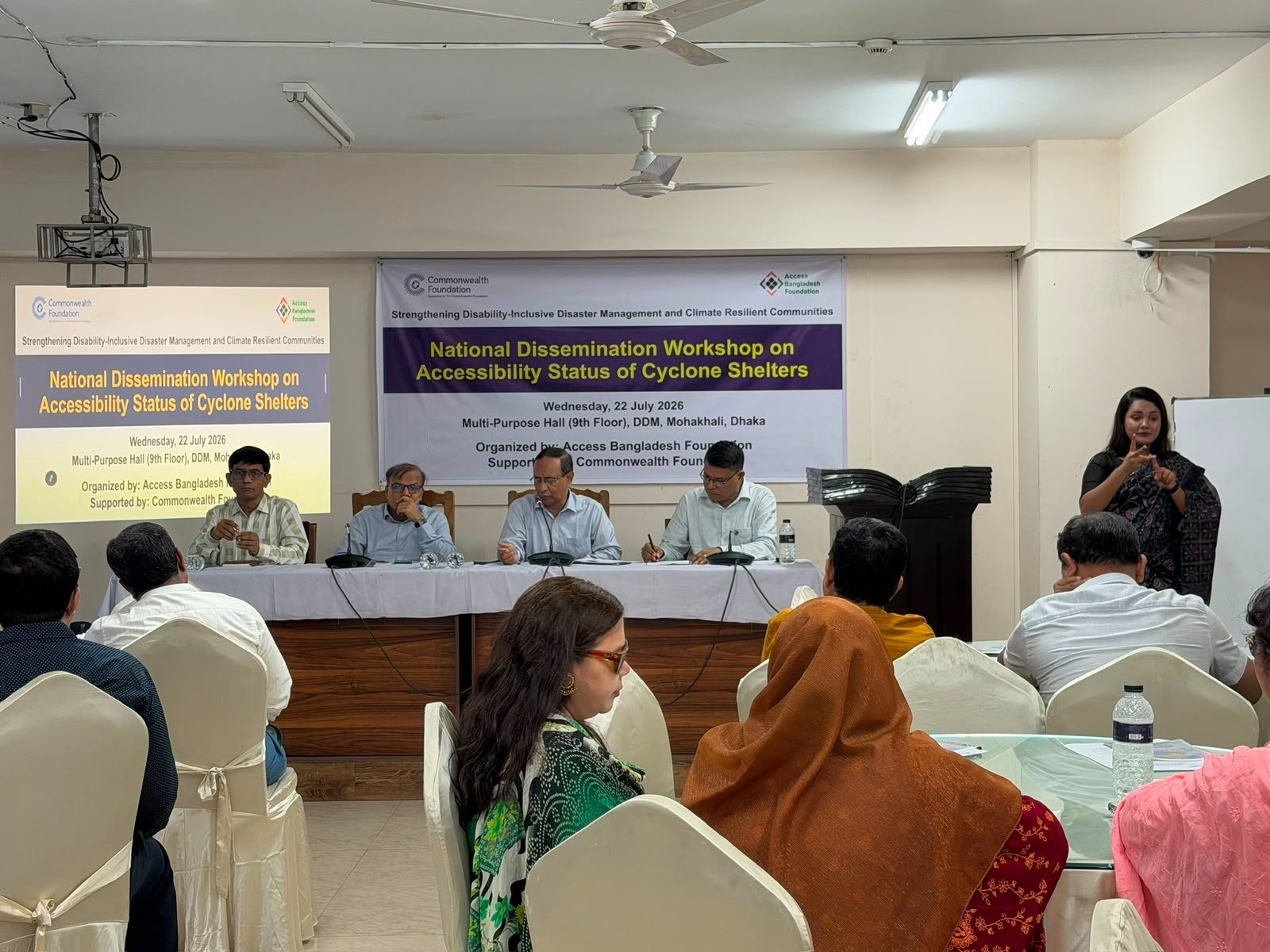
A National Dissemination Workshop on the Accessibility Status of Cyclone Shelters was held on Wednesday at the Multi-Purpose Hall of the Department of Disaster Management (DDM), Mohakhali, Dhaka.
The workshop was organized by Access Bangladesh Foundation with support from the Commonwealth Foundation to disseminate the findings and recommendations of a comprehensive accessibility assessment of cyclone shelters conducted through a disability inclusion lens.
Razwanur Rahman, Director General of the Department of Disaster Management, attended the workshop as the Chief Guest. Paritosh Hajra, Joint Secretary and Director (Planning & Development, A.D.), Department of Disaster Management, and Netai Chandra Dey Sarker, Director (MIM), Department of Disaster Management, joined as Special Guests. The event brought together senior government officials, representatives of Organizations of Persons with Disabilities (OPDs), development partners, NGOs, researchers, engineers, accessibility experts, and media professionals to discuss practical measures for ensuring that cyclone shelters are safe, inclusive, and accessible for everyone.
During the workshop, Md. Shohel Rana, Head of Program at Access Bangladesh Foundation, presented the findings of a comprehensive accessibility assessment conducted in 25 cyclone shelters in Shyamnagar Upazila of Satkhira District. The assessment examined 15 key accessibility components, including connecting roads, entrances, ramps, stairs, toilets, corridors, emergency exits, signage, water facilities, early warning systems, lighting, and shelter management practices. The assessment benchmarked cyclone shelter accessibility against the Bangladesh National Building Code (BNBC) 2020, the Rights and Protection of Persons with Disabilities Act 2013, the Cyclone Shelter Construction, Maintenance and Management Policy 2011, the Standing Orders on Disaster 2019, and international accessibility standards.
Major Findings:
The assessment found that cyclone shelters still present significant accessibility barriers for persons with disabilities, older persons, pregnant women, children, and other people at risk. Barriers exist throughout the evacuation journey, including connecting roads, entrances, ramps, internal movement, sanitation facilities, emergency communication, and shelter management.
Access roads, ramps, entrances, and internal circulation often do not meet accessibility standards, while accessible toilets, water facilities, tactile and Braille signage, and inclusive wayfinding systems remain largely unavailable.
The assessment also identified the need to strengthen the capacity of cyclone shelter management committees and frontline responders on disability-inclusive emergency preparedness and response.
Recommendations:
To improve physical accessibility, the assessment recommends implementing the Bangladesh National Building Code (BNBC) 2020 and Universal Design principles by constructing ramps with a maximum 1:12 slope, a minimum width of 4 feet, handrails on both sides, non-slip surfaces, and tactile warning indicators; ensuring barrier-free connecting roads with a minimum width of 84 inches where feasible; providing entrances and internal doors with a minimum clear width of 36 inches and low or flush thresholds; and installing accessible toilets with 5 ft × 5 ft wheelchair turning space, grab bars, accessible hand showers, emergency call systems, and non-slip flooring.
The assessment further recommends introducing multi-sensory early warning systems that combine audio, visual, and tactile communication, together with high-contrast, pictorial, tactile, and Braille signage to ensure safe navigation and timely access to emergency information for all users.
More broadly, the assessment calls for full compliance with BNBC 2020 in all new cyclone shelters, progressive retrofitting of existing facilities, regular accessibility audits, capacity building for government officials and shelter management committees, meaningful participation of persons with disabilities and their representative organizations, and stronger coordination among government, local authorities, development partners, NGOs, and the private sector to make accessibility a standard feature of Bangladesh's disaster resilience efforts.
Addressing the workshop, Chief Guest Razwanur Rahman, Director General of the Department of Disaster Management, said:
"The Government is planning to construct new cyclone shelters during this fiscal year. The findings and recommendations of this assessment come at the right time and will be highly valuable in ensuring that future cyclone shelters are safe, inclusive, accessible, and leave no one behind during disasters."
Special Guest Paritosh Hajra, Joint Secretary and Director (Planning & Development, A.D.), Department of Disaster Management, emphasized that accessibility must become an integral part of disaster management planning. He called for stronger coordination among stakeholders and proposed establishing a dedicated knowledge repository on the Department of Disaster Management's website to preserve and share accessibility knowledge and good practices.
Netai Chandra Dey Sarker, Director (MIM, C.C.), Department of Disaster Management, appreciated the initiative, stating:
"It is truly commendable to conduct this type of assessment from a disability inclusion perspective. Evidence like this is essential for improving disaster preparedness and ensuring that cyclone shelters are accessible and safe for everyone."
During the open discussion, government officials, representatives of Organizations of Persons with Disabilities (OPDs), development organizations, engineers, researchers, media professionals, and technical experts emphasized that accessibility is not merely an infrastructure issue but a prerequisite for effective disaster risk reduction.
Albert Mollah, Co-Founder and Executive Director of Access Bangladesh Foundation, who moderated the workshop, concluded:
"A cyclone shelter only fulfills its purpose when every person can enter, use, and evacuate safely. This assessment is not about identifying problems alone—it provides practical, evidence-based solutions. Bangladesh already has strong policies and standards. What we need now is coordinated implementation, adequate investment, and meaningful participation of persons with disabilities. Together, we can ensure that future cyclone shelters are truly safe, accessible, and inclusive for everyone."
The workshop concluded with a shared commitment from government, Organizations of Persons with Disabilities (OPDs), development partners, civil society, professionals, academia, and the media to work together to ensure that future cyclone shelters are designed, upgraded, and managed so that every person, regardless of disability, age, or mobility, can access life-saving protection with safety, dignity, and equal opportunity during disasters.