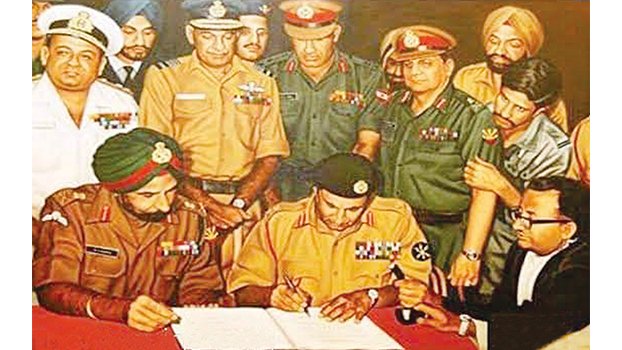
With a fresh vow to uphold the spirit of the hard-earned independence and democracy and eliminate the anti-liberation forces, the nation is celebrating the 50th Victory Day today (Wednesday). The whole nation will pay deep homage to the martyrs who sacrificed their lives for the country in the Liberation War in 1971.
And all the programmes will be observed maintaining the health guidelines this year due to the ongoing Covid-19 pandemic.
On this day in 1971, Pakistani occupation forces surrendered after a nine-month war resulting in birth of free, independent and sovereign Bangladesh.
The day is a public holiday.
Commemorating the glorious victory in 1971, the government has chalked out different programmes to celebrate the Victory Day at the national level.
People from all walks of life will pay rich tributes to the heroic and illustrious sons of the soil who sacrificed their lives to liberate their beloved motherland from the Pakistan Army and their collaborators.
This year’s celebration will be in a different manner as the coronavirus crisis has paralyzed the whole world. People are instructed to maintain social distancing, follow proper health guidelines and wear facemasks during the pandemic.
Meanwhile, all sorts of preparation have been completed to celebrate the Victory Day in the capital Dhaka and elsewhere in the country in a befitting manner amid much enthusiasm.
The government has taken elaborate programmes to celebrate the day at the national level.
The programmes include a 31-gun salute, placing wreaths at the monuments to pay homage to martyrs, hoisting of the national flags atop all government, semi-government and private offices as well as offices of autonomous bodies across the country, decorating city streets with miniature national flags and colourful festoons, and illumination of important buildings and establishments, roads and street islands at night.
People from different social groups and political, cultural, professional and academic organisations and institutions will throng the National Mausoleum in Savar to pay homage to the war heroes who embraced martyrdom to liberate the motherland. Wreaths will also be placed at the portrait of Bangabandhu Sheikh Mujibur Rahman in front of Bangabandhu Bhaban on Dhanmondi 32 road in the city.
Besides, different political, socio-cultural, professional and academic organisations have taken up elaborate programs to mark the Victory Day.
The Victory Day will also be celebrated across the country and Bangladesh’s missions abroad.
On this day, the country achieved independence after the nine-month Liberation War under the leadership of the Father of the Nation Bangabandhu Sheikh Mujibur Rahman. Finally, we got a free nation with the cost of the supreme sacrifice of three million people and the honour of nearly half a million women.
On December 16 in 1971, Lieutenant General Amir Abdullah Khan Niazi, CO of Pakistani occupation forces with his troops of 93,000 signed the Instrument of Surrender.
The surrender took place at the Ramna Race Course now Suhrawardy Udyan, in Dhaka following a miserable defeat to the joint forces of Mukti Bahini and Mitra Bahini.
In one of the heinous acts of genocide in history, the Pakistan Army and their local collaborators had launched a barbarous crackdown killing innocent and unarmed people in the erstwhile East Pakistan at midnight March 25, 1971.
After the assassination of Bangabandhu Sheikh Mujibur Rahman, the country’s democratic system and fundamental rights of the people had been held hostage under the 22 years of rule of military dictators, vested quarters and BNP-Jamaat led anti-liberation forces.
Besides, country’s Liberation War’s history had also been distorted in many ways. Even many deep-rooted conspiracies were also plotted to erase the name of Sheikh Mujibur Rahman and pro-liberation forces from the history.
People blame the two dictators - Ziaur Rahman and HM Ershad, and BNP-Jamaat led government for attempting to erase and twisting real history of the Liberation War.
When Bangabandhu’s daughter Sheikh Hasina came to power in 1996, she started working on restoring the genuine history of Bangladesh. Under her dynamic leadership, the country began moving forward undertaking massive development works including implementing mega projects.
The day is not far away when the dream of Bangabandhu’s ‘Sonar Bangla’ would be realised as Bangladesh has been making long strides in all sectors.
Bangladesh has become a role model of socio-economic development under the prudent policies and dynamic leadership of Prime Minister Sheikh Hasina.
Country’s all sectors including economic, agriculture, industry, education, health, science and technology are playing vital role in achieving the success.
To mark the Victory Day, the national flag will be hoisted atop all government, semi-government and other important establishments.
Special prayers will be offered at mosques, temples, churches and other worship places, seeking divine blessings for peace and progress of the country.
Bangladesh Television, Bangladesh Betar and private television channels will air special programmes while newspapers will bring out special supplements while Bangladesh postal department will release memorial postal stump to mark the day.
Different socio-political, educational and cultural institutions and organisations have chalked out a series of programmes to celebrate the nation’s glorious victory over the Pakistani occupation force.
The victory day celebration had reached a new height following the UNESCO’s recognition of Bangabandhu’s historic March 7th Speech as a part of the world’s documentary heritage in 2017.
On October 30 in 2017, the UNESCO announced the prestigious acknowledgement of one of the world’s most glorious speeches, through which Bangabandhu effectively decelerated the country’s independence in a mammoth public rally at Ramna Racecourse ground (now Suhrawardy Udyan) in Dhaka on March 7, 1971.
The speech inspired the Bengali nation in their quest for freedom and energised freedom-loving people to liberate the country from the enemies.