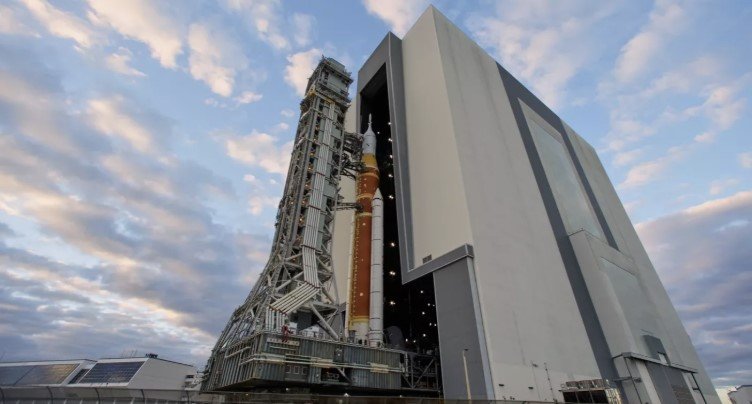
NASA’s massive new moon rocket rolled out to the launch pad early Saturday, marking a major step toward the first crewed lunar fly-around in more than 50 years, which could lift off as early as February.
The 322-foot Space Launch System rocket began its slow journey from Kennedy Space Center’s Vehicle Assembly Building at daybreak, moving at about one mile per hour on a giant transporter. The four-mile trip to the pad was expected to take most of the day.
Thousands of NASA workers and their families gathered in the early morning chill to watch the long-awaited rollout, an event that had been delayed for years. NASA Administrator Jared Isaacman and the four astronauts assigned to the mission led the cheering crowd.
Weighing about 11 million pounds, the rocket and its Orion crew capsule were carried by a transporter first used during the Apollo and space shuttle eras and later upgraded for the heavier SLS.
The only previous SLS launch took place in November 2022, when an uncrewed Orion capsule was sent into orbit around the moon. This time, astronauts will be aboard.
“This one feels very different, putting crew on the rocket and taking them around the moon,” said NASA’s John Honeycutt.
The upcoming 10-day mission will be commanded by Reid Wiseman, with Victor Glover as pilot and Christina Koch as mission specialist. They will be joined by Canadian astronaut Jeremy Hansen, making his first spaceflight.
The astronauts will not land on the moon or enter lunar orbit. That milestone is planned for a later Artemis mission.
NASA plans to conduct a fueling test on the launch pad in early February before setting a final launch date. The agency has a narrow window of five days in the first half of February before the schedule shifts into March.
If successful, the mission will mark humanity’s first return to the moon since Apollo 17 in 1972, when Gene Cernan and Harrison Schmitt завершed the era of lunar landings.