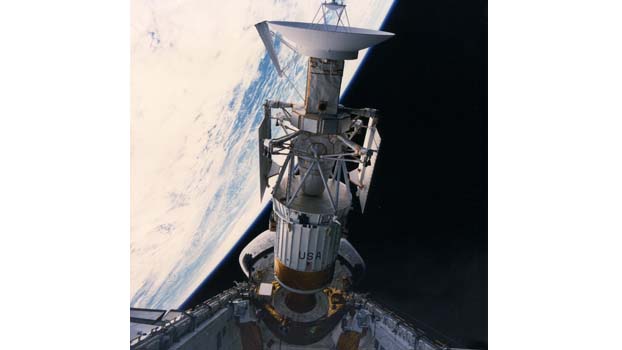
Magellan, named after the Portuguese explorer Ferdinand Magellan (1480-1521), was the first deep space probe launched by the United States in almost 11 years, and also the first probe launched by a space shuttle.
The Challenger disaster in January 1986 profoundly impacted the shuttle launch manifest into the 1990s, which included a number of planetary missions. Magellan, for example, was delayed by at least a year.
Magellan was designed to use a Synthetic Aperture Radar (SAR) to map 70 percent of the Venusian surface down to a resolution of 390 to 985 feet (120 to 300 meters).
The basic bus was assembled using spare parts left over from various prior missions including Voyager, Galileo, Ulysses and Mariner 9. Magellan was deployed by the STS-30R crew and released at 01:01 UT May 5, 1989, from the payload bay of the Space Shuttle Atlantis. One hour later, a two-stage Inertial Upper Stage (IUS) fired to send the spacecraft on a trajectory to rendezvous with Venus.
After three en route trajectory corrections (May 21, 1989, March 13, 1990, and July 25, 1990), Magellan arrived in Venus orbit Aug. 10, 1990. Orbital parameters were 185 x 5,260 miles (297 × 8,463 kilometers) at 85.5 degrees inclination.
Six days after entering orbit, Magellan suffered a communications outage lasting 15 hours. After a second 17 hour-interruption Aug. 21, 1990, the ground sent up new preventative software to reset the system in case of such anomalies.
Beginning Sept. 15, 1990, the spacecraft began returning high-quality radar images of the Venusian terrain that showed evidence of volcanism, tectonic movement, turbulent surface winds, miles (kilometers) of lava channels, and pancake-shaped domes.
In a Magellan image dubbed the "Crater Farm" we see the curious layering of volcanic activity and impact craters. Three impact craters are displayed in this three-dimensional perspective view of the surface of Venus. Credit: NASA/JPL-Caltech
Magellan completed its first 243-day cycle (i.e., the time it took for Venus to rotate once under Magellan’s orbit) of radar mapping May 15, 1991, providing the first clear views of 83.7 percent of the surface.
The spacecraft returned 1,200 gigabits of data, far exceeding the 900 gigabits of data from all NASA planetary missions combined at the time.
In the summer of 1993, controllers commanded the spacecraft to drop into the outermost regions of the Venusian atmosphere and then successfully used an aerobraking method to circularize its orbit. Magellan found that at least 85 percent of the Venusian surface is covered with volcanic flows.
The spacecraft’s data suggested that despite the high surface temperatures (887 degrees Fahrenheit or 475 degrees Celsius) and high atmospheric pressures (92 atmospheres), the complete lack of water makes erosion an extremely slow process on the planet. As a result, surface features can persist for hundreds of millions of years.
-NASA