AP, Seoul
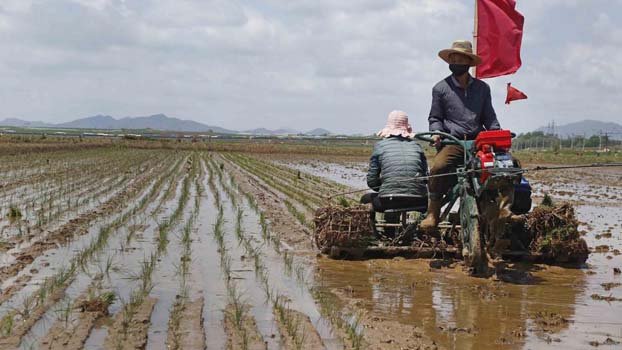
North Korea is releasing emergency military rice reserves as its food shortage worsens, South Korea’s spy agency said Tuesday, with a heat wave and drought reducing the country’s supply.
The country’s moribund economy is continuously being battered by the protracted Covid-19 pandemic, and while mass starvation and social chaos have not been reported, observers expect further deterioration of North Korea’s food situation until the autumn harvest.
Seoul’s National Intelligence Service told a closed-door parliamentary committee meeting that North Korea is supplying rice reserved for wartime uses to citizens left with little food, other laborers and rural state agencies, according to Ha Tae-keung, one of the lawmakers who attended the session.
Ha cited the NIS as saying an ongoing heat wave and drought have wiped out rice, corn and other crops and killed livestock in North Korea. The NIS said North Korea’s leadership views fighting the drought as “a matter of national existence” and is focusing on increasing public awareness of its campaign, Ha said.
Another lawmaker, Kim Byung-kee, quoted the NIS as saying that North Korea normally needs about 5.5 million tons of food to feed its 26 million people but is currently short of 1 million tons. He said the NIS told the lawmakers that North Korea is running out of its grain stockpiles.
The price of rice, the most important crop in North Korea, once doubled from early this year. The price briefly stabilized in July before soaring again, Kim cited the NIS as saying.
Ha said North Korea is trying to control the price of grains to which its public is most sensitive.
The lawmakers didn’t elaborate on North Korea’s food situation or actions it was taking.
But Kwon Tae-jin, an expert at the private GS&J Institute in South Korea, said North Korea is likely releasing the military reserves to sell at a cheaper price than at markets to stabilize prices. He said rice prices are “considerably unstable” in North Korea because the government has a limit in supplying such rice.