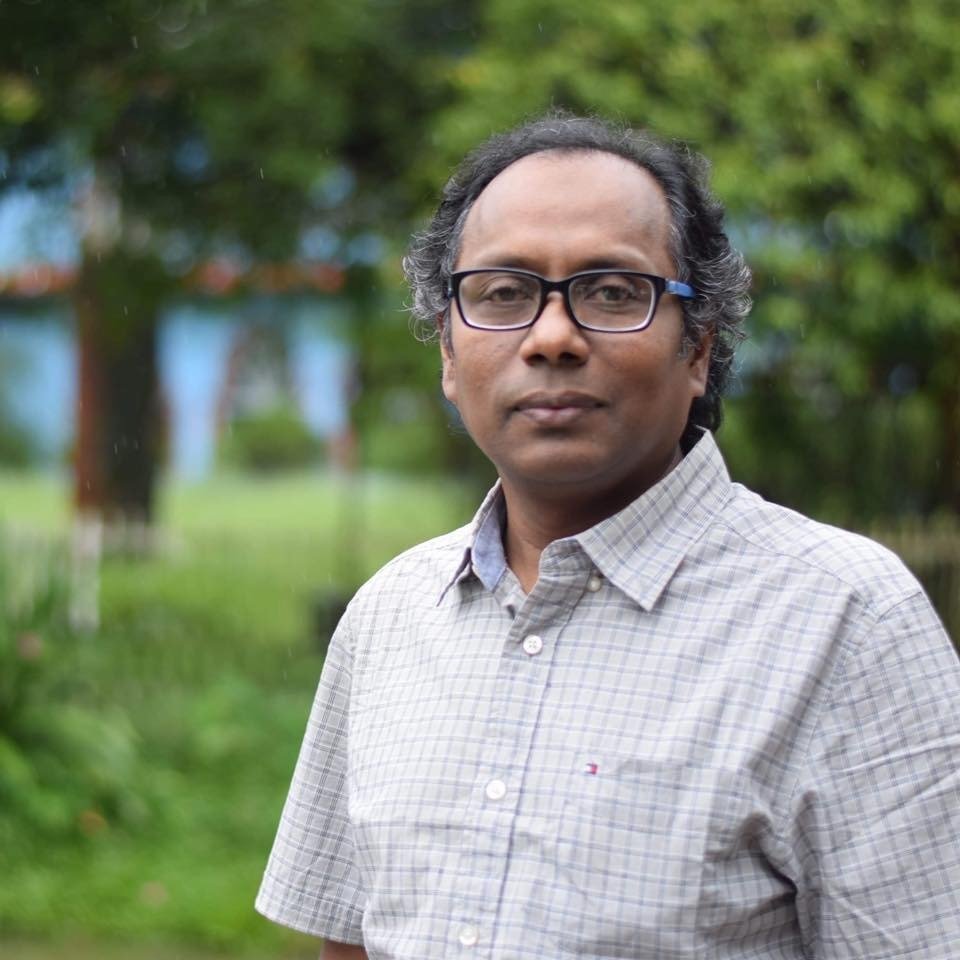
Dr Abul Hasnat Milton
Not everybody is lucky enough to see the birth of a nation in just one lifetime. I am one of those rare lucky ones. In 1971, during the war of liberation, I was only five years old. It is true that, because of age, I did not understand much then. Yet many memories of the war are still recalled vividly. In Khulna, we lived in the Bangladesh Bank colony. It was the rainy season then. The horrors of war were growing across the country. Living in town did not seem safe anymore. We decided to move to my grandparents’ house in Gopalganj, leaving my father behind. My father refused to go, despite several requests. Since our home was then a hidden hideout for the Bengali freedom fighters, he wanted to stay.
We first crossed the Bhairab river and took shelter at my father’s friend’s home. We hid in a trench dug out of the ground throughout the day. We left for Gopalganj within a few days. Often on feet, or by rickshaws, and in some cases crossing waterways brimming with water, three or four days later we arrived at our grandparents’ house in Gopalganj. Yet no relief occurred.We used to hear everyday that the Pakistani army would be coming to the village the next day. So, we all went to a lake every morning and hid. My grandparents and great grandparent used to stay at home. They had the impression that they would not be affected by the Pakistani army because they were old and Muslims. The Pakistani army came to the village one day. They killed our great grandfather, shot two grandparents, but they jumped into the water and survived. They set all the houses on fire. The fire was still burning when we returned home in the evening. The flame of fire still floats in my eyes.
We had a long tradition of political struggle for twenty-three years. Immediately after partition in 1947, East Pakistan's citizens discovered that they had been released from British rule and had Pakistani exploiters. Pakistan’s central government promptly overlooked East Pakistan’s mother tongue and proclaimed Urdu to be the only state language. The political movement against the Government of Pakistan began from that point, culminating in the liberation war of 1971.
After the landslide victory in the 1970 elections, the Pakistani Government was reluctant to hand over power to the newly elected Awami league. On 3 March 1971, Bangabandhu Sheikh Mujibur Rahman called upon the Bengalis to continue the non-cooperation movement. The civilian rule of the East Pakistan government became obsolete. In his meeting in the historic Suhrawardy Udyan on March 7, the Father of the Nation declared, 'This time it is a fight for independence, this time it is a battle for liberty’. Meanwhile, Bangabandhu took over the civilian rule of East Pakistan through non-cooperation movement. Then, in the name of addressing the political crisis, General Yahya Khan continued to conspire. In the night after the Pakistani army had invaded the sleeping and unarmed Bengalis, General Yahya Khan suddenly left Dhaka on March 25.On 10 April, the elected representatives of the people of Bangladesh formed a Constituent Assembly in Mujibnagar, Meherpur and issued the Declaration of Independence. Bangladesh was proclaimed a sovereign republic in this statement.
Bangladesh’s war of independence was a battle for the Bengali nation’s survival. The political parties in the country for independence, therefore joined it. Naturally, not all political parties in this war played an equal part. The Awami League proved to be the true representative of the Bengali people in the elections of '70. Therefore, the Awami League had to play the leading role in the liberation struggle.
The Awami League, led by Father of the Nation Bangabandhu Sheikh Mujibur Rahman, took Syed Nazrul Islam as the caretaker President and Tajuddin Ahmed as the Prime Minister among the elected representatives of the party and formed a caretaker government in Mujibnagar on 17 April. To make the liberation war a success, the Mujibnagar Government was indispensable.
In the first phase of the liberation war, efforts were made to resist the Pakistani aggressors all over the country. The East Bengal Regiment soldiers, the former East Pakistan Rifles, the police administration, and various parties tried to stop the Pakistani army. Millions of women, men, students, employees, business people, teachers, doctors, engineers and all professional people took part in the liberation war. They jumped into the liberation war to protect the motherland.
The freedom fighters adopted guerrilla tactics during the second phase of the liberation war. The Pakistani army was stopped by destroying the communication system through the covert attack of the freedom fighters. Guerrilla attacks were also aimed at blocking the supply routes of the invaders. Many Pakistani soldiers were killed in these attacks. Guerrilla attacks also weakened Pakistani army’s morality. The war of liberation took the form of a war of people.
The freedom fighters intensified their guerrilla operations during the final stage of the liberation war, and they also fought a frontal battle. Unable to withstand the attack of the freedom fighters, the Pak army left the border areas, villages and small towns and gathered in Dhaka and big cities. The freedom fighters established its control over most of the country in this way. In this way, the freedom fighters established its control over most parts of the country. Finally, on December 16, 1971, with around 93,000 soldiers,General Amir Abdullah Khan Niazi surrendered to the Indian Allied Forces and the Liberation Army’s joint command.
After a long 9-month war, Bangladesh won on 16 December 1971. But despite the birth of a new country with the desire to be free from economic inequality, the big challenge is to rebuild the war-torn country. Nearly all the infrastructures were destroyed, there was no foreign exchange reserve, no money in the state treasury. In this situation, running the country and running its development activities becomes difficult for the government of the new country. We had to depend on foreign aid for development.
Bangladesh started to grow steadily, step by step at the beginning. Social growth was also essential in conjunction with economic development. While Bangabandhu’s government focused on the coutnry’sdevelopment, reactionary political forces became involved in several conspiracies. With a particular focus on agriculture and industry, Bangabandhu established BAKSHAL for the overall development of the country.
The growth of Bangladesh was disrupted when Bangabandhu was assassinated along with many of his family members on 15 August 1975.Bangladesh suffered a major loss in political, economic and social terms following the assassination of Sheikh Mujib, during the long military rule of Zia and Ershad.
In the years 1991 to 1996 and 2001 to 2006, the next two regimes of the Jamaat-BNP alliance did not carry the country much good. It was mainly from 2009 onwards, Bangladesh began to achieve incredible success in various social development indicators through public-private efforts. In terms of social development indices, many neighbouring countries such as Pakistan remain behind. The country is now far ahead of Pakistan in various indicators including average life expectancy, literacy rate, and discrimination against women. With the success of social development, Bangladesh has surpassed Pakistan in different areas of the economy. Gross domestic product (GDP) growth in Bangladesh is now much higher than that in Pakistan.
Today's Bangladesh, headed by Honourable Prime Minister Sheikh Hasina, proves that the decision to separate from Pakistan through war was the right one. Bangladesh has risen to 41st position in the list of largest economies in terms of GDP. The information was contained in the report of the World Economic League Table (WELT) of the Economics and Business Research (CEBR), a British economic advisory center.
According to the World Economic Lague table, Bangladesh's economic growth will be significant over the next 15 years. By 2023, Bangladesh will be ranked 36th in the list of top economies. Bangladesh is to take 26th spot by 2026. The CEBR study predicts that Bangladesh will achieve an average annual growth of seven percent between 2017 and 2033. With this, Bangladesh will become the 24th largest economy country in 2033.
I have travelled around the world for professional reason. Once upon a time, while travelling with the Bangladeshi passport, the immigration officials at the several airports used to look at me with narrow eyes. But the situation has now changed. The green passport of Bangladesh is not disregarded as previously. Today, Bangladesh is a name to be respected in the heart of the world.
For us, as Bengalis, this is an enormous accomplishment. We might not even have imagined it a decade ago. Bangabandhu Sheikh Mujib's Sonar Bangla is no longer just a dream, and it is areality. I am proud of my motherland Bangladesh. I feel that my freedom is my pride.
In this month of victory, we remember with immense respectBangabandhu Sheikh Mujib, our country’s greatest hero. Three million martyrs and four lakh self-sacrificing mothers and sisters are embodied in our love and reverence. We also thank all the freedom fighters who risked their lives to fight for the country’s independence. All our best wishes for Bangladesh, we want
prosperity.
Dr Abul Hasnat Milton is a Poet, columnist, and a public
health expert in Australia.