The birth centenary of the Father of the Nation Bangabandhu Sheikh Mujibur Rahman was celebrated on Tuesday at home and abroad with due respect, and amid festivity.
The main celebratory function at Suhrawardy Udyan began through the national anthem by 100 children after 8:00pm. Later, President Abdul Hamid delivered his speech before the nation.
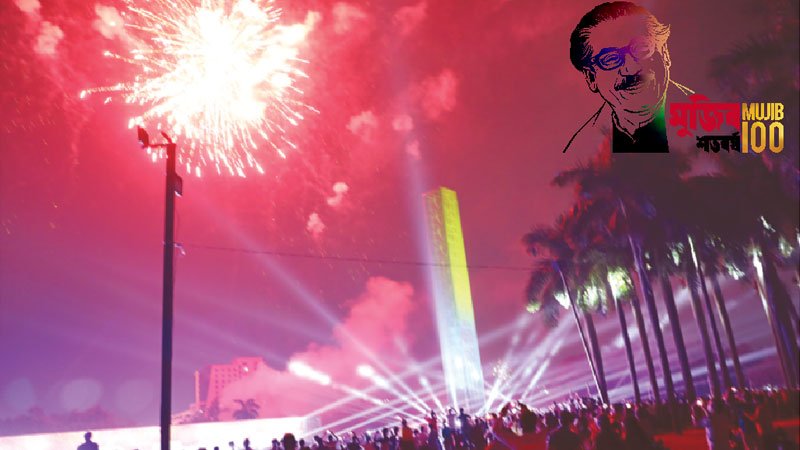
At the same time, fireworks were held at the Suhrawardy Udyan and at the South Plaza of the National Parliament premises.
After the deliberation of President’s speech, a song on Bangabandhu was sung by 100 children.
As part of the celebration programme, Prime Minister Sheikh Hasina, also the eldest daughter of Bangabandhu, also deliberated a speech to the nation.
After Prime Minister’s speech, almost all the famous artists of Bangladesh sang songs on Bangabandhu and Bangladesh.
Meanwhile, the ‘Mujib Barsho’, the yearlong birth centenary of Bangabandhu has begun with a fresh vow to establish a non-communal Sonar Bangladesh free from hunger, poverty and illiteracy.
Born a hundred years ago on this date, March 17, 1920, at Tungipara of the then Gopalganj subdivision, now Gopalganj district, Bangabandhu is also the greatest Bangalee of all time. He had a dream that the Bengali nation would be established as a self-dignified nation in the world.
The main programme centring the celebration of Bangabandhu’s birth centenary was inaugurated through fireworks at 8:00pm on the day in the capital’s Suhrawardy Udyan.
Earlier, in the morning, government and non-government organisations, different political parties including the ruling Awami League, various socio-cultural organisations and people from all walks of life paid rich tributes to the Father of the Nation on the occasion of his 100th birthday.
Apart from the capital Dhaka, various programmes were held in divisional, district and upazila levels while all the missions abroad also celebrated the birth centenary with due respect and festivity.
As part of the programme, in the morning President M Abdul Hamid and Prime Minister Sheikh Hasina paid rich tributes to the Father of the Nation at his graveyard at Tungipara. Both the President and the Premier paid their homage by placing wreaths at the mazar (mausoleum) of Bangabandhu. Later they flew back to capital Dhaka.
Later the main programme of Bangabandhu’s birth centenary was inaugurated through fireworks at 8:00pm at Suhrawardy Udyan.
Immediately, after President M Abdul Hamid addressed the nation yesterday evening on the occasion of the National Children’s Day and also ‘Mujib 100-Year’, the Bangabandhu birth centenary celebration was inaugurated.
President’s recorded speech was telecast by the radios and televisions, as the ‘Mujib Barsha’ programmes were curtailed to avoid any mass gathering, fearing the recent outbreak of the fatal disease COVID-19 (coronavirus).
Prime Minister Sheikh Hasina, daughter of the Father of the Nation, had announced the Vision 2021 before the 2008 elections with an objective to transform Bangladesh into a middle income country.
The people have mandated the ruling Awami League for the fourth time since 1996 to fulfill the dream of Bangabandhu Sheikh Mujibur Rahman.
Sheikh Hasina is materialising Bangabandhu’s dream of establishing the country as a self-dignified one in the world.
The mass people have voted the ruling Awami League led by Prime Minister Sheikh Hasina to establish a starvation and poverty-free Bangladesh as dreamt by the Father of the Nation.
It has been proved that his (Bangabandhu) dream was not an imaginary one as his daughter Prime Minister Sheikh Hasina has come to state power.
The Biography of Bangabandhu
The father of Bangabandhu, Sheikh Lutfar Rahman was a ‘serestadar’ in the civil court of Gopalganj.
Mujib, the third among six brothers and sisters, had his primary education in the local Gimadanga School. His early education suffered for about four years due to eye ailments. He passed his matriculation from Gopalganj Missionary School in 1942, Intermediate of Arts (IA) from Calcutta Islamia College in 1944 and BA from the same college in 1947.
Bangabandhu showed the potential of leadership since his school life.
During the 1946 general elections, Sheikh Mujib was deputed by the Muslim League to work for the party candidates in the Faridpur district.
After partition (1947), he got himself admitted into the University of Dhaka to study law, but was unable to complete it, because he was expelled from the University in early 1949 on the charge of ‘inciting the fourth-class employees’ in their agitation against the University authority’s indifference towards their legitimate demands.
Sheikh Mujibur Rahman was one of the principal organisers behind the formation of the East Pakistan Muslim Students League (1948).
In fact, his active political career began with his election to one of the three posts of joint secretaries of the newly established East Pakistan Awami Muslim League (1949) while interned in jail.
In 1953, he was elected general secretary of the East Pakistan Awami Muslim League, a post that he held until 1966 when he became president of the party. It was due to Mujib’s initiative that in 1955 the word ‘Muslim’ was dropped from the name of the party to make it sound secular. It is indicative of his secularist attitude to politics that he developed after 1947.
To give full time to the organizational affairs of the Awami League, Sheikh Mujibur Rahman resigned from the cabinet of Ataur Rahman Khan (1956-58) after serving for only nine months.
During the regime of general Ayub Khan, Mujib had the nerve to revive the Awami League in 1964, though his political mentor (guru), Suhrawardy, was in favour of keeping political parties defunct and work under the political amalgam called National Democratic Front for the restoration of constitutional rule in Pakistan.
Mujib, after all, was already quite disillusioned about the concept of Pakistan.
The impression that he got as a member of Pakistan’s Second Constituent Assembly-cum-Legislature (1955-1956) and later as a member of Pakistan National Assembly (1956-1958) was that the attitude of West Pakistani leaders to East Pakistan was not one of equality and fraternity.
Sheikh Mujib was one of the first among the language movement detainees (11 March 1948).
Sheikh Mujibur Rahman grew in political eminence in the early 1960s.
Through his captivating organising ability, he was able to retrieve the Awami League from intra party politics and exits of a number of factions from the party’s mainstream.
A magnetic organiser, Sheikh Mujib had established his full command over the party.
In 1966, he announced his famous six-point programme which he called ‘Our’ [Bangalis’] Charter of Survival’.
A sedition case, known as Agartala conspiracy case officially named as State vs. Sheikh Mujibur Rahman and Others, was brought against him along with 34 others. Majority of them were Bangalee officers and servicemen in Pakistan Air and Naval forces. They also included three senior Bangalee civil servants. As Mujib was already in prison he was shown arrested as number one accused. He was charged with conspiring against the state of Pakistan together with the other co-accused.
According to the allegations, Sheikh Mujibur Rahman and the other accused were secretly planning to separate East Pakistan by force with the help of India.
The counter-offensive move, however, proved to be counter-productive. The trial of the case in a special tribunal in the Dhaka Kurmitola Cantonment stirred up Bangalee emotion and sentiment against Pakistani domineering attitude to East Pakistan.
During the trial in the Agartala Conspiracy Case, Mujib’s charisma grew further and almost the whole nation stood up in protest of the trial of their leader.
The mass movement, organized especially by the younger generation, reached such a momentum in early 1969 that the Ayub regime tried to avoid an impending civil war in the country by withdrawing the case. Sheikh Mujib was released on 22 February 1969 unconditionally.
On the following day of his release, the Sarbadaliya Chhatra Sangram Parishad (All Parties Students Action Committee) which proved to be the most effective political and social force in compelling the government to free Sheikh Mujib unconditionally, organized a mass reception to Sheikh Mujibur Rahman at Ramna Racecourse ground (now Suhrawardy Udyan).
On behalf of the Sangram Parishad, Tofail Ahmed, the president of the Sangram Parishad, bestowed on Sheikh Mujibur Rahman the title of ‘Bangabandhu’ (Friend of the Bangalis). In him, they saw a kind of sacrificing leader who suffered jail terms for about twelve years during the 23 years of Pakistani rule. Twelve years in jail and ten years under close surveillance. Pakistan, to Sheikh Mujib, proved to be more a prison than a free homeland.
The first ever general elections of Pakistan in December 1970 made Bangabandhu Sheikh Mujibur Rahman the sole spokesman of East Pakistan.
Under his leadership, the Awami League won 167 (including 7 women reserved seats) out of 169 seats allotted to East Pakistan in the Pakistan National Assembly.
The people gave him the absolute mandate in favour of his Six-point doctrine. Now it was his turn to implement it.
Bangabandhu Sheikh Mujibur Rahman at a solemn ceremony held on 3 January 1971 at Ramna Race Course with all the East Pakistan representatives took an oath never to deviate from the six-point when framing the Constitution for Pakistan.
Under the circumstances, General Yahya’s military junta and Z.A Bhutto, the elected leader of West Pakistan, conspired not to allow Bangabandhu Sheikh Mujibur Rahman to form the government in the centre.
On March 1 in 1971, President Yahya Khan postponed unilaterally the Dhaka National Assembly meet scheduled to be held on March 3.
The announcement triggered off the general agitation in East Pakistan. In response, the Bangabandhu called for an all-out non-cooperation movement in East Pakistan.
The whole province supported him. During the course of non-cooperation (2-25 March 1971), the entire civil administration in East Pakistan came under his control and moved according to his directives.
He became, in fact, the de facto head of government for the province. In the words of Evening Standard (a London Daily):
‘Sheikh Mujibur Rahman now appears to be the boss of East Pakistan, with the complete support of the population. Rahman’s home in Dhanmondi, already known as Number 10 Downing Street in imitation of the British Prime Minister’s residence, has been besieged by bureaucrats, politicians, bankers, industrialists and people from all walks of life’ (12 March 1971).
During this time, on March 7, 1971 Mujib made a historic address at a mammoth gathering of a million people at the Racecourse ground which marked a turning point in the history of the Bangalee nation.
Sheikh Mujib was arrested on the night of 25 March and was kept confined at Dhaka Cantonment until he was taken to West Pakistan for facing trial for ‘sedition’ and inciting insurrection.
Before his arrest Bangabandhu sent a wireless message to Chittagong over the ex-EPR transmitter for transmission declaring the Independence of Bangladesh.
To quote his declaration: ‘This may be my last message, from today Bangladesh is independent. I call upon the people of Bangladesh wherever you might be and whatever you have, to resist the army of occupation to the last. Your fight must go on until the last soldier of the Pakistan occupation army is expelled from the soil of Bangladesh and final victory is achieved.’
Although during the war of liberation, initiating in the wake of the 25 March army crackdown, Bangabandhu had been a prisoner in the hands of Pakistan, he was made, in absentia, the President of the provisional government, called the mujibnagar government, formed on 10 April 1971 by the people’s representatives to head the Liberation War.
He was also made the Supreme Commander of the Armed Forces. Throughout the period of the War of Liberation, Sheikh Mujib’s charisma worked as the source of inspiration for freedom fighters and for national unity and strength.
The trial of Bangabandhu by the Pakistani junta giving death sentence to him moved the world leaders to save his life.
After the liberation of Bangladesh on December 16, 1971 from Pakistani occupation, Sheikh Mujibur Rahman was released from Pakistan jail and via London he made a triumphant homecoming, arriving in Dhaka on 10 January 1972 in the midst of joy and jubilation throughout the country.
Hundreds of thousands of people of all walks of life received him at the Tejgaon old Airport according to him a hero’s welcome.
With his homecoming, all uncertainties that loomed large around the leadership of the new republic, for that matter, the future of Bangladesh, were removed, and The Guardian (published from London) in an editorial on 10 January 1972 wrote: ‘Once Sheikh Mujibur Rahman steps out at Dacca Airport the new republic becomes a solid fact.’
A group of disgruntled army adventurers assassinated him on August 15 in 1975 along with most of his family members which is the blackest chapter of the nation’s history.