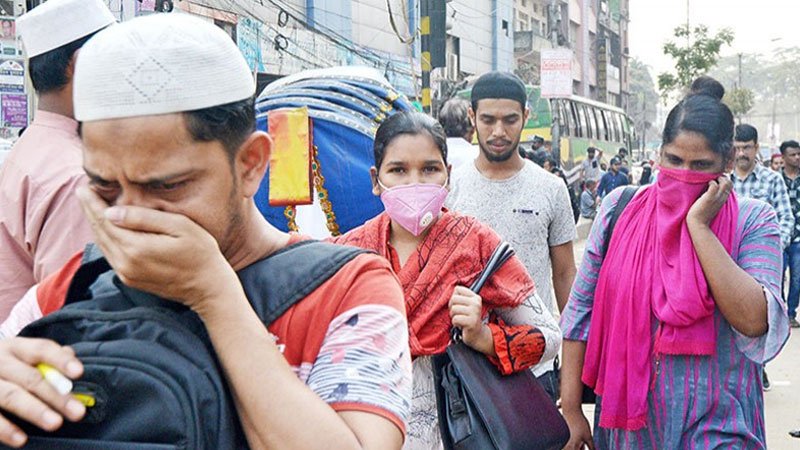
The government on Monday restricted public movement in an upazila where three new cases of COVID-19 patients, including two children below six, were identified, report agencies.
The three had no travel history abroad and got infected through family transmission.
The government is claiming that so far no community transmission was detected, but the testing of people from suspected communities are not in place.
The Institute of Epidemiology, Disease Control and Research was only testing people with travel history abroad and caught fever, coughing, sneezing and were short of breath to detect coronavirus that already spread to over 146 countries killing over 4,600 people and infecting 1.64 lakh globally.
Referring to the detection of three new cases, Institute of Epidemiology, Disease Control and Research director Meerjady Sabrina Flora said Monday that though local transmission occurred here, community transmission was not detected so far.
As a precaution, they slapped restriction on public movement in the upazila to prevent the spread of coronavirus, she said.
“We found local transmission in the first three cases when an expatriate’s wife got infected. Three new patients have also been infected via local transmission, but community transmission has not yet been detected,” she said.
“We have directed the deputy commissioner of the district to stop public gatherings, while schools and colleges have all been shut down and people were advised not to go to mosques or attend other religious gatherings,” Meerjady said.
Though the name of the upazila was not disclosed on the ground of ‘possible stigmatisation’, officials said the upazila is in the Manikganj district.
Manikganj civil surgeon Anwarul Amin Akhand said that 254 people were in home quarantine in Saturia upazila but New Age correspondent in the district reported that the people who were supposed to stay in home quarantine were wandering freely in the neighborhoods.
One of them was fined Tk 10,000 by a mobile court as he was moving freely on Monday.
Talking to journalist in a programme on Monday, Health Services director general Abul Kalam Azad said that the context of Bangladesh was not similar to that of Italy or China and complete lockdown was difficult to impose.
“In the rural settings of Bangladesh, it is not possible to impose lockdown,’ he said, adding, ‘We are advising people at least not go out of their homes and for the time being not to allow relatives to enter their homes.”
If relatives can supply food, they could do that but ensuring proper distance, he pointed out.
A COVID-19 patient who was detected with the disease after returning home from abroad mingled with neighbours before he was tested positive, a senior health official said preferring not to be named.
At least 40 people were identified after contact tracing of the patient, the official said, adding that many people who were in his contact might have been missed while the IEDCR were conducting contact tracing.
On Saturday and Sunday the government allowed around 400 people to go home after their return from Italy, the worst coronavirus affected country in Europe, after just physical screening if they have fever.
They were advised to go for home quarantine for 14 days as their symptoms might remain dormant for two weeks, but Health Services director general Abul Kalam Azad admitted on Monday that proper home quarantine was not being maintained.
Bangladesh on March 8 announced that three people were found infected with COVID-19. However, they were released from hospital after recovery.
On Saturday, two more people — one who returned from Italy and one from Germany — were identified with COVID-19, and the latest three cases were also from the family of one of the returnees.