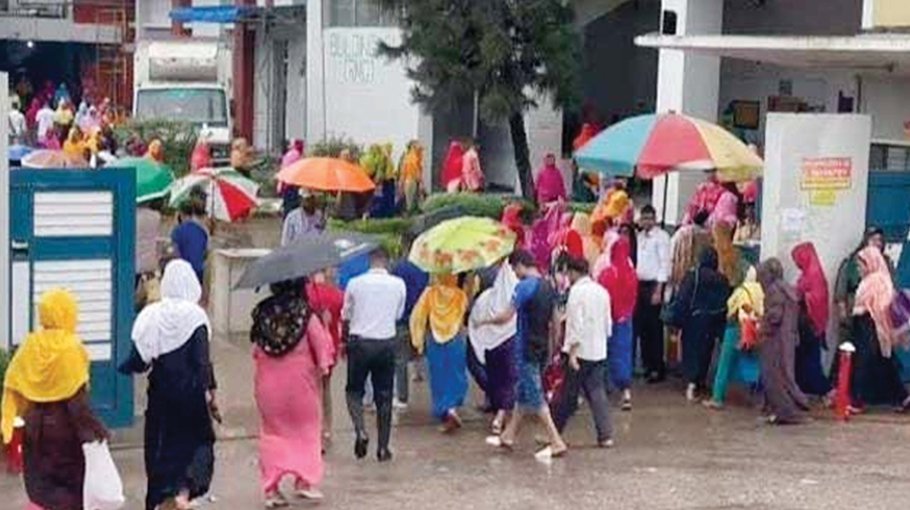
Most of the readymade garment (RMG) factories in the capital’s outskirts Ashulia and Savar and neighbouring district Gazipur resumed operations although some of the factories remained shut on Sunday.
According to the Bangladesh Garment Manufacturers and Exporters Association (BGMEA), most of the RMG units went into operation after three advisors of the interim government, law-enforcement agencies and labourer leaders assured of providing safety and security.
Besides, local leaders and factory owners also held a meeting in this regard on Saturday.
The BGMEA leaders said only 20 factories remained closed in Ashulia on Sunday while some others remained closed in Gazipur.
According to Ashulia industrial police-1, there are 1,863 factories in the area, the majority of which are garment factories.
Police Superintendent Md Sarwar Alam of industrial police-1 said, "A total of 18 factories remained closed on Sunday under Section 13(1) of the Bangladesh Labour Act 2006, and two factories have declared general holidays."
"All other factories in the industrial zone have resumed normal production activities," he added.
Although workers at four or five factories briefly stopped work to discuss demands with management, they resumed work shortly after
that. A source at the BGMEA identified some of the closed factories, including Generation Next, Sun Sweater, Mascot Fashion, and Pearl Garments, which remain shut under Section 13(1) of the Labour Act. The section 13 (1) of the labour law entails that an employer may, in the event of an illegal strike in any section or department of any establishment, close down either wholly or partly such section or establishment.
A senior official from a major garment group told The Business Standard, "We closed our factory yesterday for safety reasons, but today, all our units have resumed operations. Workers have returned voluntarily, and all activities are proceeding normally."
"Except for one or two small factories, no other factories are expected to remain closed today. Some owners may monitor the situation by keeping their factories closed, but we expect these to reopen tomorrow. The situation that prevailed over the last two weeks has improved significantly, and overall, the environment is now normal," he added.
Law enforcement agencies continue to maintain strict vigilance in the area, with joint forces patrolling the region to ensure security.
Earlier on Saturday, the owners of Readymade Garment (RMG) factory owners had threatened to keep all the factories across the country shut from Sunday for an indefinite period if the labour unrest continues further.
Factory owners came up with the hard decision even after three advisors of the Interim Government assured the RMG factory owners assured them of providing safety and security.
Bangladesh Garment Manufacturers and Exporters Association (BGMEA) announced the decision after a view exchange meeting of owners, advisers to the Interim Government and union leaders at the BGMEA office at Uttara in Dhaka.
Bangladesh Knitwear Manufacturers and Exporters Association (BKMEA) also supported the decision of the BGMEA.
At the meeting, BGMEA President Khandaker Rafiqul Islam stated that due to the continuous unrest in the RMG sector, many of the foreign buyers have shifted their huge quantity of work orders to five of our neighbours countries, including India and Pakistan.”
He said unless the situation is improve4d and security is ensured, the apparel sector might face severe catastrophe in a near future.
During the event, garment factory owners stated that if any factories were forced to close due to unrest, they would invoke section 13/1 of the labour law.
Meanwhile, at the meeting, Brig Gen Moin Khan, who has been monitoring the garment sector since the unrest erupted since August 29, told the meeting that they have identified three key reasons behind the unrest in the RMG secftor.
“unpaid wages, control over the jhut business and involvement of some outsiders are responsible for the continuous unrest in the RMG sector”, he said.
He requested the factory owners to pay the workers’ unpaid salaries as soon as possible and suggested the factory owners to solve the jhut trade through auction system.
Besides, he informed that those outsiders who are involved in the unrest have already been identified and legal steps have already been taken against many of them.