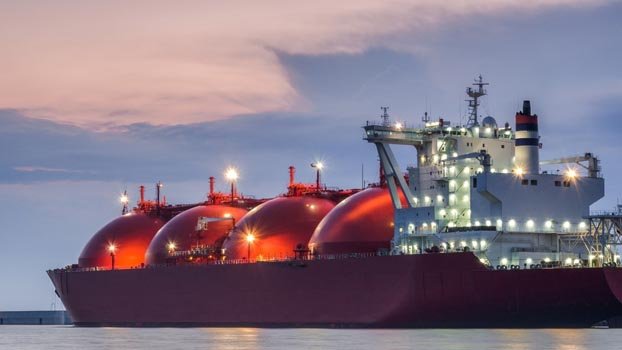
Bangladesh is set to import more LNG with quantity of around 10470600 MBTus (million British thermal units) from international open spot market by December, taking advantage of lower global fuel price amid the growing demand for local gas consumption, officials said.
Earlier, the government planned to buy 3,490,200 MMBTus (million British thermal units) of LNG from Vitol Asia Pte at $3.8321 per MMBTu with a total cost of Tk 132.93 crore, saving the country at least Tk 30 crore.
The Vitol Asia delivered its first cargo from Nigeria with 138,000 cubic metres of LNG at Cox's Bazar’s Moheshkhali LNG terminal, which already added to the national grid on September 26.
State-run Rupantarita Prakritik Gas Company Limited (RPGCL) gave the spot LNG supply tender to Vitol last month aimed at sourcing nearly a quarter of the country's LNG requirements.
However, currently, Bangladesh's LNG import price stands around $5.50 to $6.0 per MMBtu under the long-term contracts with Doha-based Qatargas and Mascot-based Oman Trading International (OTI).
State Minister for Energy and Mineral Resources Nasrul Hamid has requested Qatar's State Minister for Energy, Saad Sherida Al Kabir to reconsider the price of LNG supplied to Bangladesh in the global context.
On Monday (September 5), Nasrul Hamid made this request at an online courtesy meeting with Saad Sherida Al Kabir.
Spot market is a public market in which financial instruments or commodities are traded for immediate delivery. Spot market for the LNG was developed over the past several years with gluts of LNG output alongside the growth of the emerging markets for LNG.
Md. Rafiqul Islam, General Manager (LNG) of RPGCL told The Bangladesh Post that “Our target is to purchase three consignments with same quantity of LNG, which was already imported from Vitol Aisa from spot market this year. Of these, two consignments with same quantity will be imported next month and a single consignment will reach the country by December. To this end, international tendering process is now going on.”
“We must purchase the LNG when price drops in international markets,” he added.
Under the contracts with Qatargas and OTI, Bangladesh now has two floating storage and regasification units (FSRUs) with a total capacity of 1 billion cubic feet per day - equal to about 7.5 million tonnes a year.
However, price of LNG drops occasionally while its demand surges but the government pays as per the contracts. Buying LNG from spot market eases the burden.
Sources at Energy Division said with rising demand for gas in power generation and industrial sectors, Bangladesh sees a drop in its gas reserves.
Against the backdrop, the government decided to import LNG in 2010 to meet the energy deficit, and started importing LNG in 2018.
After that, the government allowed more gas supply to the compressed industrial factories, resulting in more applications for gas connection to the distribution companies.
More than half a dozen local and foreign companies expressed interest to set up LNG-based power plants in the country with a combined capacity to generate 13,083MW electricity under unsolicited deals, the official confirmed.
In addition, gas-enriched Brunei said it is keen to supply LNG to Bangladesh to help meet the latter’s local demand.
Besides, the government planned to construct land-based LNG terminal with a capacity of 1,000 million cubic feet a day in Moheshkhali by 2023.
The natural gas is converted into LNG by cooling down to -160°C at 1 atm pressure through refrigeration. The main component of LNG is methane, but there are mixed small number of hydrocarbons like ethane propane, butane, pentane and other hydrocarbons.
Converting Natural Gas into LNG reduces its volume by 600 times. Natural gas is converted into LNG, primarily for long distance delivery by ship instead of pipeline for economic reason. LNG is colorless, odorless, non-corrosive, nontoxic, non-explosive and its density is more or less 440 kg/m3 depending upon composition. If LNG spills on water it floats and evaporates rapidly.