Sumit Kumar
After assuming office for a third consecutive term, Indian Prime Minister Narendra Modi made his first bilateral visit to Russia to participate in the 22nd India–Russia Annual Summit on 8–9 July 2024. Modi and Russian President Vladimir Putin used the summit to review the progress in bilateral ties across areas including security, trade, commerce, energy and global issues.
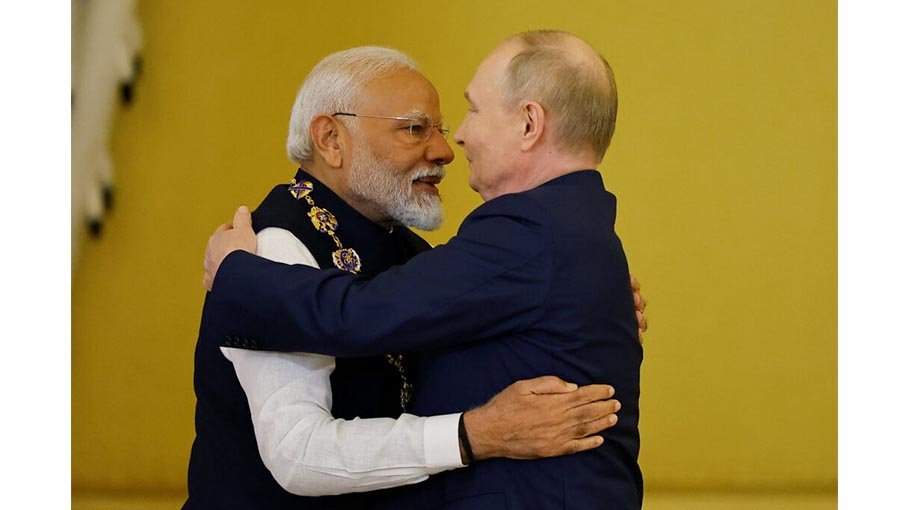
Modi described Russia as India’s ‘all-weather friend’, while Putin conferred Russia’s highest civilian honour — the ‘Order of Saint Andrew the Apostle’ — on Modi for his contribution to the development of a special and privileged strategic partnership.
The visit underlined a strong positive relationship between Modi and Putin, infusing a new momentum in bilateral ties. But the joint statement did not indicate a big leap forward in in terms of agreements. The mention of a ‘peaceful resolution of the conflict around Ukraine through dialogue and diplomacy including engagement between both parties’ in the joint statement underscored India’s efforts to take a balanced position on the Ukraine issue.
Modi’s visit to Russia was subjected to unprecedented scrutiny from the US-led Western bloc, with US Ambassador to India Eric Garcetti stating that there is no such thing as strategic autonomy in times of conflict. The change in the US administration’s tone should not be seen as a sudden development. Since the beginning of Russia’s war against Ukraine, the United States has shown its displeasure over India’s refusal to condemn Russia’s actions. New Delhi’s decision to buy cheap Russian oil has frustrated Washington’s efforts to punish Moscow economically, undermining US-led Western sanctions which have not produced the expected results. Russia continues to have an upper hand against Ukraine.
Meanwhile, the foiled assassination attempt of Gurpatwant Singh Pannun on US soil, deemed a terrorist by India, further angered Washington. In turn, US President Joe Biden declined Modi’s invitation to attend India’s Republic Day celebration. Tension between the United States and India deepened due to India having not signed a joint communique that emerged from a summit for peace in Ukraine.
If these developments were not enough to hamper bilateral ties, Washington felt betrayed by the fact that information regarding Modi’s visit to Russia was not shared with US National Security Adviser Jake Sullivan during his trip to New Delhi in June. India’s cold response towards the Biden administration’s reported request to reschedule Modi’s visit also puzzled Washington, as the visit coincided with a North Atlantic Treaty Organization (NATO) Summit.
The Biden administration must have felt uneasiness in defending its strategic ties with India in front of NATO members due to public optics between Modi and Putin. Such developments led Ambassador Garcetti to warn India not to take the United States’ friendship ‘for granted’, underlining the limits of the United States’ strategic patience.
India has made a huge investment in improving ties with the United States in the 21st century. Modi did not allow his personal differences to determine bilateral ties upon his election in 2014, even though the previous US administration had denied Modi a visa to visit the United States on account of his alleged hand in the Godhra riots of 2002.
More importantly, addressing the US Congress in 2016, Modi stated that India and the United States have overcome the hesitations of history — evident from the expansion of bilateral cooperation in shared areas of national, regional and global importance. For example, India has shown willingness to work with the United States in countering China in the South China Sea.
New Delhi also signed four major security agreements with Washington, including the Logistics Exchange Memorandum of Agreement, the Communication Compatibility and Security Agreement, the Industrial Security Agreement and the Basic Exchange and Cooperation Agreement. The two sides signed the Initiative on Critical and Emerging Technology to foster an open and secure technology ecosystem. The India–US Defense Acceleration Ecosystem was also launched to facilitate joint defence technology innovation and coproduction. India has significantly aligned its security and foreign policies with the US strategy to promote a free, open and peaceful Indo-Pacific.
This shift can be understood from India’s readiness to work with the United States in managing Asia through regional groupings — including the Quadrilateral Security Dialogue, comprised of the United States, India, Australia and Japan, and the I2U2 Group involving India, Israel, the United States and the United Arab Emirates. India today holds more bilateral meetings and military exercises with the United States than any other country. It has contracted nearly US$25 billion worth of US defence arms and equipment since 2008, with the aim of reducing its dependence on Russian arms.
But the United States should realise that India cannot easily wean itself off Russia. India’s compulsion to boost ties with Russia is due to its reliance on Russian arms, geopolitical challenges, including deepening strategic ties between Russia and China, economic challenges and capabilities deficits. Moreover, strong ties between India and Russia could also help the United States bring Moscow to the negotiating table on the Ukraine issue.
It is imperative for the United States and India to avoid having unwarranted expectations from each other. Washington should treat New Delhi as a strategic partner, rather than an informal ally. This pragmatic approach will save the strategic partnership from misunderstandings and help the two sides succeed in deepening the trajectory of bilateral cooperation.
Sumit Kumar is Officer on Special Duty at the Delhi School of Transnational Affairs, Institute of Eminence and Assistant Professor at the Department of Political Science, University of Delhi