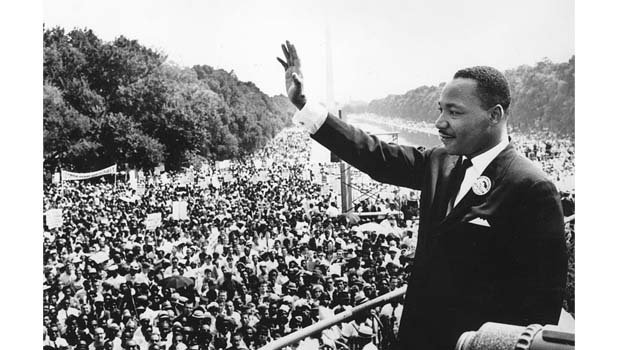
On August 28, 1963, Dr Martin Luther King Jr delivered his famous I Have a Dream speech at the March on Washington for Jobs and Freedom in Washington, D.C. The “I Have a Dream” speech, delivered by Martin Luther King, Jr before a crowd of some 250,000 people at the 1963 March on Washington, remains one of the most famous speeches in history. Weaving in references to the country’s Founding Fathers and the Bible, King used universal themes to depict the struggles of African Americans, before closing with an improvised riff on his dreams of equality. The eloquent speech was immediately recognized as a highlight of the successful protest, and has endured as one of the signature moments of the civil rights movement.
Joining Randolph and King were the fellow heads of the “Big Six” civil rights organizations: Roy Wilkins of the National Association for the Advancement of Colored People (NAACP), Whitney Young of the National Urban League (NUL), James Farmer of the Congress On Racial Equality (CORE) and John Lewis of the Student Nonviolent Coordinating Committee (SNCC).
Scheduled for August 28, the event was to consist of a mile-long march from the Washington Monument to the Lincoln Memorial, in honor of the president who had signed the Emancipation Proclamation a century earlier, and would feature a series of prominent speakers.
Its stated goals included demands for desegregated public accommodations and public schools, redress of violations of constitutional rights and an expansive federal works program to train employees.
The March on Washington produced a bigger turnout than expected, as an estimated 250,000 people arrived to participate in what was then the largest gathering for an event in the history of the nation’s capital.
Along with notable speeches by Randolph and Lewis, the audience was treated to performances by folk luminaries Bob Dylan and Joan Baez and gospel favorite Mahalia Jackson.
Toward the end, with television cameras beaming his image to a national audience, King began his speech slowly but soon showed his gift for weaving recognizable references to the Bible, the US Constitution and other universal themes into his oratory.
At times warning of the potential for revolt, King nevertheless maintained a positive, uplifting tone, imploring the audience to “go back to Mississippi, go back to Alabama, go back to South Carolina, go back to Georgia, go back to Louisiana, go back to the slums and ghettos of our northern cities, knowing that somehow this situation can and will be changed. Let us not wallow in the valley of despair.” —History