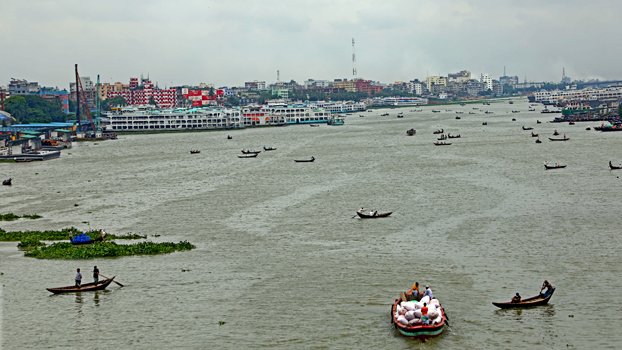
In the midst of the countrywide lockdown for the Covid-19 pandemic, another malady is in view with many districts in the northern part affected by flash floods, and others in fear of being affected due to heavy rainfall upstream.
Meanwhile, dams in at least 30 districts are already at severe risk.
According to Bangladesh Meteorological Department (BMD), moderate to heavy rains are continuing in different parts of the country as monsoon winds are quite active.
At the same time, the water levels of all the major rivers in the north and east of the country, including the Padma, Jamuna, Brahmaputra and Teesta have started rising.
Although the danger level has not yet been crossed, the water levels of major rivers in the upper Meghna Basin in the north-eastern part of the country, except Surma, are rising, which may continue for the next three days.
The Water Development Board's Flood Forecasting and Warning Center has expressed fears of flash floods in several areas.
Executive engineer Arifuzzaman Bhuiyan of the BMD said heavy rains in the upper reaches of the country could increase the water levels of major rivers in the northern Teesta, Dharla, Dudh Kumar, Brahmaputra, Upper Meghna Basin in the northeast and the hill areas in the southeast.
According to the mathematical model of the BMD and the Meteorological Department of India, in the next 72 hours, heavy rainfall may occur in the country's northern, northeastern, southeastern and adjoining Himalayan foothills of West Bengal, Sikkim, Assam, Meghalaya and Tripura in India.
As a result, the water levels of the main rivers the Teesta, Dharla, Dudh Kumar, Brahmaputra and upper Meghna Basin in the northeast and the hilly basin in the south-east may rise sharply during this time, causing flash floods in some places.
Flash floods are feared in Lalmonirhat, Nilphamari, Rangpur, Kurigram, Gaibandha, Jamalpur, Bogra, Sirajganj, Tangail, Manikganj, Pabna, Naogaon, Manikganj and Pabna in the northern part of the country. In addition, heavy rains in the northeast and southeast also may cause flash floods.
Sources in Lalmonirhat said that the low-lying and island areas in Lalmonirhat and Kurigram have been inundated due to the rise of river water level.
However, the water of all the rivers in the two districts, including the Brahmaputra, the Teesta and the Dharla, were flowing below the danger level from Friday morning.
Locals in the districts said they were facing trouble in movements as the roads were submerged in knee-deep water. Alongside, houses and croplands were also submerged.
Officials in Feni said that the flood situation has improved slightly in Fulgazi and Parshuram upazilas of the district while some seedbeds of vegetables and mangoes have gone under water. Some village roads are also damaged and fishes of some ponds washed out.
Breaking of flood protection embankments on Muhuri and Kahuwa rivers at three points is the main reason for the flood at the two upazilas, according to locals.
Seven hundred families of the upazilas are marooned with flood water due to the damage of the embankment.
Officials concerned said the low-lying areas of several upazilas in Sylhet and Sunamganj districts were submerged in a recent flash flood caused by heavy rainfall and an onrush of hill water from upstream across the border.
Local people said that the low-lying areas in Gowainghat and Companiganj upazilas in Sylhet were flooded between Thursday and Friday noon, marooning some 15,000 people of the flood-hit villages.
In Khagrachari, people living at Doyanagar, ADC Hill, Sabujbagh, Shalban, Mohammadpur, Cumillatila areas under Khagrachari district sadar and Manikchari, Dighinala, Ramgarh and Lakshmichari upazilas are at risk of landslides due to excessive rain in the past few days.
Besides, families on hills in Khagrachari, Rangamati and Bandarban districts are living with landslide risks. The water level of rivers in Khagrachari was also increasing while many rural roads have already gone under water in the district sadar.