
Shah Jalal Uddin Bhuiyan
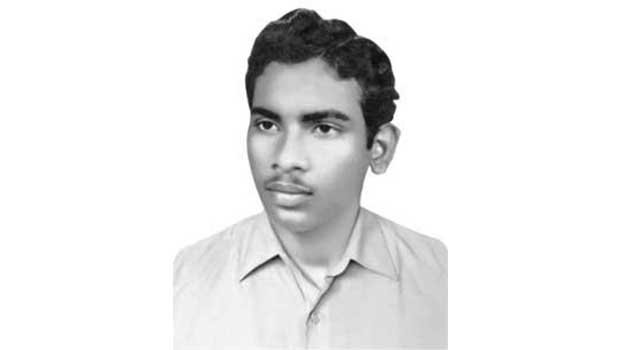
Today (September 4) is the 49th death anniversary of Bir Uttom Shahid Khwaja Nizamuddin Bhuiyan, my elder brother. He was 2nd-in-Command of Jalalpur Sub-sector of Sector-4 in the Liberation War of Bangladesh. Lt. Col. C. R. Dutta (later Major General) was the sector commander of that sector. My brother Commander (Captain) Nizam embraced martyrdom during a direct fight with the Pakistani Army and was buried in Kanaighat upazila of Sylhet district. The Bangladesh Government honoured him with the posthumous “Bir Uttom” Award.
He fought against the occupation forces in Sector-4 with approximately 400-500 freedom fighters under his command. They had inflicted heavy losses on the occupation army in that area. Commander Nizam was only 22 years old at that time.
Nizam did his BA (Hons.) and M.Com. in Management from Dhaka University and was a 3rd batch student of the IBA in Dhaka University at the time of the liberation war. He was residing in Haji Mohammed Mohsin Hall. During the non-cooperation movement against the Pakistani regime, he was still in Mohsin Hall and took an active part in the movement. On the night of March 25, 1971, he was in Mohsin Hall and witnessed all the destruction and massacre by the Pakistani army with his own eyes. During a short withdrawal of curfew, he left Mohsin Hall and decided to come back to our parents’ home in Cumilla.
It was a difficult journey for him to get back home, and sadly, he stayed for only a few days. In the meantime, he had decided that he would join the freedom fighters’ movement to liberate the country from Pakistani forces. At the beginning of April of 1971, without informing our parents, he and a few of his friends left for Agartala (in Tripura of India) to join the liberation war. After getting military training in Agartala, he and his friends were sent to Sylhet, under Sector-4 command. Within a short time, Nizam was promoted as 2nd-in-Command of Jalalpur sub-sector.
In the Jalalpur sub-sector, people knew him as Captain Nizam. He was very popular there, so much that they named ‘Nizam Nagar’ after him. His dead body was carried out by his compatriots from the battlefield (which was 5-6 kms away) with much difficulty and buried in Jalalpur Mokam Tila. After liberation, Bangladeshi government cemented his graveyard with a boundary wall and erected a placard in his name with detailed information.
I am the younger brother of Shahid Nizam and was also a freedom fighter in Sector-2 during our Liberation War. I got my military training from Tezpur Cantonment in Assam.
In August of 1971, other members of my group and I came back from Assam’s military training. We were waiting in Baicora of Sabroum (Tripura) to enter Bangladesh through the Cumilla border to fight against the occupation forces. My brother was aware that I had joined the Muktibahini (freedom fighters/liberation army) and that soon I would enter Bangladesh. In August 1971, he came to Agartala for a meeting from Silchar, India. He went with an army jeep wearing his military uniform. When he was in Agartala, he sent me a message to come to Agartala to meet him at a refugee camp a few kilometres away from town. The person-in-charge of the camp was Advocate Amir Hossain, MCA, a constituent assembly member from our Burichang and Brahmanpara upazilas.
I got the message late. When I reached Agartala and went to the camp to see him, I was told that he had already left for the sector by road. I felt utterly heartbroken for not being able to meet him. After a few weeks, when we were all in our combat areas in Cumilla, I came to know that my brother Commander Nizam had died during a direct fight with the Pakistani army, early in the morning on September 4. I will always regret not being able to see my brother one last time.
After the independence of Bangladesh, in February 1972, I went to Sylhet to see my brother’s graveyard and meet his fellow freedom fighters there. I was told that the Indian Army officer (who was staying in the Sylhet Circuit House) knew my brother very well. I went to the Circuit House and met Captain Kumar from the Rajput division. When he heard that I was the brother of Commander Nizam, he embraced me and introduced me to his family. He was very appreciative of my brother.
It is mentionable that Nizam Bhai loved music very much, and in Dhaka, he started learning the Hawaiian Guitar. His teacher was Mr. Borhan Ahmed, a renowned guitarist of that time. Whenever he used to come home to Cumilla, he would bring his guitar with him. Each day he used to practice different modern and Tagore songs for hours at a time.
I’ve heard that he used to perform in the open auditorium at various events in Dhaka. When Nizam Bhai left Dhaka at the end of March 1971, he left his guitar there. It was not possible to take a guitar because of the curfew imposed by the Pakistani army. So, he left his single-seated room locked at Mohsin Hall. In March 1972, I went to Dhaka and went to his room to collect his items - especially his favourite guitar - to keep with us as a memory. Sadly, I found that his room had been broken into, and all his possessions were missing.
Once Bangladesh achieved independence, the freedom fighters started settling back into their lives. Things got slightly back to normal, and a good number of Nizam Bhai’s compatriots came to our house in Cumilla town to meet with my parents to pay their condolences. Sometimes my father would get emotional and start crying in front of them.
By seeing this, I used to get emotional too, and tears would roll down from my eyes. My brother was loved by everyone who knew him, and we will always feel the void created by his absence in our lives. I request our friends and well-wishers to keep him in their prayers. May Allah grant him a place in the
heaven, Ameen.
The writer is the younger brother of Bir Uttom Shahid Khwaja Nizamuddin Bhuiyan. He may be reached at ‘jalal.bhuiyan@mail.com’