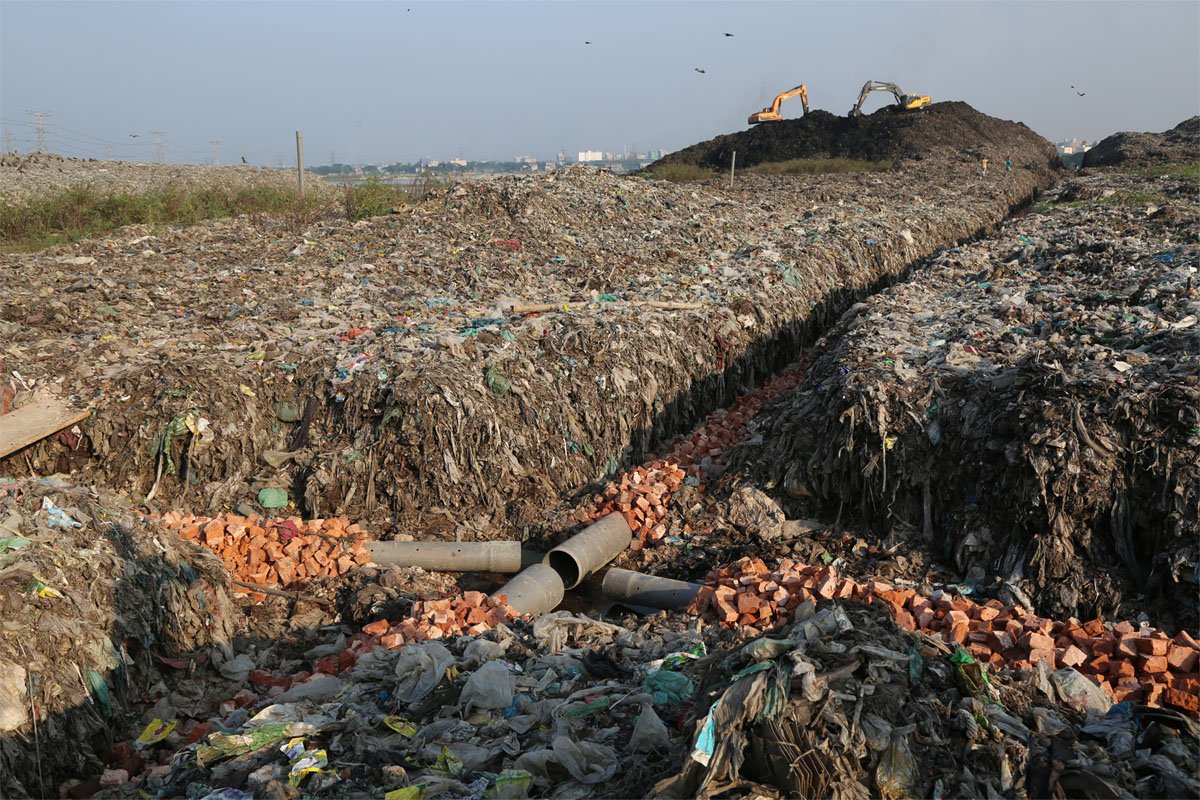
The residents of the capital city are gasping for air as the city’s waste management system reaches a breaking point. While the Aminbazar landfill has been operating far beyond its capacity for nearly a decade, the Matuail landfill on the other side of the city has become a source of toxic smoke, leaving millions vulnerable to severe health risks.
The crisis comes at a time when Dhaka’s Air Quality Index (AQI) frequently crosses the 300 mark, categorizing the air as ‘hazardous.’ While the city’s pollution is exacerbated by brick kilns, aging vehicle emissions, and massive construction dust, the open burning of waste and the release of methane from overflowing landfills are now identified as primary drivers of this environmental catastrophe.
The Aminbazar landfill, the primary dumping ground for North Dhaka, officially exhausted its capacity in 2017. Despite this, for the last nine years, the site has continued to receive an average of 700 to 800 truckloads of waste every single day.
Originally designed to hold waste up to a height of 30 feet, the landfill has now grown into a staggering 90-foot-high mountain of garbage. This over-extension is not just a logistical failure; it is a ticking time bomb. The massive accumulation is releasing high levels of methane, a potent greenhouse gas that is 25 times more effective at trapping heat than carbon dioxide, and poses a constant risk of internal combustion and landslides.
Across the city, the Matuail landfill is causing a different kind of misery. Every day, mountains of plastic and polythene are set on fire, sending thick, black, toxic smoke into nearby residential neighborhoods. The pollution is so severe that residents report being unable to open their windows for years.
During the dry season, this smoke mixes with the heavy dust from development projects and emissions from over 1,000 brick kilns surrounding the capital, creating a dense, poisonous smog that chokes the city.
Environmentalists and urban planners are warning that the city is on the verge of an ecological collapse. Professor Ahmad Kamruzzaman Majumder, a leading environmentalist, said, “The failure of the City Corporations in waste management is having a devastating impact on the health of our residents. Dhaka is frequently topping the world’s most polluted cities list. One of the main reasons behind this is the open burning of waste at Aminbazar, Matuail, and other smaller dumping sites across the city.”
Urban Planner Dr. Adil Mohammed Khan said, “The people living near these sites are enduring unspeakable suffering, and public anger is mounting. The state cannot simply allow an entire community or neighborhood to be destroyed. To save these areas, we must think of alternative solutions. Modern, scientific waste management projects must be implemented in Bangladesh without further delay.”
The Dhaka South City Corporation (DSCC) has promised to transform the way waste is handled, shifting from simple dumping to resource recovery.
DSCC Administrator Abdus Salam said, “We are working on a project to convert the total daily waste of DSCC—approximately 3,200 to 3,500 tonnes—into valuable resources. By crushing waste and setting up waste-to-energy plants, we can generate electricity and ensure the environment remains odor-free.”
While projects for ‘Waste-to-Energy’ and ‘Resource Circulation Parks’ are in the pipeline for late 2026 and 2027, the current reality remains grim. International standards dictate that an AQI score above 300 is a public health emergency. For Dhaka, this has become a daily occurrence.
Without an immediate halt to open-air burning and a transition to scientific landfilling, the ‘toxic mountains’ of Dhaka will continue to claim the health of current and future generations.