Amdadul Haque
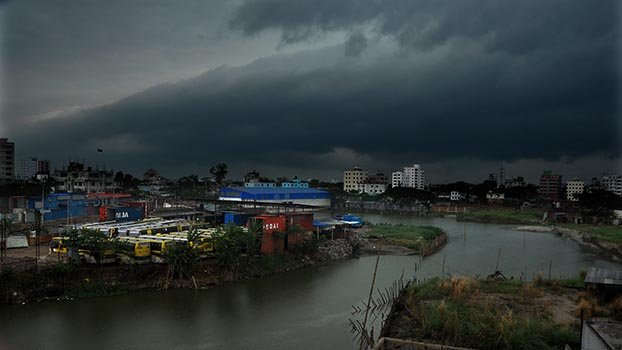
Amid the coronavirus scare, rounds of Nor’westers (kalboishakhi), thunderstorms and heavy rainfall across the country are increasing the risks of flash flooding this week. A series of storms tracking across northern part will bring unsettled weather in the coming days. With the onset of the monsoon season, kalboishakhi storms are raging in the country almost every day and increasing rainfall. Heavy rains are also rising in Assam, Meghalaya and Tripura in India.
The kalboishakhi storms are generally associated with tornadoes. Wind-speeds in Nor’westers usually range from 113km/h to 130km/h, though often their speeds exceed 162km/h. In this situation, the water level of rivers in the northern and north-eastern parts of the country has increased augmenting fear of early floods.
The Water Development Board (Paubo), citing the Meteorological Department of Bangladesh and India, said heavy rains are expected in Assam, Meghalaya, Tripura and Barak of India. The rising water levels of major rivers in the northeast will continue. People in haor areas are facing the paucity of paddy harvest workers due to coronavirus outbreak. Workers are being supplied from different places to the haor areas with the help of the government. But if the nature deteriorates, many people think that the supply may not bring any result.
Akmol Hossain, a farmer from Sunamganj, said the floods in the haor areas two years ago caused severe damage to crops. This time the type of rainfall is more. Rice harvesting workers are also not available. In this case, if the flood occurs then farmers will face huge losses.
Bangladesh has a long history of natural hazards in summer. The main hazards include tornadoes, flash floods, and cyclones. These disasters lead to the loss of lives, livelihoods, assets, and properties. They form suddenly, are of brief duration, and are extremely localized in nature. It is the pre-monsoon period when most of the abnormal rainfall or droughts occur in different parts of Bangladesh.
The wetland area inundates in advance due to heavy rains in the mountains across the border. The locals are expressing concern that this situation may happen again this year.
According to Paubo’s information, it has been seen that the water level of all the rivers in the country is increasing. However, the water level in the north and northern rivers is increasing. Among these, the water of Surma, Kushiara, Monu, Khowai, Piain and Someshwari rivers are rising very fast. The water of these rivers has come close to the danger level. The water of the Meghna, Gumti and old Surma rivers is also increasing.
Arifuzzaman Bhuiyan, flood forecasting and warning centre executive engineer of Paubo, said water level has risen in 33 of the 39 stations under their supervision. Water remains unchanged at two points.
The Meteorological Department sources said there could be moderate to heavy rains in some parts of the country by Sunday evening. However, the winds will blow over Jashore, Kushtia, Khulna, Barisal, Patuakhali, Noakhali, Comilla, Chittagong, Cox's Bazar and Sylhet at a speed of 45 to 60 kmph. Therefore, the river ports in these areas have been asked to display the number one warning signal.
Farid Hasan, a disaster risk reduction expert said, “The country has experienced an increased frequency of flash floods in the recent years. Flash floods mainly occur in haor areas of the north-eastern part of the country during the period of late April to May. These floods cause quick damage to crops and property, and are followed by relatively rapid recession. Untimely flash floods can cause people to lose their harvest.”
“Bangladesh is good at forecasting cyclones and river floods. However, there are a lot of gaps and limitations in forecasting flash floods and tornadoes. Our flood and flash flood warning information will not be at the desired level without the establishment of a strong regional data-sharing and cooperation framework,” he added.
Farid Hasan said, “A tornado forecasting system is needed, because tornadoes generate on the land and provide little time for early warning and forecasting. The Bangladesh Meteorological Department needs to play a significant role in this initiative. Reducing the disaster risks of the summer season is imperative to protecting lives, livelihoods, and properties in Bangladesh.”
Concerned authorities should act appropriately for reducing the disaster risks in line with the disaster management vision of the government of Bangladesh.
The vision is to reduce the risks faced by people, especially the poor and the disadvantaged, the effects of natural, environmental, and human-induced hazards and to have in place an efficient emergency response system capable of handling large-scale disasters. The major areas of interventions for reducing summer disaster could include the following.
According to AccuWeather’s information, thunderstorms are expected to be the strongest from the afternoon into the early night-time hours. Rounds of downpours across north-eastern parts of Bangladesh can increase the risk for flooding throughout the week.
AccuWeather warns that showers and storms will likely to continue across the country right through the weekend and can produce 150-300 mm (6-12 inches) of rain in many areas.