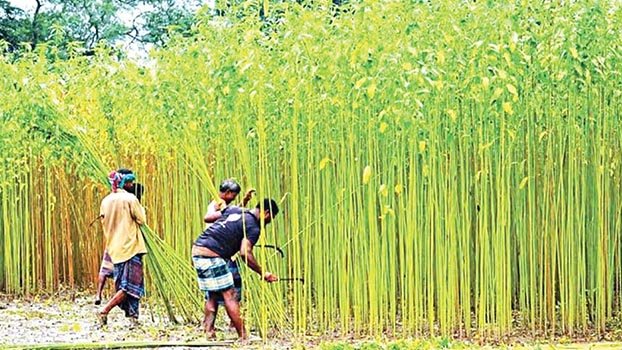
Salauddin Kazol, Jibannagar
Even in the midst of monsoon season, there is not enough rain. There is no water in the canal-beel that farmers can use for retting jute. I cultivated jute on 1.5 acres of land with a loan from an NGO. Now I can't sleep at night thinking about jute-said Habibur Rahman, a marginal farmer of Dumuria village in Jivannagar upazila of Chuadanga district. Not only Habibur Rahman but thousands of farmers like him are in trouble with jute this year. Due to lack of water, they are not able to start retting jute in the area.
Due to insufficient rainfall even in the monsoon season, no water has accumulated in the ditches, canals and ponds of the district. As a result, farmers are not able to start retting jute due to lack of water. Meanwhile, the time for cutting jute from the land is also passing. Even then, most of the farmers in Chuadanga have not started cutting jute yet. Even a handful of farmers who have started jute cutting are not getting water for jute retting. Many farmers' cut jute are lying in the field. Due to lack of desired rainfall, the low lying areas of Chuadanga are now without water. Some people arrange water with shallow machine but they have to pay extra cost. Despite knowing the guaranteed profit, the dream of the farmer is still elusive due to lack of water. This picture of water crisis is not only in Chuadanga district, but also in the neighboring Meherpur and Jhenaidah districts.
Farmers claim that due to the unusual increase in the price of jute last year, the interest in jute cultivation has increased among the local farmers this year. As a result, jute has been planted more than the target in Chuadanga district this season. Due to low cost of fertilizers, seeds and other ancillary costs and favorable weather conditions, bumper yield of golden fiber has also been achieved this year. Although bumper yields have been exceeded in jute cultivation, farmers are now in dire straits due to lack of water in the jute harvesting season. Farmers are not getting enough water to start retting the jute this season and some of them are trying to soak the jute in knee water. There is a risk of losing the quality of jute and getting lower price of jute. Although the time for cutting jute from the land has passed, the farmers are not cutting jute from the fields as there is no water to thresh it.
Farmers said that the canals and other water bodies have dried up due to lack of rainfall this year. Even if it rains 2-3 times, it is absorbing the soil and not freezing. Due to this, the farmers are not cutting jute as there is no water for retting the jute. Several villages of the four upazilas of the district have been visited on the spot, field after field is still full of jute. Pictures of some fields in Alamdanga and Damurhuda upazilas say that the time for jute harvesting has passed long ago.
According to the Chuadanga Department of Agricultural Extension, the soil and climate of Chuadanga are very suitable for jute cultivation. Every year the farmers of this district cultivate jute like any other crop. As the market price of jute was good last year, the farmers have become interested in jute cultivation this year as well.
According to the District Agriculture Extension Department, jute cultivation in 3,797 hectares of land has exceeded the target due to better jute prices last year. Last season jute was planted in 16, 730 hectares of land and this time it was planted in 20,527 hectares of land. Of this, jute has been planted in 1,050 hectares in Chuadanga Sadar Upazila, 7,245 hectares in Alamdanga Upazila, 10,535 hectares in Damurhuda Upazila and 1,697 hectares in Jivannagar Upazila. The yield of jute per hectare has been estimated at 3.5 metric tons in the current season.
Mahfuzur Rahman, a farmer from Nagdah village in Alamdanga upazila of Chuadanga district, said, “I have been cultivating jute since the time of my ancestors. I have planted jute in 5 bighas of land in the hope of good profit like last year. The green leaves of the vast field were dreaming of bringing golden fiber into the house but that left the rule. There is no rain anywhere. I can't wake up. Although the yield is good and the market price is good, I am worried that I will not be able to start retting jute in time.
Ismail Hossain, a farmer from Kantapole village in Jivannagar upazila, said Chuadanga is a relatively highland district. It goes without saying that there is no flood in this district. But there has been very little rain this year. There is no water anywhere in the field. In this situation, even though it is time to cut jute, he is not going to cut jute thinking about the difficulty of retting jute.
Azizur Rahman, a farmer from Sutia village in the same upazila, said that this time, as there is no water in the low lands, trasports had to be hired to take the jute to the Bhairab River and bring it back after the jute had rotted. This will increase the cost of production.
Sufi Rafiquzzaman, deputy director of the Chuadanga Agricultural Extension Department, said the soil in Chuadanga is very good for jute cultivation. Due to this jute cultivation is increasing every year. Jute has been planted in 20,527 hectares of land this season, which is 3,798 hectares more than last year. The cutting has started at this moment. The major problem of jute in Chuadanga is lack of water. Farmers cannot cultivate jute well due to lack of water. In order to get rid of the problem of jute threshing due to lack of water, farmers can use the ribbon retting method. We are advising the farmers to use jute in the ribbon rating system. It is possible to start retting jute at low cost. In this method the quality of jute is also good. The farmers will benefit by getting good prices.