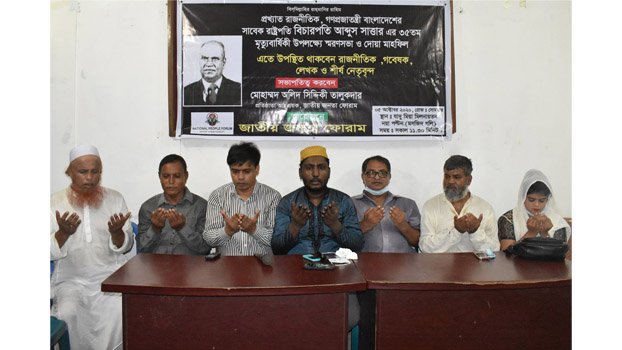
Justice Abdus Sattar, an eminent Bangladeshi jurist and politician who had served as the 9th President of the country, was remembered on Monday (October 5) marking his 35th death anniversary.
On the occasion, a memorial meeting and prayer programme was held at Jadu Mia Auditorium at Nayapaltan in the capital. Jatiya Janata Forum (National People Forum), a social platform, arranged the programme.
Secretary General of Bangladesh NAP M Golam Mostafa Bhuiyan spoke at the event as the chief while it was addressed, among others by journalist and researcher Ehsanul Haque Jasim, NDP Secretary General Manjur Hossain Isa and Organising Secretary of Bangladesh NAP Md Kamal Bhuiyan with president of Jatiya Janata Forum Md Olid Siddique Talukder in the chair.
Born on March 1 in 1906 in Birbhum in the then Bengal Presidency of British India, Justice Abdus Sattar passed away on October 5 in 1985. He served as President of Bangladesh from May 30 in 1981 to March 24 in 1982 following the assassination of Ziaur Rahman. He had previously served as Vice-President of the country.
Abdus Sattar was a judge of the High Court of East Pakistan. Later, he promoted to the Supreme Court. He was Chief Election Commissioner of undivided Pakistan during the elections of 1970. He had played a vital role in forming the Bangladesh Nationalist Party (BNP). He was also Chairperson of the party after Zia’s death. HM Ershad took over the state power from Abdus Sattar on March 24 in 1982 forcibly.
At the programme, Justice Abdus Sattar was remembered with great insights into history and political matters. Participants of the event paid rich tributes to him.
Speakers of the programme discussed from eventful life of Justice Abdus Sattar and spoke about professional integrity of the late President, who always sided with the truth. In his speech, Ehsanul Haque Jasim said that no one could deny that he had a great personality. Justice Abdus Sattar played a key role as CEC in 1970. His neutrality and professionalism were proved in that the time. In that elections, Awami League emerged as the single largest party but was prevented from forming a government.
Recalling Justice Abdus Sattar’s contributions, M Golam Mostafa Bhuiyan said that Abdus Sattar had served for Bangladesh selflessly and was an articulate voice for the country.