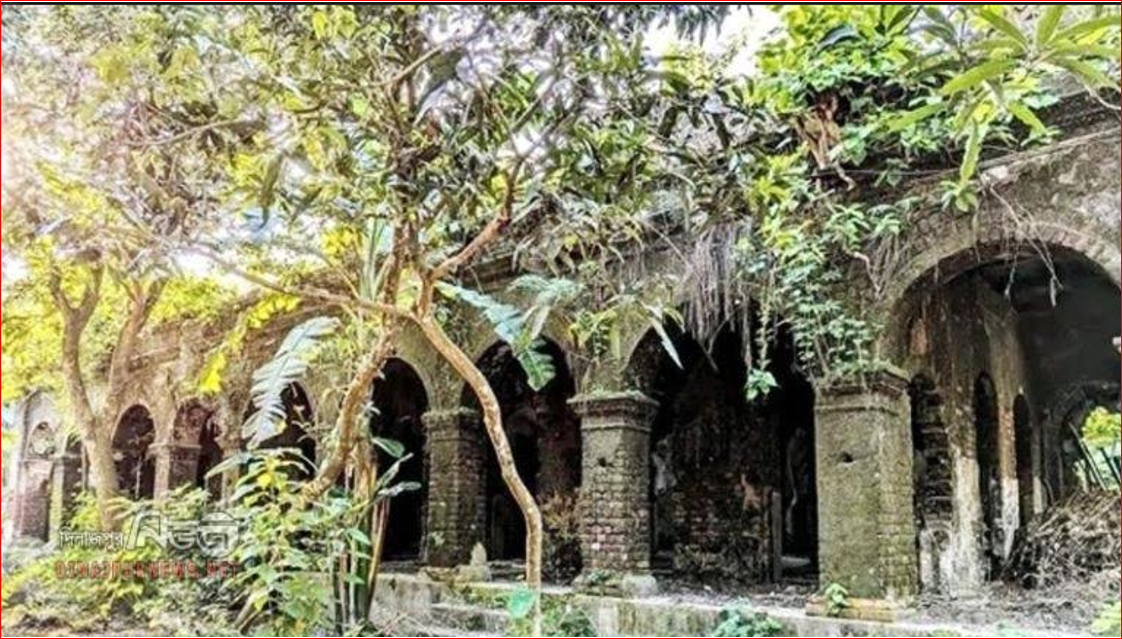
Once a magnificent seat of power, the Joyganj Zamindar house in Dinajpur's Khanasama upazila stands as a prominent yet crumbling landmark of North Bengal. Today, neglect has pushed this ancient architectural site to the verge of collapse. Visitors who journey from far and wide to witness its history are met with a disappointing sight: the once-grand palace has been reduced to a shelter for livestock and a dumping ground for rubbish.
Located in Joyganj village, Alokjhari union, on the banks of the Atrai river, about 9 kilometers northwest of Khanasama upazila headquarters, this zamindar house is locally known as Khanasama Zamindar Bari, Khanasama's Joy Shankar's Zamindar Bari, and Joyganj Zamindar Bari. The present Joyganj Bazar developed and was named after the last zamindar, Joy Shankar Roy Chowdhury.
An on-site visit reveals that the single-storied palace has been lying abandoned since the zamindari system was abolished approximately 80 to 100 years ago. The intricate designs on the walls and the bricks are gradually crumbling. One of the two main buildings has already collapsed, and the other remaining building is also on the path to ruin. Although the palace once contained living quarters, sitting rooms, storage rooms, and a temple inside, everything is now in a dilapidated state. Not only that, but it is also alleged that many valuable items from the zamindar house have been stolen.
It is known that Zamindar Joy Shankar oppressed the common people. At one point, the Raja of Dinajpur defeated Joy Shankar and ousted him from here. The zamindari system was abolished even before the partition of the country, after which the last zamindar, Joy Shankar, left for Siliguri, India, leaving behind about 100 acres of land and the zamindar house. Some parts of this vast property are now privately owned, and some parts have become government-owned Khas land.
Surprisingly, there are three ponds belonging to this historical zamindar house, which are currently used by the residents of the government-established 'Adarshagram' (Model Village) built around the zamindar house. Although the ponds and land are being used, no one pays the slightest attention to the zamindar house itself.
The exact date of establishment of this historical structure or who its founder was still remains unknown. However, it is believed to have been established during the time when the zamindari system was prevalent in India.
The local residents are now seeking government assistance to save this zamindar house of Joy Shankar Roy Chowdhury, an ancient witness to history. They demand that through proper maintenance and renovation, this heritage site be saved from extinction and developed into a tourist center.