Alok Saha, Jhalokathi
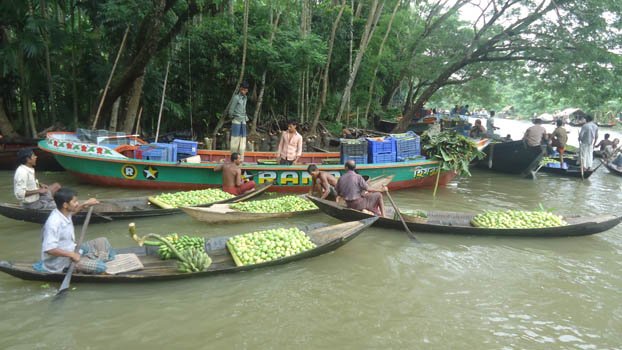
Guava is a great source of economic comfort and livelihood for thousands of people in at least 20 villages of Kirtipasha, Nabgram and Gava Ramchandrapur Unions of Jhalokati Sadar Upazila.
Although there are boat full of guavas available in the floating guava markets on the rivers and canals of these areas in the current monsoon, the guava growers are not doing well due to the adverse weather conditions and corona virus.
Guavas famous as the apple of Bengal are usually supplied from the floating market of Bhimruli in Jhalokati Sadar Upazila but due to the pandemic situation, low yields and anthrax, farmers and traders are facinghuge losses even in the pick season of guava sale.
Guava season starts from the middle of Bengali month Ashar (mid June). Local guavas are transported by boat, trawler and truck to different parts of the country every day throughout the season. From morning till evening, farmers, garden owners, retailers and wholesalers used to make noise in every guava markets including Bhimruli Floating Hat. But the picture today is completely different. Less than half of the wholesalers are seen this year due to corona and low yields.
Meanwhile, the tourism activities surrounding the floating guava market are also lifeless. As a result, the guava-centric economy has collapsed. Thousands of farmers are witnessing darkness in the face of extreme catastrophe at a loss. This information has been obtained by talking to the farmers by visiting Bhimruli, Shatadashkathi, Khajuria, Dumuria, Kapurakathi and Jagadishpur areas of Guava.
Santosh Mandal, a guava farmer from Bhimruli village, said that although Bhimruli is called a guava state, it is widespread in Banaripara in Barisal, Swarupkathi in Pirojpur and Jhalokati Sadar Upazila. Guava, the famous apple of Bengal, has been cultivated in these three upazilas for ages.
According to Agriculture Department sources, although guava is scattered elsewhere in Barisal division, it is mainly cultivated around Banaripara in Barisal district, Jhalokati Sadar in Jhalokati district and Swarupkathi in Pirojpur district.
Guava is cultivated on 937 hectares of land in Banaripara of Barisal district while, it is cultivated on 750 hectares of land in Jhalokati district. Of that, commercial guava cultivation is done on 350 hectares of land in 13 villages.
Among these areas, in Kirtipasha of Jhalokati, Bhimruli, Shatadashkathi, Khajuria, Dumuria, Kapurkathi, Jagadishpur, Mirakathi, Shakhagachir, Himanandakathi, Adakathi, Rampur, Shimuleshwar, Gavaramchandrapur and in Navgram a large part of the guavas are cultivated.
Thousands of working families in these villages have been cultivating guava for ages. There are also thousands of seasonal traders and workers in guava cultivation, trade and marketing. There used to be seasonal markets of guava in at least twenty places. During pick season, these markets sold 5/7 thousand mounds of guavas every day. However, due to low yield and corona effect, farmers are not happy this time. Moreover, Farmers are not getting the expected price for attack of anthrax virus on the guavas this time.
Jahar Mandal, General Secretary of the Guava Growers' Association, said, “The guava yield has dropped by 40 per cent this year as compared to the last few years. Diseases were also more his time and has affected the market price. Hundreds of workers have become unemployed due to low yields.”
Meanwhile, due to Corona, the upazila has become lifeless as it has banned visitors from visiting the tourist spots around the Guava markets. Due to the influx of thousands of visitors every year, local trawler drivers and hired motorcyclists made a good living every day. Lots of guests used to come to the local hotels and restaurants. The traders were also financially prosperous but, this year they have almost no income.
Fazlul Haque, Deputy Director of the Jhalokati District Agriculture Extension Department, said various natural calamities had adversely affected guava production. And due to the effect of corona, the farmers have not been able to take care of it properly and the disease has spread. Due to this the yield has been less this year.
He said, “Guava farmers will be provided free agricultural inputs (seeds, fertilizers, pesticides) and loans on easy terms so that they can recover from the losses this year. However, the government did not take any initiative to give any special incentive. If special incentives arrive, that will be given to the guava growers accordingly”.