Escalating political turmoil in Myanmar has prompted Japanese businesses and entrepreneurs to exit the ASEAN nation and explore opportunities in Bangladesh.
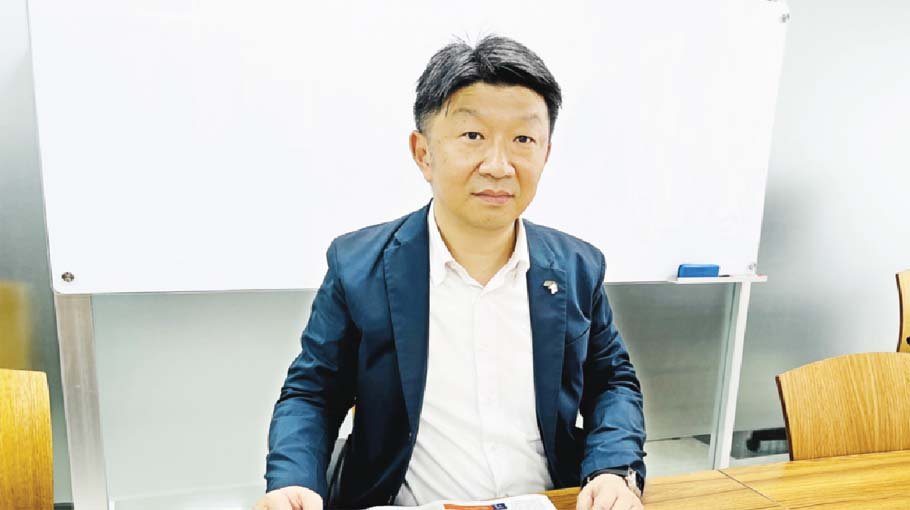
Hirokazu Ipponsugi, general manager of Tekken Corporation Dhaka Office, and a member of the Japan-Bangladesh Chamber of Commerce and Industry (JBCCI), has expressed this view while talking to a group of journalists in Dhaka, the capital of Bangladesh, recently.
Japanese business enterprises are evaluating the prospect of relocating to Bangladesh, attracted by its strategic regional position and the sustained economic growth the country has demonstrated over the years.
The Dhaka office of Tekken Corporation is actively involved in contributing to the construction of Mass Rapid Transit Line 6 (MRT Line 6) that connects Farmgate and Karwan Bazar.
The construction of Mass Rapid Transit Line 6 (MRT Line 6), which connects Uttara and Kamalapur, the third terminal of Hazrat Shahjalal International Airport, and Matarbari Port, has received funding from JICA (Japan International Cooperation Agency). The under-construction third terminal of Hazrat Shahjalal International Airport, with a capacity to handle 24 million passengers and 500,000 tonnes of cargo per year, is expected to be soft launched on October 7.
Prime Minister Sheikh Hasina is expected to inaugurate the third terminal of Hazrat Shahjalal International Airport next month.
Hirokazu Ipponsugi said that transparent tax policy and zero tolerance to corruption is mandatory in the interest of luring Japanese investment.
Over last 40/50 years back, Japanese society also experienced that sort of the social crisis as Japanese government shows zero tolerance to this social disease. He also said that Bangladesh society will gradually phases out this social disease in the coming days.
He also pointed out that Japanese investors are not habituated with the practice of corruption and Bangladesh government and society will be like that of Japan in the coming days.
To a question of recruitment of workers into Japanese labor market, he said Bangladesh people who intend to work in Japan must learn Japanese language and culture properly.
He said that Japanese construction firms never compromise with the safety and security of workers and people.
Tetsuro Kano, president of the Japanese Commerce and Industries Association (JCIAD) in Dhaka, said Bangladesh should reform the taxation system and speed the process of letter of credit (L/C) settlements.
Terming the tax system in Bangladesh as cumbersome that needs to be simplified and improved, Iwama Kiminori said letter of credit (L/C) settlements should be resolved quickly as lingering the process increases the cost of industries. Tetsuro Kano, also chief representative and general manager of Itochu Corporation for Dhaka Liaison office, said Bangladesh’s perception to the rest of world needs to be improved among rest of the world as part of luring Japanese investment.
Despite significant progress, Bangladesh ranked 168th in the Ease of Doing Business Index out of 190 countries in 2022.
Japanese foreign direct investment (FDI) in the 2021-22 fiscal year stood at 122.72 million US dollars with 3.6 per cent of total investment in Bangladesh. FDI recorded at 3429.63 million US dollars in Bangladesh in 2021-22 fiscal year, according to the data of Bangladesh Bank.
Japan ranked the ninth position in terms of FDI in Bangladesh in 2021-22. Meanwhile, Myanmar was once known as the “last frontier” of Asia and the backyard of the vast Chinese market.
Investors had piled into the country after the military eased its iron grip a decade ago, paving the way for democratic and economic reforms.
However, the firms’ fortunes suffered a dramatic turn for the worst after junta leader Min Aung Hlaing and his military seized power.
Most Japanese and Taiwanese companies with operations in Myanmar declined media interviews, choosing not to draw attention to themselves.
After all, human rights groups have been targeting those involved in development projects in Myanmar, suspecting their investments have been a source of funding for the military regime.
The businesses also refused to comment on Myanmar’s political situation, fearing backlash on their operations.
Japan began providing development assistance to Myanmar in 1954.
Many Japanese firms were actively investing in the country until 2020, but the flow of aid and investments has been disrupted since the 2021 coup.
The Japan External Trade Organisation (JETRO) said many Japanese financial institutions left the country after the coup.
For non-financial companies, one of the highest profile withdrawals was beverage giant Kirin, which sold its 51 per cent stake in a joint venture, Myanmar Brewery.
As of June 2022, there remain 413 Japanese companies registered with the Japan Chamber of Commerce and Industry in Myanmar.
Yuichi Shibata, director of systems network company Brycen Myanmar, said “Japanese firms had about 4,000 Japanese in Myanmar. At one point there were only 200 Japanese left.”
“Our customers were leaving or reducing operations. When Myanmar, Yangon was in lockdown, I proposed to my headquarters in Japan to reduce our operation. But the answer was to take advantage of the situation to hire talented engineers. I was surprised. Our staff did not have much work to do,” he said. Seeing Myanmar as the backyard of the vast Chinese market, Taiwanese businesses began entering the country in earnest after 2010.
Meanwhile, Japan Ambassador in Dhaka Iwama Kiminori said Bangladesh should improve macro-economic stability and reform the taxation system in a bid to attract Japanese investment in Bangladesh.
Iwama Kiminori was speaking as the chief guest at the 12th Networking Program of the Japan- Bangladesh Chamber of Commerce and Industry, sponsored by Arab Bangladesh Bank Limited at Lake Shore Hotel in Dhaka recently.