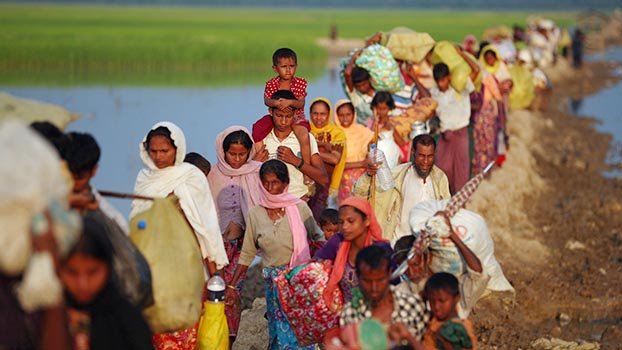
Japan strongly supports repatriation of Rohingya refugees to their homeland in Myanmar’s Rakhine state and wants to see the start of the process next year, new Ambassador in Dhaka Ito Naoki said on Thursday.
“We should see the start of the repatriation process next year. Japan will continue to help,” he said at the Diplomatic Correspondents Association, Bangladesh’s (DCAB) flagship event ‘DCAB Talk’ at the Jatiya Press Club.
The ambassador said the repatriation is very important for a lasting solution to the Rohingya crisis. DCAB President Angur Nahar Monty and General Secretary Touhidur Rahman were also present.
Bangladesh is now hosting over 1.1 million Rohingyas in Cox’s Bazar. Most of them fled the August 2017 ‘ethnic cleansing’.
Myanmar did not take back any of them despite assurances and signing of deals with the Bangladesh government.
The ambassador said Myanmar, like Bangladesh, remains a traditional friend of Japan and there is a strong interest in both the countries.
Japan is one of the largest development partners of Bangladesh. It is providing financial support under its ODA packages to many development projects, including the ongoing Uttara-Farmgate-Motijheel MRT-6 metro-rail construction project, MRT-5 and MRT-1 metro rail construction projects and Railway bridge parallel to Bangabandhu bridge on the Jamuna River.
During the pandemic, it announced the first-ever budget support loan and also helped the country to make personal protective equipment (PPE) for healthcare workers.
The Japanese Ambassador said Bangladesh will keep growing beyond COVID-19 and Bangladesh's strategic location will play a more important role in integrating the market and supply chain in Asia and beyond.
He highlighted the quality infrastructure development and said there would be a ‘complete different picture’ in Bangladesh in the next three to five years.
He also hailed the development successes of the government and said the government has done a ‘wonderful job’ in improving the investment climate.
This will have a positive impact on investments from next year, he hoped.
Bangladesh is also a key partner of Japan’s BIG-B Initiative (The Bay of Bengal Industrial Growth Belt) due to its growth potential and geographically strategic location.
Bangladesh is located with embracing the Bay of Bengal from the sea point of view, and in-between South Asia and South-East Asia from the land point.
Under the current global economic power shift toward the Indo-Pacific Ocean region, this geographical advantage will provide a unique opportunity for the country to play a node and hub role in regional as well as inter-regional matters.
This also suggests Bangladesh's renewed focus on "Look East" policy to exploit the vibrant economic growth from Pacific to Indian Ocean, according to Japan.
The BIG-B initiative is to accelerate industrial agglomeration along the Dhaka-Chittagong-Cox's Bazar belt area and beyond, encompassing developing economic infrastructure, improving investment environment and fostering connectivity.
BIG-B foresees Bangladesh transcending its national borders to become a heart of the regional economy and providing a gateway for both South Asia and South-East Asia to step into a closer inter-regional relation, so that she may reshape herself as a sparkling trading nation deeply incorporated into inter-regional and global value chains.
BIG-B is not incompatible with other existing vital frameworks for regional cooperation. Rather, it aims to supplement and reinforce them for the maximization of the benefit for Bangladesh, according to Japan’s development arm, JICA.