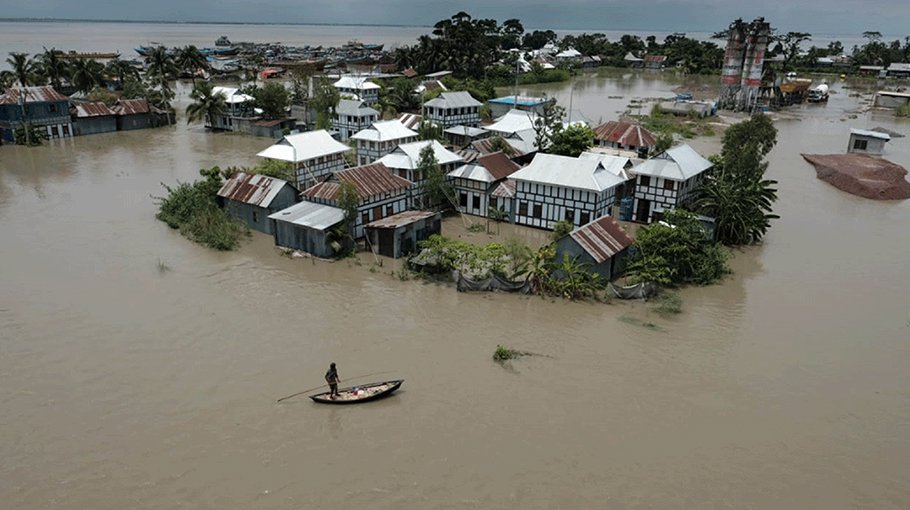
People living in the Jamuna and the Ganges basins might expect to see the rivers flow very high, close to the danger level, over the next three to five days with very strong current, said a forecast by the Flood Forecasting and Warning Centre.
The overall flood situation in the north – covering low-lying areas in the districts of Rangpur, Kurigram, Nilphamari, Gaibandha and Lalmonirhat – improved as major northern rivers receded.
Only the trans-boundary River Dudhkhumar flowed 9cm above its danger mark at 9:00am at Pateswari after its water level dropped by 32cm, reported the FFWC.
‘Overall we expect the situation to improve in the north and remain more or less the same along the Jamuna and the Ganges,’ said FFWC executive engineer Sarder Udoy Raihan.
The Jamuna was flowing less than 10cm below its danger levels in four out of its eight gauging stations, showed the FFWC data.
Rivers in the Ganges basin, however, swelled fast, recording close to half a metre of swelling at places.
Bangladesh Meteorological Department on Sunday said that it expected rather less precipitation in the coming five days.
‘Temperature might rise a little,’ said meteorologist Monwar Hossain.
On Monday, the country’s highest maximum day temperature of 34.4C was recorded in Srimangal. Dhaka, on the other hand, recorded highest maximum day temperature of 31.4C.
In Rangpur people in low-lying areas, particularly in chars, are living with limited supply of drinking water and relief. Many houses are still submerged for river banks are not equally protected with embankments and often in bad condition following decades of lack of repair.
The flood also left vast cropland and houses sunk in silt.
Many are still living in high ground where they had fled to escape flooding.
In Kurigram, rivers in the district receded but people continued to suffer.
Thousands of people remained stranded in Fulbari as rivers did not recede so much as to reveal roads and bridges from beneath. The Fulbari sadar upazila became incommunicable for several thousand people living in separate unions as the Nilkomol River continued to flow over bridges.
Bangladesh’s highest rainfall of 93mm in the 24 hours until 9:00am on Sunday was recorded in Tangail.
Flood continued to wreak havoc in areas upstream in India, with rivers in the Brahmaputra and the Ganges basins flowing above their danger marks in five places each.
There are over a dozen places in the basins where rivers are flowing very close to their danger levels.