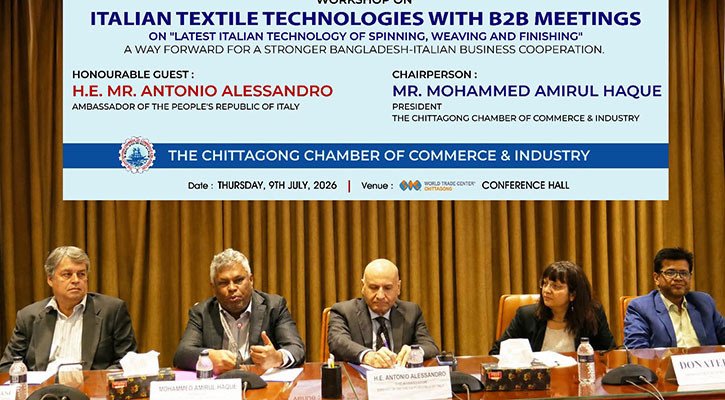
Italy has reaffirmed its commitment to strengthening technology cooperation, investment and long-term industrial partnerships with Bangladesh's textile and apparel sector, underscoring its readiness to support the industry's transition towards higher-value, technology-driven and sustainable manufacturing.
The commitment came during the 'Italian Textile Technologies with B2B Meetings' workshop organised by the Chittagong Chamber of Commerce and Industry (CCCI), where senior government officials, business leaders and textile manufacturers from both countries explored new avenues for collaboration.
Addressing the event, Italian Ambassador to Bangladesh Antonio Alessandro said bilateral trade between the two countries has now surpassed €2 billion, with Italy importing around €1.6 billion worth of Bangladeshi products annually. He noted that Italian companies have remained trusted technology partners of Bangladesh's garment industry for more than 40 years, contributing significantly to its industrial development.
Highlighting Bangladesh's remarkable transformation, Alessandro praised the country's progress in workplace safety, compliance standards and technological modernisation, saying these achievements have enhanced the global competitiveness of its apparel industry.
He, however, stressed that sustaining future growth would require greater investment in advanced machinery, product diversification, innovative textiles and environmentally sustainable production.
"Italian companies stand ready to support Bangladesh with cutting-edge technologies, engineering expertise and innovative industrial solutions to help the sector move up the global value chain," he said.
Describing Chattogram as one of Bangladesh's principal economic and industrial hubs, the ambassador said its expanding infrastructure, strategic location and growing manufacturing base present attractive opportunities for Italian investors seeking long-term partnerships in South Asia.
CCCI President Mohammad Amirul Haque said Bangladesh is entering a new phase of industrial expansion, driven by the development of economic zones, free trade zones and major infrastructure projects that are creating a more investment-friendly environment.
He invited Italian companies to expand their footprint in Bangladesh by investing in textiles, leather, steel and other manufacturing industries while promoting technology transfer, skills development and innovation.
Mirza Salman Ispahani, Honorary Consul of Italy in Bangladesh and Chairman of Ispahani Group, said demand for Italian textile machinery continues to rise as Bangladeshi manufacturers increasingly modernise their production facilities to remain competitive in global markets.
He said business-to-business (B2B) engagements such as the workshop serve as valuable platforms for exchanging technical knowledge, introducing new technologies and fostering long-term commercial partnerships between enterprises from the two countries.
The workshop brought together representatives of the Italian Trade Agency (ITA), the Association of Italian Textile Machinery Manufacturers (ACIMIT), 11 leading Italian textile machinery manufacturers and prominent entrepreneurs from Bangladesh's textile and apparel industry.
Participants held a series of B2B meetings focusing on advanced textile technologies, automation, sustainable manufacturing, machinery upgrades and future investment opportunities, reflecting the growing momentum in Bangladesh-Italy industrial cooperation.