By Daoud Kuttab
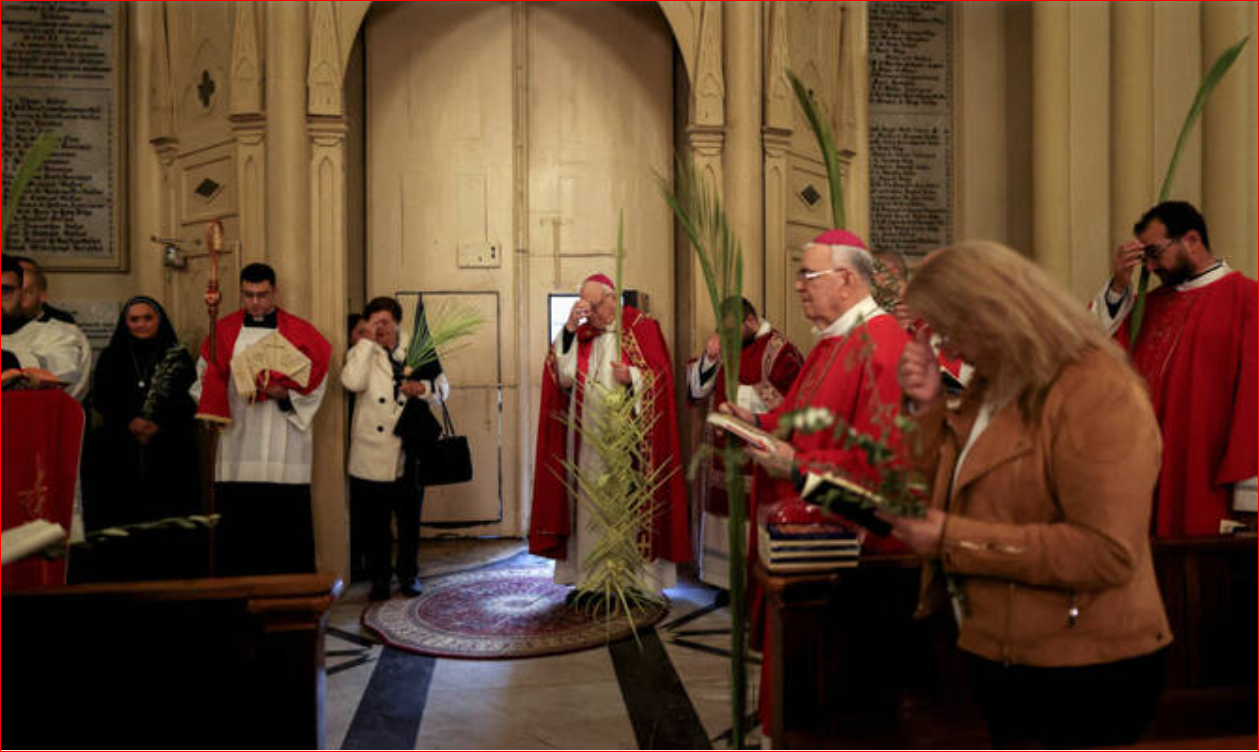
While many Western world leaders appeared to wake up to Israeli harassment of Christians following last month’s entry ban on the Latin patriarch of Jerusalem and three priests attempting to hold Palm Sunday prayers in the Church of the Holy Sepulcher, attacks on and harassment of Christian religious figures and laity in Israel and East Jerusalem have long preceded that incident.
The Israeli-registered nongovernmental organization the Rossing Center for Education and Dialogue documented 155 cases of attacks against Christians in 2025, a 40 percent increase on the previous year. The incidents, which occurred mostly in Jerusalem and saw little accountability for Israeli perpetrators, included 61 physical attacks, 52 attacks on church property, 28 cases of harassment and 14 defacements of Christian signs.
Christians, many of them Arab, form a small but enduring minority and their fate is deeply tied to the health of Israeli society, the fairness of its institutions and the prospect for a just peace in a volatile region.
In Israel proper, Christians number roughly 184,000, about 1.9 percent of the population, with nearly four out of every five identifying as Arab. In Jerusalem, the picture is even more complex — as of 2022, the city housed about 597,000 Jews and 384,700 Arabs, including about 13,000 Christian Arabs, making the Arab share a substantial portion of the city’s tapestry.
The Christian presence remains deeply interwoven with the broader Arab community, a reminder that faith and citizenship coexist within the same urban canvas.
Perhaps the most urgent human story lies in education. The Christian schools of Jerusalem, many of them historic pillars of the city’s education landscape, now face an existential policy shift. Last month, the Israeli Ministry of Education issued a directive that, from September, only teachers who reside in Jerusalem and hold Israeli teaching certificates can work in the city.
As a result, Palestinian teachers from the West Bank who had long been able to teach in Jerusalem under a “green card” arrangement will be barred from these schools. The potential impact is staggering. More than 200 teachers could lose their jobs, threatening decades of institutional memory and the continuity necessary to sustain a pastoral and academically rigorous curriculum. This is not about mere employment statistics — it is about the future of a generation’s access to education in a language and tradition that many Christians regard as a living, intergenerational bridge to their past and their aspirations for the future.
Against this backdrop, the need for accountability and humane policy becomes urgent. The patterns of harassment, the rise in crime against Arab citizens and the precarious future of Christian schooling demand a principled response from policymakers and society at large. Protecting and empowering minority rights must become a core national obligation.
This means robust enforcement against hate crimes, transparent investigations and accountability for any perpetrators who target clergy, congregations or Christian-owned institutions. It means making reporting accessible and safe, removing barriers that discourage victims from coming forward and ensuring that authorities respond with seriousness and speed.
It means safeguarding educational continuity by honoring professional standards while recognizing the legitimate contributions of teachers from diverse backgrounds who meet rigorous criteria. And it means fostering an inclusive civic space, where debates respect religious pluralism and where policies that embed faith in public life are balanced by unwavering protections for freedom of worship and expression for all communities.
The current year has added a troubling layer to this reality. The West Bank is experiencing a sharp escalation in violence linked to settlement activity and broader conflict. For Christian communities living in or near these flashpoints, the impact is not abstract. Security concerns, disruptions to daily life and the constant pressure of near-daily alerts reshape where people live, worship and educate their children.
Perhaps the most obvious case of repeated attacks is in the Palestinian Christian village of Taybeh, which is part of the greater Ramallah governorate. Jewish settlers repeatedly attack homes, destroy property and try to set fire to homes and churches. The situation became so dire that church leaders last year made an urgent call for diplomats to visit and see for themselves. In July, a large number of diplomats, including the pro-Israeli US ambassador, made a solidarity visit to Taybeh and spoke out against the lack of accountability for settlers attacking the peaceful village.
Within Israel’s Arab communities, crime — often tied to organized networks and inter-family feuds — has claimed many lives, including among Christians. The toll is a stark reminder that security, agency and dignity are precarious, even for those who hold Israeli citizenship and long for integration into the country’s broader civic life.
The Rossing Center’s research found that younger, more religious Israeli Jews are more likely to carry out attacks on Christians and churches.
Beyond the violence, the daily reality for Christians in Jerusalem and across Israel is tempered by a broader political and social shift: a consolidation of religious-nationalist themes within public life. A series of policy debates and proposals this year has embedded a particular religious-nationalist narrative deeper into state institutions and public discourse. The consequences are felt not only in how laws are written but in how communities perceive their safety and belonging within the state’s promise of equality.
The international and regional community — the voices that often shape, monitor and critique policy — has an essential role to play, as we saw in the case of the ban on the Latin patriarch.
Advocating for reforms rooted in rights, rather than measures that deepen segregation or exclude qualified educators, can help restore balance to a fragile system in which coexistence, rather than polarization, offers the best hope for a peaceful future.
The Christian communities of Israel and East Jerusalem are not relics of a bygone era but living witnesses to a shared past and a fragile, hopeful future. The cases documented in the Rossing Center’s 2025 report show a mosaic of demographic shifts, violence and threats to educational continuity. These violations of basic rights demand a sustained commitment to protection, dignity and opportunity for all residents.
• Daoud Kuttab is an award-winning Palestinian journalist and former Ferris Professor of Journalism at Princeton University. He is the author of “State of Palestine Now: Practical and Logical Arguments for the Best Way to Bring Peace to the Middle East.”
X: @daoudkuttab