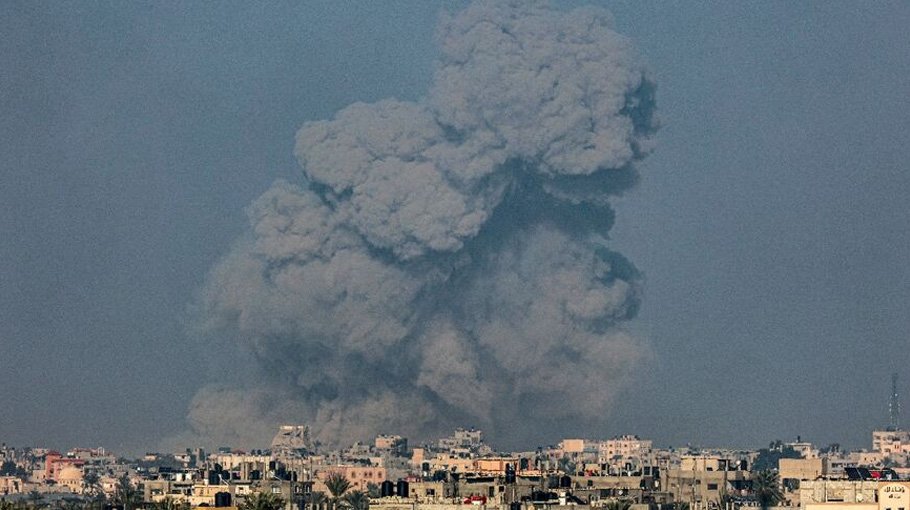
Israel ratcheted up its attacks in the south of the Gaza Strip on Saturday after Prime Minister Benjamin Netanyahu and US President Joe Biden discussed differences over a post-war future for Palestinians that have suggested a rift between the two allies.
Witnesses said the Israeli bombardment was again focused overnight on Khan Yunis, the largest city in Hamas-controlled Gaza's south, although Palestinian media also reported intense fire around Jabalia in the north early on Saturday.
Biden and Netanyahu held their first call since December 23 a day after the Israeli leader reiterated his rejection of any form of Palestinian
sovereignty, deepening divisions with Israel's key backer over the war.
While the two leaders spoke of what might come next, the reality of the war was all too clear in Khan Yunis and elsewhere in the Hamas-controlled territory.
A child with a bloodied face cried on a gurney at Al-Nasser hospital in Khan Yunis, while ambulances carrying the wounded and the dead arrived to the sound of automatic weapons in the distance.
The conflict began with unprecedented attacks by Hamas that resulted in the
deaths of about 1,140 people in Israel, mostly civilians, according to an AFP
tally based on official Israeli figures.
Israel has vowed to destroy Hamas in response and its air and ground
offensive has killed at least 24,762 Palestinians, around 70 percent of them
women, young children and adolescents, according to Gaza's Hamas-run health
ministry.
Netanyahu has said Israel expects the war to continue for months, but his
comments on Thursday rejecting a so-called two-state solution suggested a
rift with key backer the United States.
Biden said after Friday's call with Netanyahu, with whom he has had a
complicated relationship over some 40 years, it was possible the Israeli
leader might still come around.
"There are a number of types of two-state solutions. There's a number of
countries that are members of the UN that... don't have their own
militaries," Biden told reporters after an event at the White House.
"And so, I think there's ways in which this could work."
Netanyahu said on Thursday Israel "must have security control over the entire
territory west of the Jordan River", which "contradicts the idea of
(Palestinian) sovereignty".
US Secretary of State Antony Blinken had said in Davos a day earlier that
Israel could not achieve "genuine security" without a "pathway to a
Palestinian state".
- Famine, disease -
Biden has stood firmly behind Israel since the October 7 attacks by Hamas,
although he has also warned that Israel could lose support by "indiscriminate
bombing" in Gaza.
The United Nations says the war has displaced roughly 85 percent of Gaza's
people and warns better aid access is needed urgently as famine and disease
loom.
The White House also said after Friday's call that Israel will allow flour
shipments for Palestinians through its port of Ashdod.
Nearly 20,000 babies have been born "in hell" in the Gaza Strip since the
start of the Israeli offensive, the UN children's agency UNICEF said on
Friday.
A week-long communications blackout in Gaza has amplified the challenges,
although the telecommunications ministry and operator Paltel said internet
services were starting to return on Friday.
Israel's military offensive has moved further south in Gaza as the conflict
has progressed.
Metawei Nabil, recently released by Israeli forces and bearing scars on his
arms, told AFP he fled Beit Lahia in northern Gaza only "to face death" in
the devastated southern city of Rafah, near the Egyptian border.
Some residents who fled the initial stages of the war in northern Gaza have
begun returning to what remains of their homes.
In Gaza City's Rimal district, "everything is destroyed and the people are
dying of hunger", said Ibrahim Saada, who told AFP he lost his whole family.
Groups of isolated fighters still confront troops in northern Gaza despite
the Israeli military saying this month Hamas's combat structures in the north
had been dismantled.
The health ministry in Gaza said at least 90 people were killed in Israeli
"attacks" across Gaza overnight.
- Hostage video released -
Militants also seized about 250 hostages during the October 7 attacks, around
132 of whom Israel says remain in Gaza.
At least 27 hostages are believed to have been killed, according to an AFP
tally based on Israeli figures.
A Hamas-allied militant group in Gaza released a video on Friday showing an
Israeli hostage who it said was killed in an Israeli strike.
The video was undated and could not be independently verified.
- Huthi missiles -
The Gaza war has spilled into the surrounding region, with Iran-aligned
groups carrying out attacks and regular exchanges of cross-border fire
between Israeli forces and Lebanon's Hezbollah movement.
Violence has also surged in the occupied West Bank, where Israeli troops and
settlers have killed more than 360 people since October 7, according to the
Palestinian health ministry.
Palestinian news agency Wafa reported Israeli fire in Al-Mazraa al-Sharqiya,
east of Ramallah, killed a 17-year-old Palestinian.
Attacks by Yemeni Huthi rebels on Red Sea shipping in support of Palestinians
in Gaza have prompted retaliatory strikes by US and UK forces, adding to
fears of a wider escalation.