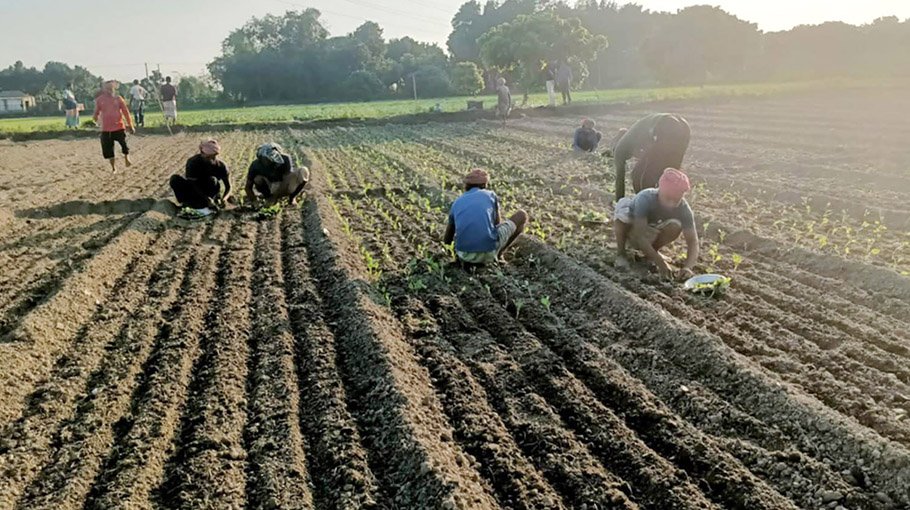
Farmers in many areas in the county, including Ishwardi of Pabna, are now busy growing early winter vegetables despite a late start.
Winter vegetable cultivation and the Rabi season typically begin in October. However, due to continuous rain throughout September, fields remained muddy, preventing farmers from starting vegetable cultivation in October.
As a result, farmers in Ishwardi upazila of Pabna district began planting winter vegetables one month later than usual. With favorable weather now, farmers are busy in the fields from dawn.
From March to July this year, Ishwardi experienced intense heat without any rainfall. However, September brought continuous rain, which left the fields waterlogged and soil muddy, preventing farmers from starting cultivation. According to the Meteorological Department, rainfall in September was recorded at 492.5 millimeters.
Local farmers said that continuous rain throughout September caused water to accumulate in many fields, with excessive rainwater damaging numerous vegetable seedbeds. The soaked and muddy soil became unsuitable for planting vegetable saplings, delaying this year’s winter vegetable cultivation. Besides, the heavy rain harmed early vegetable crops, causing further losses for farmers.
According to the Upazila Agriculture Officer, this year, a total of 6,082 hectares of land was allocated for vegetable cultivation in the rural and municipal areas. The production target is set at 1,58,314 metric tons. The highest vegetable cultivation usually takes place in the Solimpur, Muladuli, Laxmikundo, Sahapur, and Pakshi unions.
However, local agricultural officials expressed concerns about whether the target will be met due to the delayed start of planting this year.
It is known that Ishwardi Upazila is one of the prominent areas for vegetable and fruit cultivation. Over 15 farmers from this area got national awards for their success in agriculture. The area is widely known for the cultivation of beans, radishes, carrots, eggplants, cauliflower, cabbage, broccoli, tomatoes, gourd, pumpkins, onions, and more.
Additionally, Ishwardi is famous for producing some of the country's best lychees, guavas, plums, and jackfruits.
During a field visit to several villages in the upazila, it was seen that farmers were busy planting vegetable saplings.
During this visit, Nasir Uddin, a farmer from Char Mirkamari village in the Solimpur union, said that he owned 3 bighas of land and rented 25 bighas, and his total cultivated area is 28 bighas for winter vegetable farming. He has planted turnips on 8 bighas, carrots on 7 bighas, turmeric on 4 bighas, radishes on 3 bighas, and onions on 3 bighas, while the remaining 3 bighas are used for other vegetables.
Planting early vegetables in September caused significant damage due to the excessive rain, with many crops being ruined in the fields. However, with the favorable weather now, we are optimistic that, if the conditions continue, we will have a good harvest and be able to make a profit, he added.
Ishwardi Upazila Agricultural Officer, Mita Sarkar said the upazila is one of the leading areas in the country for vegetable cultivation. Farmers give special attention to winter vegetables. This year, farmers are working tirelessly to cultivate winter vegetables across 6,082 hectares of land in the upazila and municipal areas. The production target has been set at 1,58,314 metric tons.
Due to the delayed start of vegetable cultivation this year, there is a possibility that the production target may not be met. Nonetheless, we remain optimistic because the farmers here are determined not to leave any land unused. If the weather continues to be favorable, meeting the target should not be a problem, she added.