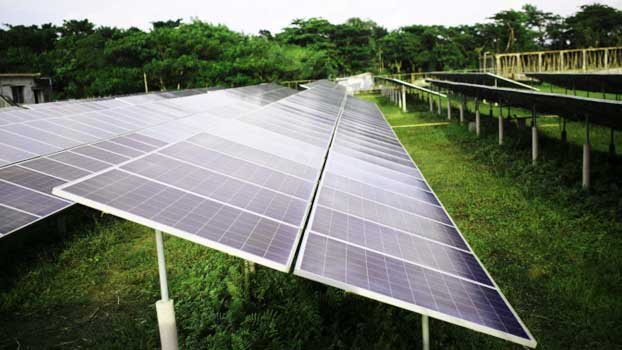
Indian company Hero Future Energies (HFE) expressed its interest to build a 50MW solar power plant at Terokhada upazila of Khulna at a cost of $50 million.
The Delhi-based company submitted a proposal to the Bangladesh Power Development Board (BPDB) several months back, which is now under process, people with direct knowledge of the matter told Bangladesh Post.
The Delhi-based company, a subsidiary of Hero Motors Company, proposed a tariff of $0.1025/unit, which would involve the lowest solar power tariff offered to a non-publicly-procured grid scale solar project.
HFE originally envisaged a 100 MW project at the site but had to halve the scale because of the capacity of power evacuation infrastructure available.
Specialising in wind and solar power generation, HFE states in its website states that the company wants to expand its solar and wind project portfolio to 5GW by 2022.
A top official at BPDB told Bangladesh Post that the leading Indian Independent Power Producer (IPP) want to involve its mother company with the project.
“The Ministry of Power, Energy and Mineral Resources has sought the BPDB's opinion. We are working on it and will reply to the ministry shortly,’ the official said.
Sources said once then ministry will process further once it gets a positive response from the BPDB. The project, if agreed by cabinet committee on government purchases, would also mark the first Indian investment in utility scale solar in its northeastern region.
The lowest solar tariff awarded in Bangladesh to date was the $0.065/kWh agreed for the $13.25 million, government-owned, 7.4 MW facility built in Rangamati district by Chinese company ZTE Corporation, which came online a year ago. That plant was financed by the Asian Development Bank.
In addition, the government has taken various initiatives to enhance generation of renewable energy as part of its efforts to ensure energy security keeping carbon dioxide emissions at a low level. It has set a target to increase renewable energy generation to 2,000MW, 10 percent of the total generation, by 2021.
“Bangladesh has attained outstanding success in the field of green energy as it secured the second position in producing renewable energy (RE), especially off-grid solar solutions,” according to REN21's Renewables 2020 Global Status Report (GSR).
On June 2, a report by the UN watchdog International Renewable Energy Agency (IRENA) said the electricity generation cost from renewable energy sources such as solar and wind is declining by 13 percent each year. In the last 10 years, the generation cost of solar power has decreased by 82 percent and wind power by 39 percent.
According to the IRENA report, currently the generation cost per unit of solar power plants is on an average 6.8 cent (Tk 5.78). The generation cost of wind power is 5.3 cents (Tk 4.50) on land and 11.5 cents (Tk 9.77) at sea. However, the generation cost of newly solar power plants will be 3.9 cents (Tk 3.31), which is 43 percent less than the cost in 2019.
‘The generation cost per unit from fuels like oil and coal is 6.6 cents (taka 5.61),’ the report says.
However, the cost is higher in Bangladesh due to the import of coal and oil. The average power generation cost per unit is Tk 8.5 to Tk 9.
According to the report, not only generation, but also the construction cost of renewable energy-based power plants has come down. In 2010, per unit generation cost of a solar power plant was $4,695, which was only $995 in 2019. The land-based wind power plant construction cost in 2010 was $1,849, which is now at $1473.