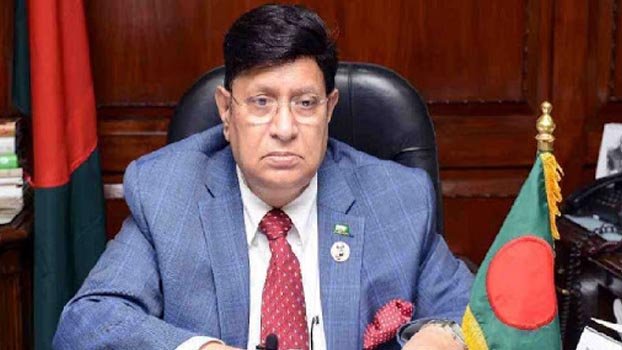
Foreign Minister Dr AK Abdul Momen has said that India is the “historic time-trusted” friend of Bangladesh and that the two neighbours are tied “with civilisational, cultural, social and economic bonds”.
“The two nations share a common history, linguistic and cultural heritage. This unity is reflected in multi-dimensional and expanding relations,” he said while speaking at the webinar on ‘India’s Contribution to the Liberation War of Bangladesh’, the foreign ministry said on Monday.
The webinar was organised to celebrate the historic December 6 when in 1971 India recognized Bangladesh as an Independent country amidst war. Bangladesh won the war against Pakistan on December 16.
“We express our profound tribute to the organizers of the Great Liberation War and the people from all walks of life whose supreme sacrifice and unmatched valour earned us the long-cherished independence. We also register gratitude to our friends worldwide, foremost among them India, then USSR, UK and others whose support in those difficult days emboldened us,” the foreign minister said.
“The story of Bangladesh’s birth is that of pride and pain, of valor and sacrifice, of blood and tears. No people have sacrificed so much for freedom, for dignity.
“Our War of Liberation was the climax of an epic struggle of our people for freedom. India played a vital role in the Liberation war of Bangladesh. Not only political, but also military as well as people-to-people support was given by India,” he said.
“Besides, India provided support and refuge to the people of Bangladesh. The contribution of Indian government and the people of India is an integral part of the history of the Liberation War of Bangladesh. The personal, political and diplomatic role of the former Indian Prime Minister Indira Gandhi in our Liberation War is inseparable from the Bengalee Nation’s history.”
“As Pakistan's atrocities increased, Indira Gandhi decided to step in. Despite constrained with her limited resources, India shared whatever it had with their Bangladeshi brothers and sisters, and opened its door for the refugees whose numbers rose to ten million by November 1971 and I was one of those millions,” Dr Momen said.
“India took the responsibility of these unfortunate men, women and children for nine months and it also provided training, arms and ammunition to the freedom fighters.
“Prime Minister Indira Gandhi conducted herself with remarkable patience, maturity, and restraint. In the lead-up to the war, Indira Gandhi waged a multi-pronged strategy.
“For over six months, between March and October 1971, Indira Gandhi wrote letters to world leaders, informing them of the situation on the Indian border.
“She visited Moscow—and undertook a tour to Germany, France, Britain, Belgium and the USA to garner international public opinion in favour of independent Bangladesh.
“She was successful in getting both the United Kingdom and France to stand by the cause of Bangladesh and block pro-Pakistan moves at the UN Security Council.
“She tried to arouse the world’s conscience over the merciless butchering of the Bengalee Unarmed civilian population.
“New Delhi also helped us establish the provisional government of Bangladesh. The Indian government provided all assistance in raising, organizing, training and equipping Mukti Bahini. During our war of liberation many Indian soldiers and Jawans died.”
He said the blood of these Indian soldiers is mixed with the soil of Independent Bangladesh.
“Never shall we forget them. In November 1971 Indian govt. formed Joint Command of Indian and Bangladeshi forces and on 6th December, it extended its recognition to independent Bangladesh and they upheld a new era. I can never explain the joy and emotion that touched our heart and soul on that day.”
Dr Momen said: “We are happy that Prime Minister Narendra Modi will participate in the celebration of the 50th Independence Day of Bangladesh on 26 March 2021. Both the Prime Ministers of India and Bangladesh will meet for a virtual summit coinciding with the celebrations of our victory in December.”
“The 50th anniversary of independence is expected to witness a large number of bilateral activities between India and Bangladesh. The saga of our Great Liberation War was, by its enormity, a triumph for the ‘free world’ and democracy. The creation of Bangladesh was also a triumph of the innate democratic ideals and resolve of the people who delivered tears, toils and blood in pursuit of a homeland in which they could speak their own language, nurture their culture, and live in dignity—free from the spectre of extremism and exploitation.”
“We carried through the battlefield an eternal dream of universal liberty, pluralism, religious harmony, human rights and a democratic and egalitarian society, not only for our own selves but also for the rest of the world. Bengalee is a martial nation of heroes and victors. We have earned independence of the country in exchange for the millions of martyrs. Such a nation can never stay behind in the world.”