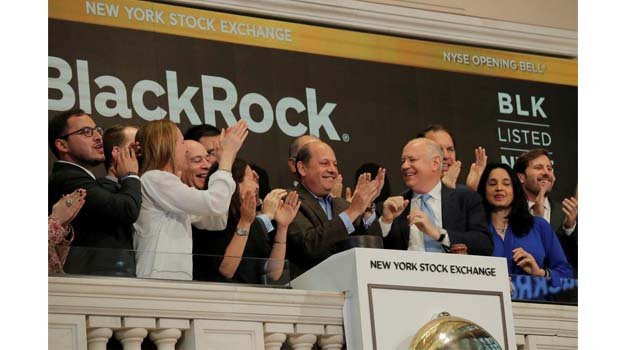
Index funds now control half tmsnrt.rs/2Mhmc6L the US stock mutual fund market, giving the biggest funds enormous power to influence decisions and demand better returns at the companies in which they invest trillions of dollars, report agencies.
But the leading US index fund firms, BlackRock Inc, Vanguard Group and State Street Corp, rarely use that clout. Instead, they overwhelmingly support the decisions and pay packages of executives at the companies in their portfolios, including the worst performers, according to a Reuters analysis of their shareholder-voting records.
The three fund firms, for instance, supported doubling the pay of the chief executive at California utility PG&E Corp after its stock plummeted over potential liability from maintenance problems linked to California wildfires. The funds supported big pay packages for executives at beauty products company Coty Inc - including nearly $500,000 for their children’s tuition - as the company struggled to digest its acquisition of Procter & Gamble’s beauty business. And all three cast pivotal votes against the proposed reform of splitting the CEO and chairman roles at General Electric Co after a decade of poor performance.
Such votes reflect a larger trend of deference to management, according to an analysis of proxy voting at 300 of the worst-performing companies in the Russell 3000 index, as measured by three-year returns through the end of 2018. The analysis was conducted for Reuters by shareholder-voting data firm Proxy Insight.
The study looked at the 300 worst performers who held proxy votes in 2018. It found that BlackRock voted with management 93% of the time, followed by Vanguard at 91% and State Street at 84% during the proxy year ended June 30, 2018. The analysis showed that the three index fund firms supported management at the worst-performing Russell 3000 firms only slightly less often than they did for all companies in the index, regardless of performance.
‘If we think that informed and engaged shareholders play an important role in disciplining company management, the rise of index investing is a problem,’ said Dorothy Lund, a law professor at USC’s Gould School of Law and an author of several published corporate-governance studies.
Actively managed funds also routinely support management in proxy ballots. But their voting records are not directly comparable to those of index funds because active managers routinely signal their displeasure with company management by simply dumping a stock or never buying it. Index funds, by contrast, are prevented from active trading by their own rules because they aim to match, rather than beat, the market. They are required to own all the companies in the index they track, such as the Russell 3000 or the S&P 500 - high-flyers and dogs alike.
That leaves proxy voting as the primary leverage for index funds firms to hold companies accountable for practices that undermine shareholders’ interests, such as exorbitant executive pay. But the index providers face powerful disincentives in confronting management at the companies in their portfolios, industry experts said.
With no mission to outperform market indices, the funds lack a financial incentive to ensure that portfolio companies are well-run, Lund said. Their business models also rely heavily on recruiting everyday investors away from actively managed mutual funds with the promise of lower fees. And large companies - like the ones in major stock indexes - are key to acquiring new customers for the big fund firms: BlackRock, Vanguard and rival firms count on corporations to offer their funds to employees in retirement plans, which often limit the options workers can select.