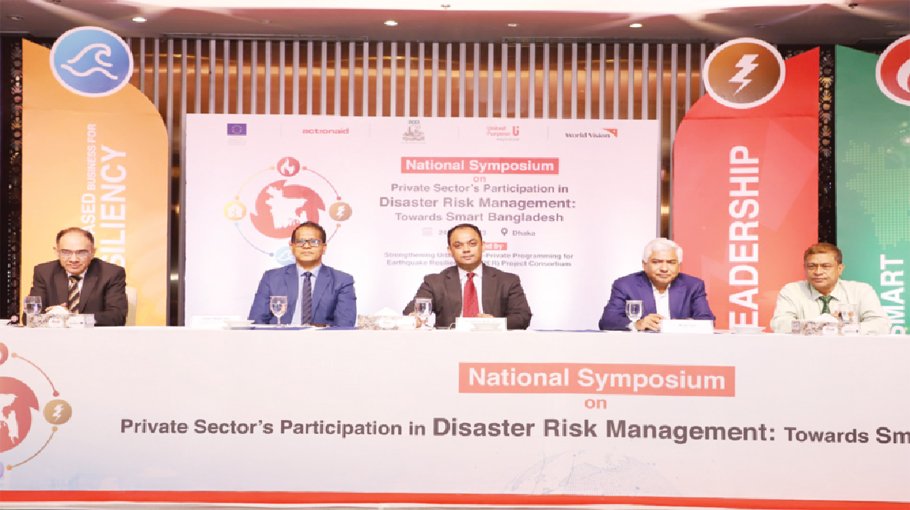
A symposium on “Private sector’s participation in disaster risk management: towards Smart Bangladesh” jointly organized by the Dhaka Chamber of Commerce and Industry (DCCI) and the Strengthening Urban Public-Private Programming for Earthquake Resilience (SUPER) Project Consortium held at the Radisson Hotel in the capital on Saturday. The symposium emphasized the crucial role of technology, finance, and public-private partnerships (PPP) in creating a disaster-resilient and smart Bangladesh.
Barrister Md. Sameer Sattar, President of DCCI, highlighted the need for a strong public and private sector collaboration to effectively manage disaster risks and safeguard industries. Acknowledging the broad socioeconomic implications of disasters, Sattar emphasized that the business sector, contributing 36 percent to Bangladesh’s GDP, must be protected from such risks. He outlined various financial tools and incentives, including awareness building, compliance measures, a central disaster management fund, easy access to low-cost funds, and tax advantages, as potential solutions to enhance the financial resilience of the private sector.
Barrister Sheikh Fazle Noor Taposh, Mayor of Dhaka South City Corporation, stressed the importance of implementing disaster risk management strategies through public-private partnerships to ensure sustainability. He suggested making private sector emergency operation centers (PEOC) more effective and highlighted the allocation of an increased budget for training and fire drills in the Dhaka South City Corporation. Taposh emphasized the importance of collaborative efforts for building a smart Bangladesh.
Md. Atiqul Islam, Mayor of Dhaka North City Corporation, called for mandatory fire drills in offices, homes, and markets to raise awareness. He also highlighted the need for accurate underground utility service mapping and proper Geographic Information System (GIS) mapping to mitigate risks during infrastructure-related work, particularly on roads. Islam suggested that canals could serve as an additional water source during fire incidents if reclaimed, and urged owners of commercial towers to conduct regular fire drills and ensure sufficient space within the buildings. He emphasized that disaster risk management cannot be solely implemented by the government.
Lokman Hossain Miah, Executive Chairman of the Bangladesh Investment Development Authority (BIDA), emphasized the importance of adhering to building codes and developing a masterplan for a disaster-resilient country. Referring to Dhaka as the most vulnerable city in Bangladesh, he stressed the need for a nationwide masterplan. Miah highlighted the significance of technology as a tool to combat disasters and emphasized the importance of establishing easy financing mechanisms to address disaster-related challenges.
Md. Jashim Uddin, President of the Federation of Bangladesh Chambers of Commerce and Industry (FBCCI), highlighted the competitive nature of businesses in the international market and emphasized the need to protect industries and workers from potential disasters. He called for the identification and preparation of high-risk factories and industries, as well as the strengthening of fire services and civil defense capabilities. Uddin emphasized the crucial role of compliance in industries, stressing the need for collaboration between the private and public sectors. Mizanur Rahman, Director General of the Department of Disaster Management, emphasized the importance of inclusive disaster risk management, given Bangladesh's vulnerability to disasters. He highlighted the role of technology in addressing disaster risks and encouraged young people to engage in the disaster risk management system. As part of the event, a website for the private sector emergency operation center was launched.
The symposium also featured two parallel sessions titled ‘disaster risk management financing strategy’ and ‘technology in DRM towards smart Bangladesh’, where leaders from various sectors shared their perspectives.
In conclusion, the symposium highlighted the significance of technology, finance, and public-private partnerships in building a disaster-resilient and smart Bangladesh. The collective efforts of the public and private sectors, supported by technological advancements and adequate financing mechanisms, are crucial for effectively managing disaster risks and ensuring the sustainability of industries and businesses in the country.