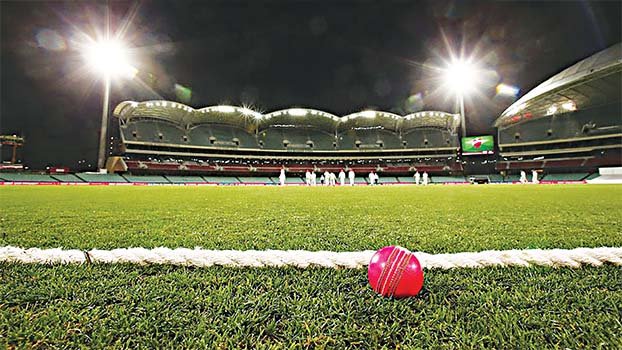
Bangladesh and India play their first day-night Test match with the pink ball at the Eden Gardens in Kolkata from November 222. How will the battle look like? That question is doing the round in cricket circles.
The question being asked is: which side will benefit more? The answer, according to cricket experts, relates to three key aspects: (1) the timing of the middle session of the Test when the day light gives to dusk (2) the grass on the pitch and the dew in late November in Kolkata and (3) how much the pink ball throws up reverse swing, an area of strength of Indian medium pacers.
Fresh from a crushing victory against South Africa recently, India will look to continue their good run on home turf. On the other hand, turmoil-hit Bangladesh side are without world no 1 all-rounder Shakib Al Hasan, banned by the ICC for not reporting approaches by an Indian bookie, and seasoned Tamim Iqbal who opted out of India tour citing his wife expecting the couple’s second child. The Board of Control for Cricket in India under the new President Sourav Ganguly, a keen enthusiast of day-night Test, has ordered the manufacture of 72 pink balls that are expected to be delivered in the middle of next week, which will give enough time for Indians to practice with it. Of particular interest would be how Indian pacers like Mohd Sami, Ishant Sharma and Umesh Yadav adjust to the pink ball. Experts say a major concern over the pink ball has so far been its retaining the shape and colour and generating the reverse swing of the traditional red ball.
Paras Anand, Managing Director of the Indian company manufacturing the pink ball, said he has already taken the views of the Indian players and the pink ball would have the same black seam as the red ball.
Reverse swing has played a key part in Indian pacers’ good show in recent years when India have depended more on its pace attack.
The pitch in Kolkata is likely to have a fair sprinkling of grass and the dew factor would pose a challenge in the evening hours, according to the Eden Gardens curator Sujan Mukherjee.
It may be recalled that pacers had held the sway, especially after the dusk, in the Test history’s first-ever day-night game at the Adelaide Oval in Australia in November, 2015.
Experts say the pink ball become flat faster than the red one and spinners do not get much assistance after dusk when the pitch gets more lively and batsmen find it a tad tougher to sight the ball’s colour.
All the eleven day-night Tests played so far with the pink ball have yielded results and it remains to be seen if the Eden Gardens Test between Bangladesh and India is going to be in sync with that trend.