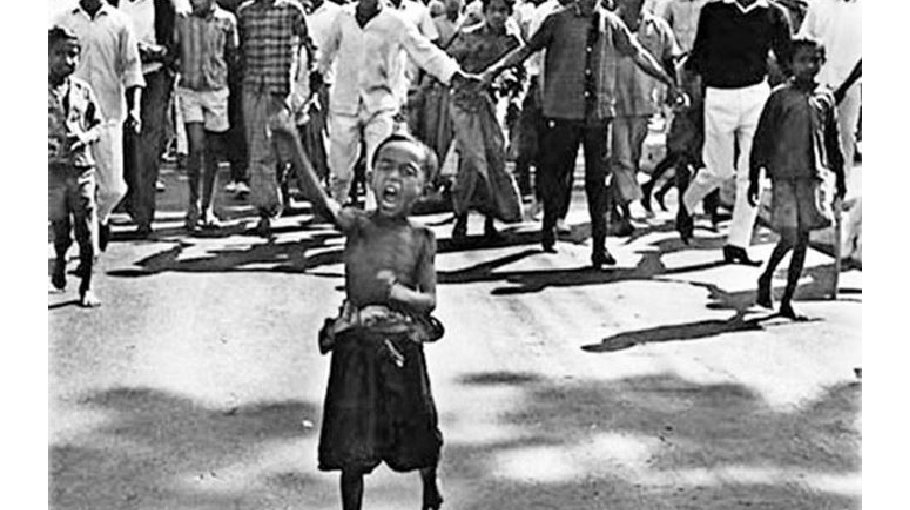
The historic 'Mass Upsurge Day', commemorating the 1969's movement for autonomy from the then East Pakistan that eventually led to the Liberation War and the emergence of Bangladesh in 1971, will be observed today in a befitting manner.
On January 24, 1969 Matiur Rahman Mallik, a standard IX student of the Nabakumar Institution, and Rustam Ali, a rickshaw-puller, were killed in a police firing on demonstrators in Dhaka as Pakistani rulers desperately tried to suppress the popular uprising.
The killings spread intense protests across the country that eventually saw the fall of the autocrat Ayub regime.
It is said that the day teaches Bangladeshis the values of democracy and protest against oppression. Different political and socio-cultural organisations have taken separate
programmes in observance of the day. Bangladesh Awami League will place
wreaths at Shaheed Matiur Rahman Smiriti Saudha at Nabakumar Institute in
Bakshibazar at 10am tomorrow. AL General Secretary and Road Transport and
Bridges minister Obaidul Quader has urged party leaders-workers to join the
programme maintaining health protocol.
On the eve of the day, President M Abdul Hamid and Prime Minister Sheikh
Hasina today issued separate messages, expressing profound respect for those
who had embraced martyrdom in the historic movement in 1969.
"The January 24 of 1969 is a historic day in the progress of independence and
democracy of Bangladesh," the President said in his message.
Paying profound homage to the memory of those who were martyred in the
independence freedom, he said the day has been remembered in the history of
the country's struggle of independence and freedom movement as the day of
mass uprising.
Abdul Hamid said Father of the Nation Bangabandhu Sheikh Mujibur Rahman
declared the historic Six-Point Demand in 1966 to make the Bangalee nation
free from Pakistani rule, exploitation and deprivation.
The six-point was the charter of Bengalees' freedom, he added.
He said after the six-point declaration, the speed of the freedom movement
intensified and it spread all over the East Bengal.
"The joint movement of Awami League as well as various political parties and
student organisations accelerated the mass movement," the President said,
adding that the then dictator filed the Agartala conspiracy case to foil the
movement.
He said breaking curfew, politicians-students-teachers-mass people brought
out a procession on January 24 in 1969 and demanded the release of
Bangabandhu and other accused, and overthrow the military rule.
Class-IX student Matiur Rahman was killed in the procession by police firing,
he said, adding: "The blood of Matiur and other martyrs did not go in vain."
The withdrawal of Agartala conspiracy case, the release of political
prisoners and President Ayub Khan's power handover due to the mass uprising
was a milestone in the Bangalees' liberation movement, Abdul Hamid said.
Following the path of this mass upsurge, the independence and democratic
rights of the people were achieved, he said, stressing the need for working
together to uphold the independence and democracy.
Abdul Hamid urged all to work together for building a prosperous Bangladesh
being imbued with the spirit of the 1969 mass uprising.
In her message, Prime Minister Sheikh Hasina called upon all, irrespective of
party affiliations, to work together for building a modern, developed and
prosperous nation dreamt by Father of the Nation Bangabandhu Sheikh Mujibur
Rahman.
She said the 1969 mass upsurge is a significant chapter in the history of the
country's independence.
The nation achieved independence following the 1952 Language Movement, Six-
Point Demand, 11-Point Demand, the Mass Upsurge of 1969 and the armed War of
Liberation, the premier said. "We got an independent-sovereign Bangladesh,"
she added.
She said the greatest Bangalee of all time, Father of the Nation Bangabandhu
Sheikh Mujibur Rahman, declared the six-point demand in 1966 to liberate the
nation from the exploitation of the Pakistani rulers.
To foil the mass movement of Bangalees, she said the Pakistani ruling clique
had filed the Agartala conspiracy case in 1968 and arrested 35 leaders,
including Bangabandhu.
Recalling all the Bangalees' movements en route to their independence, Sheikh
Hasina said on January 20 in 1969, police opened fire on a procession of
students on the street in front of Dhaka Medical College where Asaduzzaman
was killed and many others were injured.
To make Bangabandhu Sheikh Mujib free and oust the Pakistani military rule,
the struggling mass people brought out a procession on January 24 in 1969,
avoiding the ruling party's repression and violating evening law, she said.
Matiur Rahman Mallik and Makbul of Nabakumar Institute, Anwar, Rustam, Milon,
Alamgir and many others were killed in police firing, said the premier.
In the emergence of mass upsurge, the government of dictator Ayub was forced
to release Bangabandhu Sheikh Mujib and other accused in the so-called
Agartala conspiracy case, she said.
"As a result of this, Ayub Khan's government fell. The mass uprising of 1969
against mal-governance and exploitation still inspires us today. The martyrs,
who sacrificed their lives in the mass 1969 mass upsurge will be remembered
among the people who love democracy," she added.
Sheikh Hasina said the Awami League government has continued the country's
development and progress being imbued with the spirit of the Liberation War.
During the last 14 years, the government worked relentlessly and achieved
tremendous success in all areas including socio-economic sector, she said,
adding: "Now the people even at the grassroots level are enjoying the
benefits of the development."
"Bangladesh is now acclaimed as a role model of development globally," she
said, adding that after implementing MDGs, Bangladesh is on the way of
implementing SDGs and the country achieved SDG Progress Award.
The Prime Minister said Bangladesh achieved developing country status. The
government is working to turn the country into a developed one by 2041 and it
is also working to implement the Delta Plan by 2100, she continued.
"With our united efforts, we will build a hunger-poverty free Bangladesh,"
she added.